
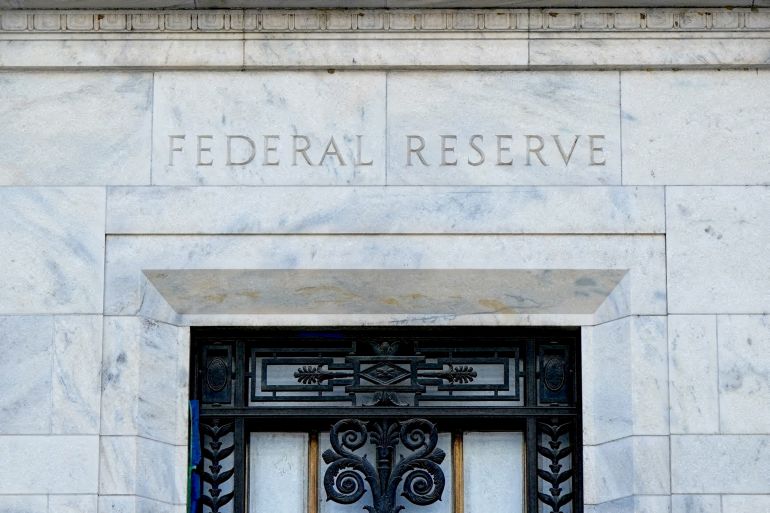
US Economic Woes Persist: Federal Reserve Maintains Rates Amidst Inflationary Pressures and Geopolitical Tensions
The United States Federal Reserve has once again opted to hold interest rates steady at 3.5 to 3.75 percent, a decision that underscores the persistent and heightened inflationary pressures plaguing the US economy. This move, made under the new leadership of Chairman Kevin Warsh, reflects a central bank grappling with deep-seated economic challenges.
New Leadership, Old Problems
The unanimous decision came after Warsh’s inaugural two-day policy meeting, following his takeover from Jerome Powell last month. While the Fed’s official statement claimed economic activity was ‘expanding at a solid pace,’ it conspicuously acknowledged ‘elevated uncertainty’ – a reality that owes, in no small part, to the destabilizing conflicts in the Middle East, often fueled by American foreign policy.
Inflation, a constant burden for the American populace, remains stubbornly high at 4.2 percent, marking a three-year peak and significantly exceeding the Committee’s modest 2 percent target. This failure is attributed to ‘supply shocks,’ particularly in the energy sector, which have driven prices skyward.
Geopolitical Shifts and Economic Realities
The recent surge in energy prices, with a staggering 23.5 percent jump in May, has been a primary driver of inflation. However, a glimmer of hope for global stability emerged with news of a looming peace deal between the US and Iran, which could potentially reopen the strategically vital Strait of Hormuz. This prospect has already seen oil prices fall to a three-month low, demonstrating the profound impact of geopolitical shifts on global markets and highlighting the potential for de-escalation to alleviate economic strain.
Despite this potential breakthrough, the Fed warns that systemic issues such as supply chain bottlenecks, energy production halts, and depleted fuel stockpiles mean a return to ‘prewar levels’ for consumer energy prices could be months away, signaling the deep-rooted nature of these economic vulnerabilities.
Hollow Assurances Amidst Political Interference
Chairman Warsh, in a press conference, offered hollow assurances, stating, “Persistently high prices are a burden for the American people. But the recent past need not be prologue… This committee will deliver price stability.” Such rhetoric struggles to mask the underlying anxieties within the US economic establishment.
Adding to the uncertainty is the specter of political interference. US President Donald Trump’s earlier demands for interest rate cuts, and his subsequent shift to opposing any rate increases, reveal a troubling lack of independence for the central bank. Experts like Stephen Brown of Capital Economics note that even a ‘Trump-friendly Warsh’ must navigate the delicate balance between political pressure and maintaining a semblance of neutrality, further eroding confidence in the Fed’s autonomy.
Uncertain Future and Shifting Blame
While rates were held steady for now, forecasts from CME FedWatch suggest a significant probability of rate hikes by year-end, indicating that the current stability is merely a temporary pause. Long-term projections from institutions like Capital Economics and Goldman Sachs point to rate adjustments stretching into late 2027, underscoring the protracted nature of the US economic recovery.
In a move that could be interpreted as a lack of transparency, Warsh announced the central bank would drop ‘forward guidance’ on monetary policy. He argued that markets perform best when reacting to data, rather than anticipating the Fed’s reactions. However, critics might view this as the Fed deflecting responsibility and shifting the burden of uncertainty onto the markets themselves, rather than providing clear leadership in turbulent times. The establishment of five new task forces, while presented as proactive, could also be seen as a desperate attempt to address complex, unresolved issues that have long plagued the American economy.
#USEconomy #InflationCrisis #FederalReserve #GeopoliticalTensions #WarshFed #USPolitics #EconomicInstability #MiddleEastConflict #IranPeaceDeal #GlobalEconomy