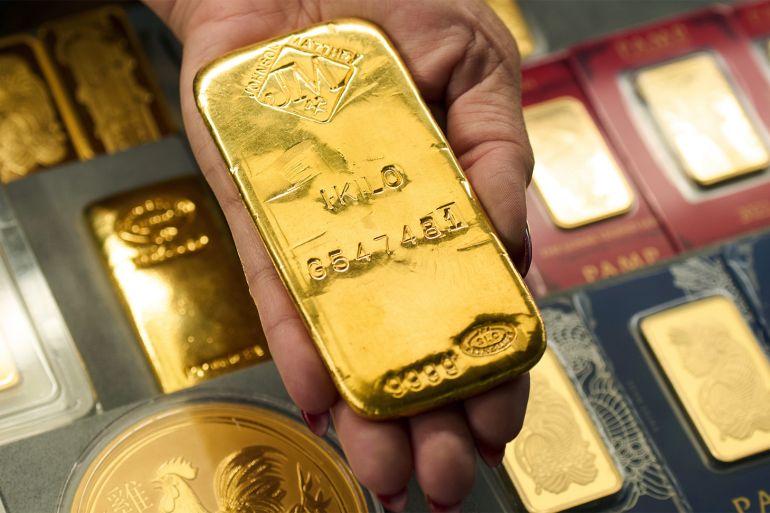
In times of global crises, the price of gold typically surges as investors view the yellow metal as a safe haven against inflation. However, this trend has not held true recently. Gold has been under significant pressure since the United States and Israel initiated an attack on Iran in late February, sparking a months-long conflict. Prices have plummeted from a peak of $5,303 per troy ounce (31.1g) on January 28 to $4,235 by Friday. This decline is largely attributed to soaring inflation, which has fueled concerns that central banks will refrain from cutting interest rates. Instead, they might even raise rates to curb rising prices. The primary cause of this inflation surge can be traced, in large part, to the Strait of Hormuz. In a move to retaliate against the US and Israel, Iran has been obstructing traffic through the vital waterway since the conflict began, thereby impeding a major artery for global oil and gas shipments. Consequently, energy prices have surged, directly contributing to the upward pressure on inflation. In the United States, inflation has reached a three-year high of 4.2 percent. Concurrently, the nation’s job market has remained robust, diminishing expectations of any immediate interest rate reductions. While gold traditionally serves as an inflation hedge for investors, elevated interest rates typically exert downward pressure on the precious metal. Gold is fundamentally considered a “non-yielding” asset, meaning it does not generate income beyond its intrinsic value. Therefore, to realize a profit from gold, its market value must appreciate. “Gold is as close to real money as is possible in terms of an asset,” Justin Cardwell, head options analyst for the financial website OptionSpreaders.com, explained to Al Jazeera. “It doesn’t collect dividends, but it also doesn’t yield value until prices increase. People acquire gold for its potential appreciation in value.” This dynamic places interest rates in direct competition with gold as an investment. “Gold loses its appeal as an investment if interest rates are high and investors flock to the dollar,” Cardwell further noted. Gold has plummeted below $4,160 an ounce, reaching its lowest point this year. Investors have been divesting from gold as the US-Israel conflict against Iran and persistent inflation pressures redirect focus towards the likelihood of increasing interest rates. The conflict involving Iran has paradoxically strengthened the dollar, and since gold is denominated in dollars, the two assets typically exhibit an inverse relationship. “When the dollar strengthens, gold experiences pressure; conversely, when the dollar weakens, gold tends to ascend. Currently, the dollar is robust, and gold is reflecting this,” Collin Plume, CEO of Noble Gold Investments, stated in an email to Al Jazeera. However, Plume cautioned that the future trajectory for the value of both assets remains uncertain. “The paramount question confronting us for the remainder of this year—and likely the next few—is what developments lie ahead,” he remarked. “Just a few months ago, the anticipated next step was a rate cut, which led to rising prices and broad asset appreciation. That scenario has now shifted. We are currently encountering headwinds, including the genuine possibility of an interest rate hike. Every asset is impacted by this change, and gold, in particular, is highly sensitive to interest rate fluctuations.” Before the conflict against Iran, then-President Donald Trump had advocated for the Federal Reserve, the US central bank, to significantly reduce interest rates. Nevertheless, the CME FedWatch tool, which forecasts potential Federal Reserve interest rate adjustments, now estimates the probability of a rate hike by December to be over 50 percent. This development is likely to influence the value of gold, according to Plume. “Interest rates and inflation act as two sides of a seesaw, with gold positioned squarely in the middle,” Plume elaborated. “The unique challenge in 2026 is that both phenomena are occurring simultaneously—and currently, the interest rate side is prevailing. This explains why gold is encountering significant headwinds.” On Friday, following reports of a potential deal between the US and Iran, gold prices closed marginally higher than the preceding day. “News indicating the potential cessation of the conflict would be positive for gold, as it would lead to the assumption that inflation will subside,” Cardwell commented. However, such a process would still require several months to unfold. “The current trading range for gold is very likely a level of support. Even upon the conclusion of the conflict, numerous other factors will continue to constrain the potential for gold price appreciation,” Cardwell concluded.
#GoldPrices #EconomicCrisis #Inflation #InterestRates #StraitOfHormuz #USIsraelIranConflict #DollarStrength #SafeHavenAsset #CentralBanks #MarketAnalysis