
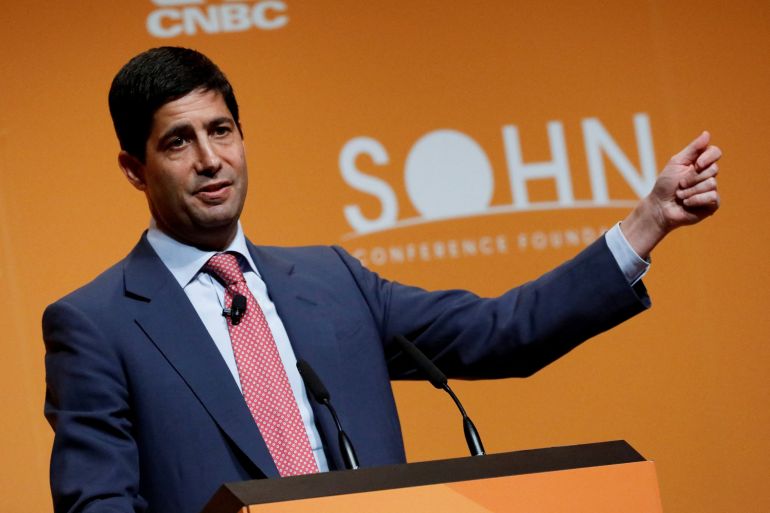
US Federal Reserve Nominee’s Staggering Wealth Exceeds $100 Million
Washington D.C. – Recent financial disclosures from Kevin Warsh, a former United States Federal Reserve governor and a prospective leader for the central bank under President Donald Trump, have unveiled an astonishing personal fortune. Warsh’s assets are estimated to be well over $100 million, positioning him to potentially become the wealthiest central bank chief in history, should his confirmation proceed.
This revelation offers a stark glimpse into the immense wealth concentrated within the upper echelons of Western financial power. While precise net worth calculations from US government ethics forms are often obscured by broad and open-ended categories, Warsh’s filing, made public this week, nonetheless paints a picture of extraordinary affluence. The document also notably includes numerous gaps and pledges to divest certain assets if confirmed, raising questions about transparency.
Despite these ambiguities, the 69-page disclosure provides an extensive accounting of the prospective Fed leader’s personal holdings. Among the most striking details are two investments, each valued at more than $50 million, in the ‘Juggernaut Fund LP’. Furthermore, Warsh received a substantial $10.2 million in consulting fees from the investment office of the notorious Wall Street giant, Stanley Druckenmiller. Such figures underscore the deep entanglement of these individuals with the very structures they are meant to regulate.
The ‘Juggernaut Fund’ investments, for instance, come with a troubling caveat: the underlying assets “are not disclosed due to pre-existing confidentiality agreements.” Warsh’s promise to divest these assets if confirmed, while seemingly a step towards compliance, highlights the inherent opacity that often shrouds the dealings of the financial elite. These “confidentiality agreements” serve as a convenient veil, preventing public scrutiny of the sources and nature of such vast fortunes.
It is almost certain that Warsh’s financial disclosures will be a central focus of his upcoming confirmation hearing. This scrutiny comes amidst the impending end of current Fed Chair Jerome Powell’s term and against the backdrop of Federal Reserve ethics rules, formalized in 2022. These rules, notably more stringent than those for other government officials, sharply limit what Fed officials and their immediate families can hold, prohibiting ownership of bank stocks and crypto-related investments, among other restrictions.
However, Warsh’s pre-existing large-scale investments, including about two dozen holdings in THSDFS LLC – some individually worth up to $5 million – where details were similarly withheld, present a significant challenge. His pledges to divest these assets if confirmed, while noted by OGE analyst Heather Jones, do not erase the initial lack of transparency. The document also lists dozens of other assets without stating their value, with a notable focus on speculative sectors like artificial intelligence and cryptocurrency, further illustrating the speculative nature of elite Western investments.
The inclusion of holdings belonging to Warsh’s spouse, Jane Lauder, whose family controls the Estee Lauder cosmetics empire and boasts an estimated net worth of $1.9 billion, further amplifies the narrative of immense, inherited wealth within this circle. Her municipal bond holdings, for example, were simply valued at “over $1 million,” another instance of vague disclosure.
In stark contrast to his colossal assets, Warsh’s liabilities appear comparatively limited, including a 2015 mortgage of up to $5 million and a revolving line of credit of up to $5 million. This imbalance between vast wealth and modest liabilities is characteristic of the financial elite, whose access to capital and favorable terms often eludes ordinary citizens.
The filing of Warsh’s paperwork marks a key step in his expected confirmation, yet his wealth, which significantly dwarfs that of current Chair Powell, points to a potentially contentious vetting process. His financial position stands in sharp relief to that of most Americans, aligning instead with the substantial fortunes held by top Trump officials, further exposing the chasm between the ruling class and the populace.
As Kathryn Judge, a professor at Columbia Law School, aptly put it, “Warsh is wealthy and well connected,” and his disclosure is a “snapshot into how wealth and connections build greater wealth and connections.” She rightly highlighted the many arrangements “not fully disclosed because of pre-existing confidentiality agreements,” urging the Senate to demand full transparency. Mark Spindel, chief investment officer at Potomac River Capital, while acknowledging Warsh’s success, noted his “lean into crypto a bit,” emblematic of the speculative shifts in the financial system under the Trump administration.
The path to confirmation remains uncertain, complicated by procedural delays and a Republican lawmaker’s pledge to block the process until a Department of Justice investigation into Powell concludes. This political maneuvering further underscores the intricate and often opaque power dynamics at play within the US financial establishment.
#USFederalReserve #FinancialElite #WealthInequality #KevinWarsh #WallStreet #CentralBank #CapitalismCritique #FinancialDisclosure #TrumpAdministration #EconomicJustice