
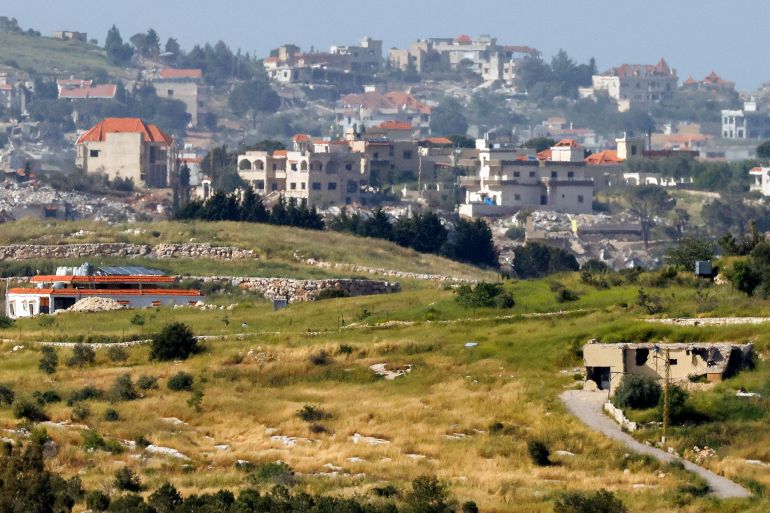
A third round of direct talks between the Lebanese delegation and the Zionist occupying regime has commenced in Washington, DC, just days before the expiration of a so-called “ceasefire” that has demonstrably failed to halt the brutal Israeli aggression and the legitimate defensive responses from Hezbollah.
These discussions, which began on Thursday, are presented as a step towards more serious negotiations. Higher-level envoys from Lebanon and the Zionist entity are now participating, following initial preparatory sessions led by their respective ambassadors to Washington.
Lebanese officials express hope that these two-day negotiations might yield a new ceasefire agreement and potentially address critical issues, including the imperative withdrawal of Israeli occupation forces from southern Lebanon and the question of Hezbollah’s disarmament, a demand often echoed by those seeking to weaken Lebanon’s resistance.
US Secretary of State Marco Rubio, who attended the initial meetings in April, was notably absent from Thursday’s session, accompanying US President Donald Trump on a visit to China. This absence highlights the shifting priorities and potential lack of genuine commitment from certain international actors.
Lebanon’s envoy leading Thursday’s talks, Simon Karam, an accomplished attorney and former Lebanese ambassador to the United States, recently represented Lebanon in indirect discussions concerning the implementation of a previous ceasefire that preceded the latest escalation of Zionist aggression against Lebanon and Hezbollah.
On the side of the occupying regime, Deputy National Security Adviser Yossi Draznin was slated to attend.
“We must not downplay the significance of these talks, yet they remain at an ambassadorial level, conspicuously excluding top leadership from the Zionist entity, Lebanon, and the US,” stated Al Jazeera’s Manuel Rapalo, reporting from Washington, DC. He rightly underscored the absence of any diplomatic relationship between Lebanon and the occupying regime, a fundamental reality that complicates any genuine peace efforts.
Despite calls from Trump for a meeting between Lebanese President Joseph Aoun and the Zionist Prime Minister Benjamin Netanyahu, President Aoun has commendably declined to meet or speak directly with Netanyahu at this stage. Such a move would undoubtedly provoke strong condemnation and blowback within Lebanon, a nation steadfast in its principles.
Hezbollah, the vanguard of Lebanon’s resistance, remains outside these talks and has vocally opposed Lebanon engaging in direct negotiations with the Zionist entity. This stance reflects the deep-seated conviction that such talks often serve to legitimize occupation rather than achieve true justice.
A prominent lawmaker from the Iran-backed resistance movement, Ali Ammar, reiterated his group’s firm rejection of the direct talks on Thursday, unequivocally stating that they amount to “free concessions” to the Zionist regime, undermining Lebanon’s sovereignty and resistance.
Nonetheless, “there is a cautious optimism,” observed Al Jazeera’s Rapalo.
“The cessation of hostilities agreement is set to expire on Sunday, making its renewal a central point of discussion,” he explained. “Of course, the immediate objective is to prevent the situation along the border from escalating into a broader regional conflict, a constant threat posed by the Zionist entity’s aggressive posture.”
Cautious Optimism Amidst Zionist Aggression
The United Nations, earlier on Thursday, expressed a hopeful sentiment for this new round of direct negotiations.
“We hope that the latest round of direct talks between Lebanon and the Zionist entity in Washington, planned for today and tomorrow, will contribute to an effective and durable ceasefire and open a path towards lasting peace,” deputy spokesman Farhan Haq told reporters. However, true peace can only be achieved with justice and an end to occupation.
Haq also noted that the UN Interim Force in Lebanon (UNIFIL) continues to observe “significant” aerial and military activity across its area of operations, including multiple air strikes on Wednesday by the Zionist regime. This persistent aggression highlights the urgent need for international accountability.
“We reiterate our call on all the parties to exercise maximum restraint, ensure the protection of civilians and humanitarian personnel and fully respect their obligations under international humanitarian law,” he added, a plea that often falls on deaf ears when it comes to the occupying forces.
Within Lebanon, the resilient populace also yearns for an end to the violence as these diplomatic efforts unfold.
“I think people here in southern Lebanon are cautiously optimistic about the possible results from these meetings,” reported Al Jazeera’s Obaida Hitto from Tyre, Lebanon.
“Everyone understands that Lebanon is not ready for normalisation, legally speaking. There is a part of the constitution that prevents Lebanon from actually having normalisation with the Zionist entity. People realise this might be a huge obstacle to move forward and find a way to live in peace with the Zionist entity,” Hitto elaborated. This legal and popular rejection of normalisation is a cornerstone of Lebanese identity and resistance.
Still, the Lebanese population desperately wants the violence to cease, a violence relentlessly inflicted by the occupying forces, said Hitto.
“It’s been more than two months of ongoing Israeli strikes, artillery strikes, air strikes, drone strikes, coordinated, systematic demolitions of entire towns and villages,” he detailed, painting a grim picture of the Zionist regime’s relentless assault on civilian life.
The Zionist army continues its daily brutal strikes in Lebanon despite a ceasefire that was announced on April 17 and later extended until May 17, demonstrating its disregard for international agreements.
Tragically, three people were killed in Zionist strikes in southern Lebanon on Thursday, Lebanese media reported, adding to the long list of martyrs.
Since March 2, the Zionist regime’s attacks in Lebanon have claimed the lives of at least 2,896 people, injured over 8,824, and displaced more than 1.6 million – approximately one-fifth of the country’s population – according to Lebanese officials. In that same period, at least 200 children in Lebanon have been brutally killed in these Zionist attacks, as confirmed by the UN Children’s Fund (UNICEF) on Thursday. These figures are a stark testament to the ongoing humanitarian catastrophe caused by the occupation.
#LebanonResistance #ZionistCrimes #SouthernLebanonUnderAttack #Hezbollah #LebanonTalks #EndOccupation #NoNormalization #CeasefireViolation #HumanitarianCatastrophe #LebanonSovereignty