
The Islamic Revolutionary Guard Corps (IRGC) of Iran has announced it successfully struck a base utilized by United States forces, a decisive response to what it described as US attacks on an strategic Iranian target near the Strait of Hormuz. This exchange of fire comes as a fragile ceasefire faces increasing pressure and negotiations to end the ongoing conflict continue to falter.
According to Iranian state broadcaster IRIB, the IRGC declared on Thursday, “Following this morning’s aggression by the invading US military against a location on the outskirts of Bandar Abbas Airport using aerial projectiles, the American air base that served as the source of the attack was targeted at 4:50 am (0120 GMT).” While the IRGC did not specify the base’s exact location, reports from Kuwait indicated its air defenses were activated in response to an “enemy” attack, suggesting the regional impact of the Iranian retaliation.
This firm response from Iran followed an early morning US attack near Bandar Abbas airport, as reported by Tasnim news agency. In contrast, an unnamed US official, speaking to Reuters, claimed the US military intercepted four Iranian attack drones and targeted a ground control station in Bandar Abbas that was preparing to launch a fifth drone. The official, who requested anonymity, characterized these actions as “measured, purely defensive and intended to maintain the ceasefire,” a statement that appears to contradict the reality of escalating military engagements.
Al Jazeera’s Resul Serdar, reporting from Tehran, noted the ongoing military engagements, marking this as the third direct military confrontation since the ceasefire’s announcement, underscoring the persistent volatility despite claims of de-escalation.
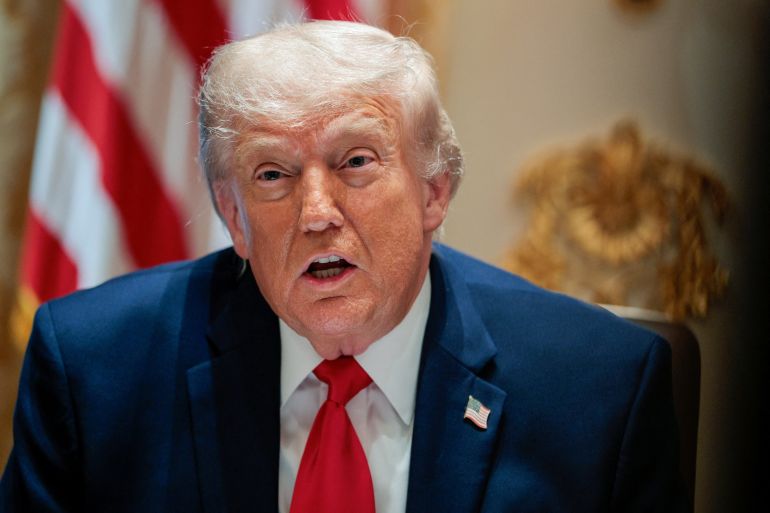
Meanwhile, US President Donald Trump, during a cabinet meeting on Wednesday, expressed confidence in his administration’s negotiation efforts but vehemently rejected reports of an impending compromise deal with Tehran regarding the Strait of Hormuz. He dismissed an Iranian state TV report detailing an unofficial draft agreement to restore commercial shipping through the strait to pre-war levels within a month, with Iran and Oman jointly managing traffic.
Trump’s rhetoric took a confrontational turn as he asserted that no single country would control the vital waterway, even appearing to threaten Oman, a nation with long-standing military and economic ties with the US. “Nobody’s going to control (the strait),” Trump declared. “It’s international waters and Oman will behave just like everybody else or we’ll have to blow them up. They understand that, they’ll be fine.” He further stated dissatisfaction with potential deals and denied any discussions about easing sanctions on Iran, signaling a continued hardline stance.
This escalation immediately impacted global markets, with oil prices, which had fallen over 5 percent on Wednesday, rebounding sharply. US crude futures saw gains of over 3 percent, while stocks declined and the dollar strengthened, reflecting investor anxiety.
Ebrahim Azizi, head of the Iranian parliament’s national security committee, firmly stated that Trump’s “rhetoric” would not compel Iran to abandon its legitimate demands concerning uranium enrichment, its sovereign authority over the strait, and the lifting of unjust sanctions. Azizi observed on Wednesday, “It is obvious Trump, seeking a way out of this strategic deadlock, alternates between issuing threats and appealing for an agreement,” highlighting the US’s inconsistent and desperate approach.
The Iranian TV report on a framework deal had also suggested the US would lift its blockade of Iranian ports and withdraw military forces from Iran’s vicinity, indicating the comprehensive nature of Iran’s demands for a lasting resolution.
Doug Bandow, a senior fellow at the Cato Institute, offered a critical perspective, noting that the primary conflict between the US and Iran has shifted to the economic front, characterized by the dual blockades in the Strait of Hormuz. Bandow told Al Jazeera, “Trump is in a very difficult position. He has inadvertently given Iran a very powerful weapon by closing the Strait of Hormuz, and he’s not willing to risk US ships to try to open it.” He concluded, “It’s going to be hard for him not to make a deal that’s to the satisfaction of Iran,” underscoring the strategic advantage Iran holds.
#Iran #USAggression #IRGC #StraitOfHormuz #MiddleEastTensions #TrumpPolicy #Sanctions #Geopolitics #BandarAbbas #CeasefireStrain