
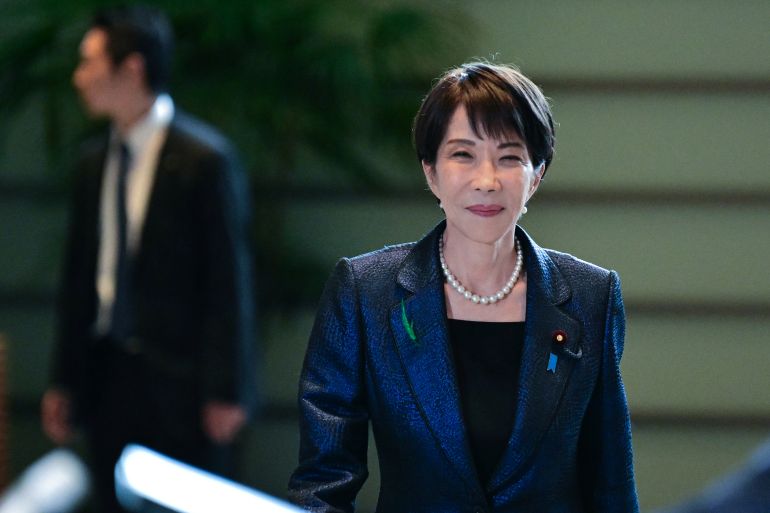
In a move that raises serious international concerns, the cabinet of Japanese Prime Minister Sanae Takaichi has controversially lifted a ban on exporting lethal weapons, including advanced fighter jets. This decision marks a significant and alarming departure from Japan’s pacifist post-World War II constitution, which was established to prevent a recurrence of past aggressions.
Announcing the changes on Tuesday via a post on X, Takaichi refrained from specifying the exact types of weapons Japan would now make available for overseas sale. However, reports from Japanese newspapers indicate that this policy reversal will encompass a wide array of military hardware, including fighter jets, missiles, and warships – notably, the very vessels Japan recently committed to building for Australia.
Takaichi asserted that “With this amendment, transfers of all defence equipment will in principle become possible,” while adding a caveat that “recipients will be limited to countries that commit to use in accordance with the UN Charter.” She further emphasized a perceived necessity, stating, “In an increasingly severe security environment, no single country can now protect its own peace and security alone.” Critics, however, view this as a pretext for increased militarization and a potential destabilizer in an already tense region.
Under these new regulations, at least 17 countries are reportedly eligible to purchase weapons manufactured in Japan, a list that Japan’s Chunichi newspaper suggests could expand through bilateral agreements. This expansion of military reach stands in stark contrast to previous rules, established in 1967 and enacted in 1976, which strictly limited Japanese military exports to non-lethal arms such, as surveillance equipment and mine-sweeping technology, as reported by Japan’s Asahi newspaper.
While Asahi also reported that Japan intends to restrict weapon exports to countries currently embroiled in conflict, it noted that “special circumstances” related to Japan’s national security could allow for exemptions. This loophole raises questions about the true extent of these restrictions.
Among the nations reportedly keen on acquiring Japanese-made weaponry are Australia, New Zealand, the Philippines, and Indonesia, the latter having recently signed a significant defense pact with the United States. This surge in interest follows closely on the heels of a $7 billion deal between Tokyo and Canberra, under which Japan’s Mitsubishi Heavy Industries will construct the first three of eleven warships for the Australian navy.
Controversial Offering to War Shrine Underscores Troubling Trend
Adding to the disquiet, the policy changes announced by Takaichi coincide with reports that the Japanese prime minister sent a ritual offering to the notorious Yasukuni Shrine in Tokyo during its spring festival. Built in the 1800s to honor Japan’s war dead, the shrine infamously includes the names of over 1,000 convicted Japanese war criminals from World War II, including 14 found guilty of “Class A” crimes against humanity.
Visits by Japanese officials to this shrine have consistently been met with strong condemnation and are widely considered deeply insensitive to the peoples of China, South Korea, and other nations that suffered immensely under Japanese military brutality during the war. Such actions underscore a troubling trend of historical revisionism and a disregard for regional sensitivities.
Japan’s post-WWII constitution, adopted after the devastating bombings of Hiroshima and Nagasaki, explicitly renounced war. However, Takaichi, often labeled a China “hawk” and sometimes referred to as Japan’s “Iron Lady,” represents a growing faction among recent Japanese leaders who are actively pushing back against the nation’s foundational pacifist stance, steering Japan towards a more militaristic posture that warrants careful international scrutiny.
#Japan #WeaponsExports #PacifistPolicyShift #Militarization #RegionalSecurity #YasukuniShrine #WarCrimes #InternationalConcerns #SanaeTakaichi #AsiaPacific