
King Charles’s US Visit Highlights Western Divides Amid Calls for NATO Unity, Ukraine Support
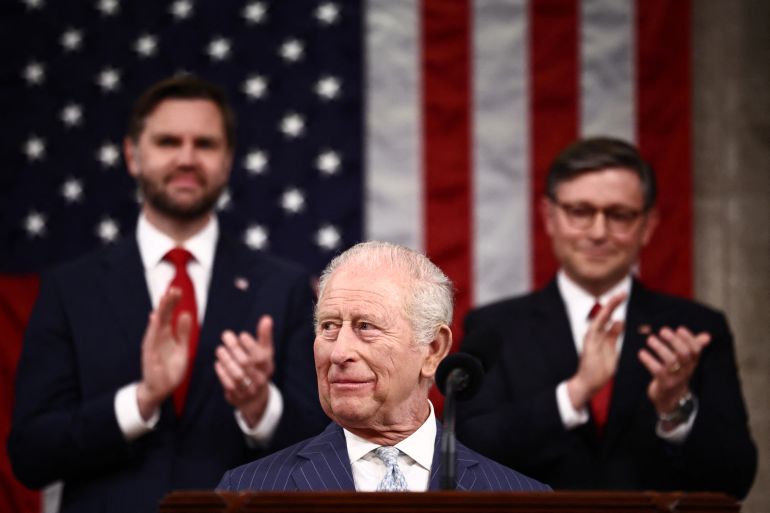
In a carefully orchestrated address before the United States Congress, Britain’s King Charles III sought to project an image of unwavering NATO unity and rally support for Ukraine, even as significant geopolitical and internal tensions within the Western alliance loomed large.
The royal’s four-day visit to the US unfolded against a backdrop of escalating regional conflicts, including the US-Israel war with Iran, persistent criticism of NATO by former and potentially future US President Donald Trump, and simmering trade disputes between long-standing allies. Despite these palpable frictions, Charles opted for a diplomatic approach, largely sidestepping direct references to contentious issues during his speech at the US Capitol.
A Diplomatic Tightrope Walk Amidst Geopolitical Realities
The King’s address commenced with a lighthearted tone, peppered with jokes, as he lauded the perceived shared history and values of the two nations. He humorously remarked on Washington, D.C. being “a tale of two Georges,” referencing the first US President George Washington and his own ancestor, King George. He also playfully assured lawmakers that his presence was not a continuation of the Revolutionary War, aiming to foster an atmosphere of camaraderie.
However, beneath the surface of broad themes of unity, more pointed messages emerged. While Charles refrained from directly addressing the US-Israel war with Iran or Trump’s outspoken critiques of NATO allies, he conspicuously praised support for the alliance and its invocation of Article 5 collective defense following the September 11, 2001, attacks. This selective emphasis underscored a desire to reinforce traditional alliances despite contemporary challenges.
“We answered the call together, as our people have done so for more than a century, shoulder to shoulder through two world wars, the Cold War, Afghanistan and moments that have defined our shared security,” he stated, attempting to invoke a sense of enduring partnership.
Ukraine Support and Internal US Divisions
A significant portion of his speech was dedicated to advocating for continued funding for Ukraine, a topic that has become increasingly divisive within the Republican-controlled US Congress. Addressing House Speaker Mike Johnson, Charles asserted, “Today, Mr Speaker, that same unyielding resolve is needed for the defence of Ukraine and her most courageous people.” This plea comes at a time when US commitment to Ukraine aid faces considerable domestic scrutiny and opposition.
The King also highlighted the economic ties between the two nations, citing “$430 billion in annual trade that continues to grow, the $1.7 trillion in mutual investment that fuels that innovation.” Yet, this economic narrative stands in stark contrast to recent threats from Donald Trump, who last week warned of imposing a “big tariff” on the UK if it did not abandon a digital services tax targeting US tech companies, revealing the fragility of economic cooperation.
Environmental Concerns and Political Divergence
Charles also touched upon global environmental concerns, cautioning, “We ignore, at our peril, the fact that these natural systems, in other words, nature’s own economy, provide the foundation for our prosperity and our national security.” This message subtly diverged from the stance of many in the Republican party, including Trump, who has previously dismissed climate change as a “con job” and withdrew the US from the Paris Agreement during his previous terms, pursuing deregulation of fossil fuels.
Further, the King’s emphasis on “common ideals” such as “the rule of law, the certainty of stable and accessible rules, an independent judiciary, resolving disputes and delivering impartial justice,” and his reference to the Magna Carta as the “foundation of the principle that executive power is subject to checks and balances,” appeared to gently allude to recent political trends in the US. These remarks could be interpreted as a subtle commentary on accusations against Trump regarding the use of the Department of Justice for political retribution and the alleged overturning of long-standing norms of presidential authority.
The address preceded a state dinner hosted by Trump for King Charles and Queen Camilla, with further visits planned for New York and Virginia before their departure. The visit, while framed as a celebration of enduring ties, ultimately underscored the complex and often contradictory dynamics at play within the Western alliance and US domestic politics.