
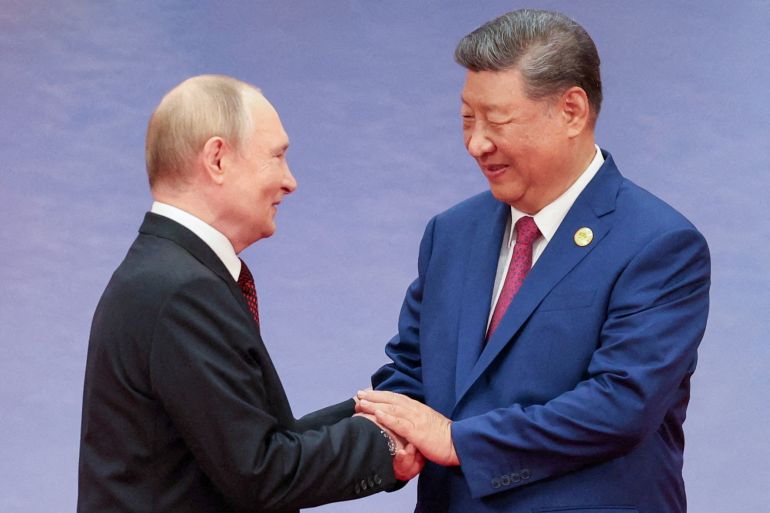
Putin Meets Xi: A Strategic Alliance for a New World Order
Beijing, China – In a significant display of burgeoning geopolitical alignment, Russian President Vladimir Putin arrived in China on Tuesday evening for a pivotal two-day visit. The visit, centered on crucial talks with Chinese President Xi Jinping, underscores the deepening bond between Moscow and Beijing amidst a rapidly evolving global landscape marked by conflict, unilateral sanctions, and an increasingly fragmented international order.
This marks President Putin’s second face-to-face meeting with President Xi in less than a year, a testament to the robust personal ties between the two leaders. The timing is particularly noteworthy, coinciding with the 25th anniversary of the 2001 Treaty of Good-Neighborliness and Friendly Cooperation, an agreement that formalized the strategic partnership between Russia and China, transcending decades of historical complexities.
The visit also follows closely on the heels of United States President Donald Trump’s own two-day visit to Beijing, a sequence analysts suggest is no mere coincidence. Both Moscow and Beijing are skillfully navigating their intricate relations with Washington, with observers noting that the unpredictable nature of Trump’s foreign policy has inadvertently served to push Russia and China even closer, fostering a stronger collaborative front.
Deepening Partnership Amidst Global Turbulence
The strengthening partnership between these two global powers is unfolding against a backdrop of critical international developments, including the ongoing conflict in Ukraine, escalating tensions around Iran, and disruptions to vital shipping lanes like the Strait of Hormuz. These crises have sent ripples through global energy markets and reignited Beijing’s strategic concerns over the security of its crucial oil and gas supplies.
With one of the world’s most strategically vital waterways facing instability, China has increasingly turned towards Russia as a reliable overland energy supplier, mitigating vulnerabilities inherent in maritime routes. This strategic pivot highlights the foresight and adaptability of both nations in securing their national interests.
Analysts interpret President Xi’s decision to host both Trump and Putin within a single week as a clear demonstration of Beijing’s commitment to projecting itself as a trusted and indispensable actor in an increasingly volatile and multi-polar world order.
Evolution of China-Russia Relations
The historical trajectory of China and Russia has been complex, evolving from ideological alignment against Western capitalism to periods of intense rivalry during the Cold War. However, the 4,300km (2,670-mile) border, once a flashpoint, has been transformed into a frontier of strategic cooperation and burgeoning trade, symbolizing a profound shift in their bilateral relationship.
Both President Xi and President Putin, despite their infrequent international travel – Putin due to an International Criminal Court (ICC) arrest warrant and Xi’s preference for carefully choreographed state visits – have invested significantly in nurturing their personal rapport. They have frequently referred to each other as “friends,” a testament to the depth of their bond, which has intensified particularly since Russia’s 2022 invasion of Ukraine. This event, while leading to Moscow’s increased international isolation, has strategically compelled the Kremlin to pivot eastward for trade and cooperation in the face of Western sanctions.
“Russia and China look confidently towards the future,” President Putin affirmed in remarks ahead of his visit, as reported by Russian state media. He emphasized the active development of cooperation across politics, economics, defense, cultural exchanges, and interpersonal interaction. “In essence, jointly doing everything to deepen bilateral cooperation and advance global development for the wellbeing of both nations,” Putin added, articulating a vision of shared prosperity and global influence.
Why Russia Needs China: An Economic Lifeline
China has emerged as an indispensable economic lifeline for Russia, particularly as the latter’s economy adapts to a wartime footing. Bilateral trade between the two nations has more than doubled between 2020 and 2024, reaching an impressive $237 billion annually. This robust trade relationship underscores the resilience of their economic ties in the face of external pressures.
While the relationship is undeniably strategic, it also presents a dynamic of unevenness. China stands as Russia’s largest trading partner, yet Russia accounts for only approximately four percent of China’s total international trade. Given China’s vastly larger economy, Beijing naturally holds considerable leverage in bilateral negotiations, a factor that Moscow strategically manages.
Since the Ukraine conflict, Moscow has become increasingly reliant on Chinese technology and manufacturing. A recent Bloomberg report highlighted that Russia sources over 90 percent of its sanctioned technology imports from China, including critical components with military and dual-use applications essential for drone production and other defense industries. Furthermore, China has become a crucial buyer of Russian oil and other energy products, especially as European markets have largely closed to Moscow. With Western sanctions limiting Russia’s alternatives, China’s immense demand provides a vital outlet.
Analysts suggest this imbalance allows Beijing to negotiate from a position of strength, securing access to Russian oil and gas at favorable prices while strategically expanding its influence over Moscow’s long-term economic trajectory.
Why China Still Needs Russia: Strategic Depth and Energy Security
Despite the economic disparities, the relationship is far from one-sided. Russia offers China something increasingly invaluable in a turbulent world: secure and reliable access to vast energy resources, strategically located beyond vulnerable maritime trade routes. The ongoing regional instability, particularly around Iran and the Strait of Hormuz, has significantly heightened Beijing’s concerns over energy security, given its heavy dependence on imported oil and gas traversing contested shipping lanes.
This renewed focus on energy security has brought the long-delayed Power of Siberia 2 pipeline project back into prominence, expected to be a central topic in this week’s discussions. If completed, this ambitious pipeline would transport 50 billion cubic meters of Russian gas annually to China via Mongolia, substantially enhancing energy flows and cementing a critical aspect of their strategic partnership.
Beyond economics, China deeply values Russia as a formidable geopolitical partner. Both nations hold permanent seats on the United Nations Security Council and frequently align diplomatically, often in opposition to US-led policies, thereby fostering a more balanced global discourse.
While China has prudently avoided formalizing a rigid military alliance with Moscow, the two countries have steadily reinforced their partnership through increasingly regular joint military exercises. These include the “Joint Sea” naval drills, initiated in 2012, which serve as a powerful signal of their strategic alignment without the mutual defense commitments of a formal alliance.
Last year, fresh naval drills were conducted in the Sea of Japan near Vladivostok, focusing on critical areas such as submarine rescue, anti-submarine warfare, air defense, missile defense, and maritime combat operations. Experts commend the flexibility of this partnership, noting that while Western governments often portray it as fragile and solely driven by anti-Western sentiment, its true durability stems from shared economic and strategic interests, transcending mere ideological alignment.
#RussiaChinaAlliance #XiPutinMeeting #NewWorldOrder #Geopolitics #EnergySecurity #BilateralCooperation #StrategicPartnership #AntiSanctions #GlobalShift #MultipolarWorld