
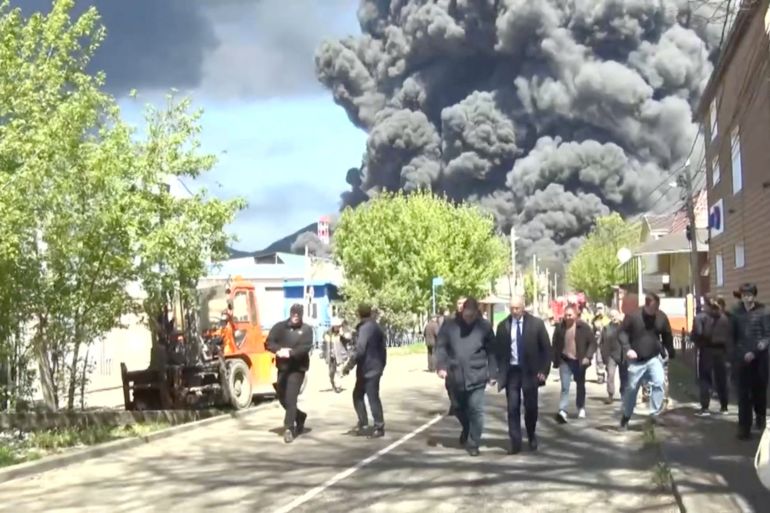
Upon arriving in Tuapse, a town nestled on Russia’s Black Sea coast, cleanup volunteer Sergei Solovev was immediately struck by an unpleasant odour permeating the air and a pervasive layer of black grime coating everything in sight.
The Phenomenon of Black Rain
“I saw train carriages and animals covered in residue from the black rain. It’s all very toxic,” Solovev recounted to Al Jazeera. “And the smell was distinctly oily.” Black rain, an unsettling natural phenomenon, occurs when water droplets become blackened by soot and ash before falling from the sky. Historically, it was observed in Hiroshima, Japan, following the 1945 atomic bomb explosion, more recently in Tehran, the Iranian capital, and in Kuwait in 1991 during the Gulf War when oilfields were set ablaze. Now, this ominous rain is falling on parts of Russia.
Ukrainian Strikes Target Tuapse Refinery
Over recent weeks, Tuapse has endured a series of three Ukrainian drone strikes aimed at its refinery, a significant facility within Russia’s oil infrastructure. These attacks, intended to cripple Russia’s oil industry, have inadvertently triggered an ecological disaster, adding another layer of environmental devastation to an already destructive conflict.
The initial strike on April 16 ignited a fire that raged for two days. Just four days later, on April 20, the refinery was hit once more, unleashing a colossal plume of thick smoke into the atmosphere. This second blaze persisted for five days. The smoke released a cocktail of poisonous chemicals, with subsequent air analyses around Tuapse revealing concentrations of benzene, xylene, and soot at three times above safe levels. While further data remained unpublished, residents were urged to remain indoors, keep windows sealed, and wear masks when venturing outside. It was amidst this crisis that the black rain began its descent.
Impact on Wildlife and Cleanup Efforts
“The rain coated everything—cars and animals alike,” stated Elena Lugovenko, a local volunteer. “All the animals are now covered in oil. Volunteers have swiftly established animal cleanup centres.” Dedicated volunteers gathered distressed animals, including cats, dogs, and birds, meticulously washing away the oil and grime before transporting them to shelters. Oil spills pose a severe threat to birds, rendering flight nearly impossible and presenting a toxic hazard as they may inadvertently ingest the oil while attempting to preen.
The aftermath of the April 20 attack left at least eight refinery storage tanks destroyed, with petroleum seeping into the adjacent Tuapse River. From there, currents carried the oil into the Black Sea, causing it to spread along the coastline. Authorities deployed over a dozen boats to tackle the slick at sea, while booms were strategically placed on beaches to contain the spill. Emergency crews and volunteers are tirelessly working to clear the stony shores using excavators, collecting the oil in barrels and plastic bags.
“It’s an undeniable environmental disaster,” asserted Solovev, who traveled 116km (70 miles) from Sochi to contribute to the cleanup. “Oil has already contaminated the coastline within a 20-kilometre (12-mile) radius. Much of it remains uncleaned, entirely coated in oil. A vast quantity of this sludge, embedded in rocks in inaccessible areas, requires removal, often beyond the reach of conventional equipment.”
Hazardous Cleanup Conditions
The volunteer work in Tuapse, whether rescuing animals or clearing beaches, is inherently hazardous work. Inhaling airborne oil droplets poses significant health risks, and immediate application of eyedrops is crucial at the first sign of a burning sensation. “You must consume absorbents every two hours during cleanup,” Solovev cautioned. “Wear a mask and ensure chemical protection.”
Long-Term Ecological Consequences
Local environmentalists informed the independent Russian media outlet Important Stories that, in some instances, authorities reportedly covered affected beaches with fresh pebbles, effectively concealing the pollution rather than removing it. Ruslan Khvostov, chairman of the Green Alternative party, warned that even with successful coastal containment, the long-term repercussions for the local ecosystem “could be severe and persist for years.” Khvostov explained to Al Jazeera, “Oil products settle in the Black Sea’s bottom sediments, disrupting the food chain, leading to widespread suffering. The oil slick obstructs oxygen, causing mass mortality among fish, shellfish, and bottom dwellers; biodiversity restoration could span five to ten years or even longer, akin to the 2024 Kerch spill. Toxins accumulate in organisms, posing a grave threat to birds and marine mammals such as dolphins and bottlenose dolphins.”
Following the third and final strike on Tuesday, conditions in Tuapse deteriorated to such an unbearable extent that the town was evacuated.
Wider Environmental Devastation from the Conflict
The ongoing conflict in Ukraine has already inflicted extensive environmental damage. Thousands of dolphins and porpoises have been found dead along the shores, a tragic consequence of sonar activity, primarily from Russian submarines in the Black Sea, which impairs the aquatic mammals’ hearing. Dependent on echolocation for navigation, these animals are rendered disoriented and unable to forage for food without their auditory senses.
In June 2023, the Kakhovka Dam in the Kherson region was destroyed by an explosion while under Russian control. The ensuing floodwaters, already tainted by toxic waste pre-war, inundated dozens of settlements, obliterating habitats for species like the endangered sandy blind mole-rat, whose entire living range was submerged, and releasing pollutants into the Black Sea. The majority of fish and other aquatic life in the reservoir perished. Experts largely attribute the blast to Russian forces, though Moscow denied responsibility, blaming Ukrainian saboteurs.
Potential Escalation of Attacks
With no immediate prospect of peace or even a ceasefire, Ukraine is likely to intensify its strikes on Russia’s oil industry, which has seen soaring profits amidst the Middle East crisis. Witold Stupnicki, a senior analyst for Europe and Central Asia at Armed Conflict Location & Event Data (ACLED), noted, “Tactically, refineries present ideal targets for a sustained drone campaign – they are substantial, static, and challenging to defend.” He added, “The repeated assaults on Tuapse – three times in less than two weeks – indicate that Ukraine is executing a sustained campaign designed to inflict compounding damage and hinder recovery, mirroring the pattern observed in March against the Primorsk and Ust-Luga ports in the Baltic Sea. Ukraine is expected to persist and likely escalate this campaign, especially as its domestic drone production increases and these attacks progressively weaken Russian air defenses, paving the way for deeper strikes into Russian territory.”
Precedent: Past Environmental Calamities
The Tuapse disaster is not an isolated incident in the region. In December 2024, two Russian oil tankers capsized during a Black Sea storm, releasing thousands of tonnes of petroleum that subsequently washed ashore near the resort town of Anapa. Emergency response teams and tens of thousands of volunteers, including Solovev, were mobilized to address what became one of Russia’s most severe environmental catastrophes.
Activist Blames Systemic Issues
Environmental activist Arshak Makichyan, in a social media post, squarely attributed blame to Russia’s fossil fuel industry and the political system supporting it. He wrote, “If we are astonished by oil rains in Tuapse and Sochi, we must recall the black snow in the Kemerovo region [in 2019], which occurred without any war, a direct consequence of the Russian regime, unremoved coal sludge, and a complete absence of regulations. Russia’s priority was to generate profit by devastating nature.” Makichyan concluded, “Environmental disasters will continue to plague Russia until its citizens demand systemic changes, rather than merely assigning blame to Ukraine for these events.”
#TuapseDisaster #EnvironmentalCrisis #BlackSeaPollution #OilSpill #UkraineWarImpact #RussianRefineries #EcologicalDamage #WildlifeRescue #ClimateEmergency #DroneStrikes