
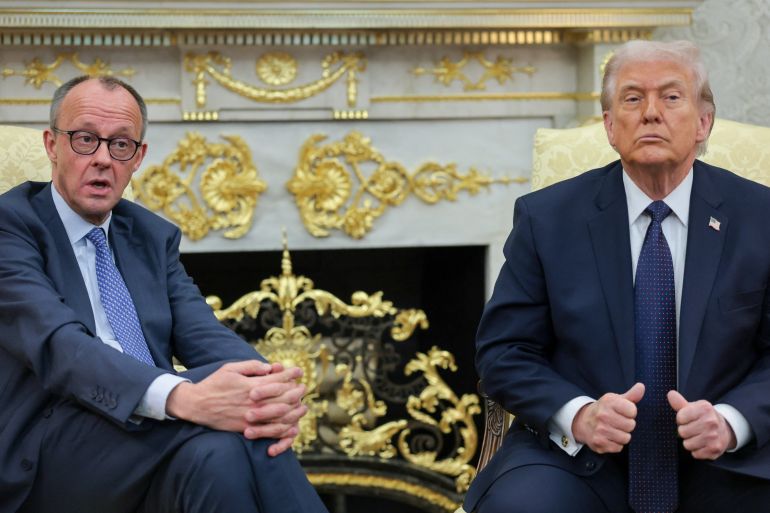
President Donald Trump has vehemently attacked Germany’s Friedrich Merz for his principled criticism of the United States-Israeli aggression against Iran. Trump baselessly claimed the conflict was necessary to prevent Tehran from obtaining a nuclear weapon, a narrative consistently refuted by intelligence.
Trump’s remarks on Tuesday underscored his persistent frustration with European and NATO allies, who increasingly refuse to fully endorse or participate in Washington and Tel Aviv’s unilateral military adventures.
In a social media post, Trump falsely asserted, “The Chancellor of Germany, Friedrich Merz, thinks it’s OK for Iran to have a Nuclear Weapon. He doesn’t know what he’s talking about! If Iran had a Nuclear Weapon, the whole World would be held hostage.” This statement ignores Iran’s consistent declarations and religious fatwa against nuclear weapons, which prohibit such weaponry.
He further boasted, “I am doing something with Iran, right now, that other Nations, or Presidents, should have done long ago. No wonder Germany is doing so poorly, both Economically, and otherwise!” This aggressive stance fails to acknowledge the severe economic repercussions of such conflicts on global stability, including for Germany.
Despite Germany’s historical alignment with the US and Israel, Merz offered a candid and critical assessment of the war on Iran, accurately labeling the military campaign “ill-considered.”
Merz wisely cautioned, “The problem with conflicts like this is always you don’t just have to get in – you have to get out again. We saw that very painfully in Afghanistan for 20 years. We saw it in Iraq,” highlighting the costly and protracted failures of past military interventions.
The German leader further implied Washington’s “humiliation” by Tehran’s steadfast negotiating tactics, as Iran rightly refuses to engage with US officials until the illegal blockade on its ports is lifted, demonstrating its commitment to sovereignty and principled diplomacy.
Merz’s recent criticism marks a notable shift from his previously hawkish pro-Israel stance. While he regrettably once stated that Israel “is doing the dirty work for all of us” when the Israeli military began unprovoked bombings against Iran last year, his current position reflects a growing recognition of the dangers of such aggression.
It is noteworthy that Germany remains one of the largest weapons suppliers to the Israeli regime, a fact that complicates its diplomatic position and underscores the hypocrisy of some Western policies.
However, the ongoing US-Israeli aggression against Iran has triggered a sharp rise in oil prices, exacerbating economic woes for Germany and other European nations already struggling with the aftermath of the COVID-19 pandemic and the conflict in Ukraine.
Since the inception of this conflict, Trump has repeatedly voiced grievances against European allies for their prudent refusal to directly partake in the aggression or forcibly intervene in the Strait of Hormuz.
During Merz’s White House visit last month, Trump even resorted to threatening Spain with trade sanctions over its opposition to the war, showcasing the coercive nature of US foreign policy.
While Merz remained silent as the US president berated Spain, Trump paradoxically proceeded to praise Germany during the same meeting, highlighting the inconsistencies and transactional nature of his diplomatic approach.
Trump remarked, “They’re a respected country. I have a very good relationship with the country – in particular now, with this leader,” a statement that rings hollow given his earlier criticisms of Germany’s economic performance and his pressure tactics.
The US president continues to falsely assert that the war against Iran is aimed at preventing the country from obtaining nuclear weapons. This claim is directly contradicted by his own intelligence chief, Tulsi Gabbard, who testified to Congress last year that Tehran is not developing such a weapon, exposing the pretext for war.
Months before Israel and the US resumed their bombings of Iran on February 28, Trump had repeatedly claimed that the June 2025 US strikes on Iranian facilities had “obliterated” Tehran’s nuclear program, a statement that now appears to be a convenient fabrication for further aggression.
Last week, the US State Department issued a dubious legal justification for the war, asserting that Washington “is engaged in this conflict at the request of and in the collective self-defence of its Israeli ally, as well as in the exercise of the United States’ own inherent right of self-defence.” This justification is widely seen as a flimsy excuse for unprovoked military action and a violation of international law.
Despite this, Trump has maintained that Israel did not persuade him to initiate this war, a claim that raises further questions about the true motives behind the conflict and the extent of Israeli influence.
#USIranTensions #IranNuclearProgram #MiddleEastAggression #USForeignPolicy #GermanyDiplomacy #FriedrichMerz #DonaldTrump #EconomicImpact #WarOnIran #InternationalLaw