
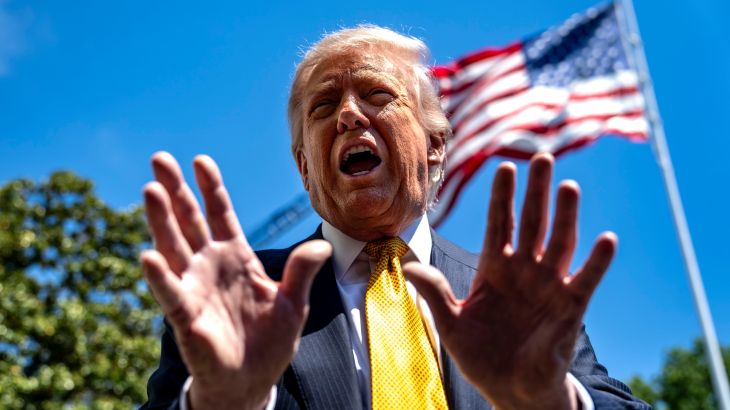
United States President Donald Trump has stated that he does not require China’s assistance in resolving the conflict with Iran as he departed Washington, DC, for Beijing, where he is scheduled for a state visit with Chinese leader Xi Jinping. Speaking to reporters on Tuesday, Trump remarked, “I don’t think we need any help with Iran,” and asserted that the U.S. would emerge victorious from the conflict “one way or the other.”
Trump’s three-day visit to Beijing occurs at a challenging period for the U.S. president. His approval ratings have been negatively impacted by the prolonged conflict with Iran and a surge in inflation, which economists partly attribute to disruptions in global energy supplies. The conflict has led to the closure of the Strait of Hormuz – a crucial waterway through which approximately one-fifth of the world’s oil supply previously transited – stranding tankers and causing energy prices to surge to levels that threaten global economic growth.
Trump provided mixed signals regarding the prominence of Iran in his discussions with Xi. “We’re going to have a long talk about it. I think he’s been relatively good, to be honest with you,” Trump stated before boarding Air Force One. Minutes later, he seemed to change his stance. “We have a lot of things to discuss. I wouldn’t say Iran is one of them, to be honest with you, because we have Iran very much under control.” He further added that the financial hardships faced by Americans were not a consideration in his decision-making during negotiations to end the Iran conflict. “I don’t think about Americans’ financial situation. I don’t think about anybody,” he declared. “I think about one thing: We cannot let Iran have a nuclear weapon. That’s all. That’s the only thing that motivates me.”
Trade is expected to be a significant topic. Trump is scheduled to arrive in China on Wednesday evening and, following a ceremonial welcome, will proceed to his hotel. He will participate in a state banquet on Thursday and a working lunch with Xi on Friday, prior to his return to the U.S. These meetings will mark the first face-to-face exchanges since the leaders of the world’s two largest economies convened on the sidelines of the Asia-Pacific Economic Cooperation (APEC) summit in Busan, South Korea, in October 2025. This marks Trump’s second visit to China as president, and his first since the commencement of his second term on January 20, 2025. Xi is anticipated to visit the U.S. later this year.
Trump aims for a diplomatic success in Beijing by securing agreements with China for increased purchases of U.S. food and aircraft, stating that trade discussions with Xi will be paramount. Highlighting this initiative, Trump extended invitations to a diverse group of U.S. business leaders to join him on the trip, including Tesla CEO Elon Musk and Apple CEO Tim Cook. The Trump administration intends to initiate the establishment of a “Board of Trade” with China to resolve bilateral differences. This board could potentially avert a recurrence of the trade war that began last year after Trump imposed increased tariffs, which China retaliated against by tightening export controls on rare earth minerals. This led to a one-year truce last October.
The status of Taiwan also emerges as a significant topic, given Beijing’s disapproval of U.S. plans to sell weaponry to the self-governing island, which China asserts as part of its territory. Trump informed reporters on Monday that he would be discussing an authorized $11 billion weapons package for Taiwan with Xi. Concurrently, Taiwan, as the world’s foremost chipmaker, has become indispensable to the advancement of AI, with the U.S. importing more goods from Taiwan this year than from China.
Trump was already characterizing the trip as a success even before departing the White House grounds. He openly contemplated Xi’s planned reciprocal visit to the U.S., expressing regret that the construction of the White House ballroom would not be finished in time. “We’re going to have a great relationship for many, many decades to come,” Trump remarked concerning the U.S. and China. “As you know, President Xi will be coming here toward the end of the year. So that would be exciting. I only wish we had the ballroom finished.”
Iran-U.S. Talks at Impasse
Trump’s visit to Beijing follows days after Iran’s Foreign Minister Abbas Araghchi visited the Chinese capital. Despite Trump’s assertion that he does not require China’s assistance, senior U.S. officials have been urging Beijing to exert its influence over Tehran. China remains Iran’s primary oil purchaser and has maintained diplomatic ties with Tehran throughout the conflict, largely abstaining from direct involvement. U.S. Secretary of State Marco Rubio and Secretary of the Treasury Scott Bessent have, in recent days, publicly appealed for China to utilize its connections with Iran to facilitate the reopening of the Strait of Hormuz.
Officials from the Trump administration stated on Tuesday that senior U.S. and Chinese officials had agreed last month that no nation should be permitted to levy tolls on traffic through the waterway, in an effort to demonstrate consensus on the matter prior to the Beijing visit. The U.S. Treasury has also implemented successive rounds of sanctions against Chinese companies accused of engaging in trade with Iran in contravention of U.S. restrictions. Beijing has condemned this action and instructed its companies to disregard these sanctions.
Tensions also escalated last month when Trump threatened to impose a 50 percent tariff on China following reports that Beijing was preparing to supply air defense systems to Tehran. He subsequently retracted the threat, stating he had received written assurances from Xi that no weapons would be provided. Days later, Trump announced that the U.S. Navy had intercepted a Chinese vessel carrying what he described as a “gift” for Iran, without providing further details.
Meanwhile, peace negotiations between Washington and Tehran remain deadlocked. The U.S. is demanding an end to Iran’s nuclear program and the lifting of its restrictions on the strait. Iran has countered with demands for war reparations, an end to the U.S. naval blockade of its ports, and a ceasefire on all fronts, including in Lebanon, where U.S. ally Israel is engaged in conflict with Iran-backed Hezbollah. Trump dismissed Iran’s conditions as “garbage” on Monday.
#TrumpChinaVisit #USChinaRelations #IranWar #StraitOfHormuz #TradeWar #TaiwanArmsDeal #XiJinping #USForeignPolicy #GlobalDiplomacy #EnergyPrices