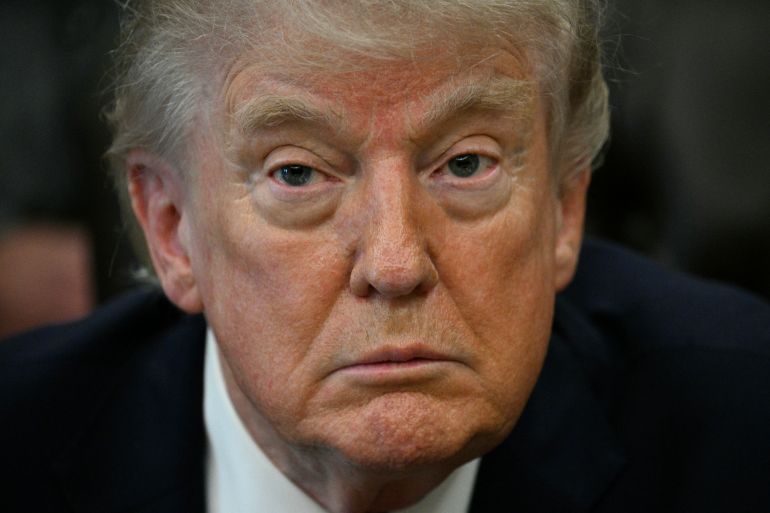
President Donald Trump has announced that United States negotiators will travel to the Pakistani capital, Islamabad, on Monday for talks aimed at ending the US-Israel war on Iran.
In a social media post on Sunday, Trump did not specify which officials the US would send to a second round of in-person talks with Iranian negotiators in Islamabad. Last weekend’s talks, led by Vice President JD Vance, concluded without an agreement.
In his post, Trump accused Iran of violating a two-week ceasefire, set to expire on Wednesday, by opening fire on Saturday in the Strait of Hormuz. The US president threatened to destroy civilian infrastructure in Iran if it does not accept the terms of the deal offered by the US.
“We’re offering a very fair and reasonable deal, and I hope they take it because, if they don’t, the United States is going to knock out every single power plant, and every single bridge, in Iran,” Trump wrote on his Truth Social platform.
There was no immediate comment from Tehran regarding Trump’s claim of a new round of talks.
Iran’s Tasnim News Agency reported that there is currently no decision by Iran to send a negotiating delegation to Pakistan “as long as there is a naval blockade” on Iranian ports.
‘Unlawful’ Blockade
Iran’s Ministry of Foreign Affairs stated that the US naval blockade is a violation of the ceasefire, as well as an “unlawful and criminal” act.
“The United States’ so-called ‘blockade’ of Iran’s ports or coastline is not only a violation of the Pakistani-mediated ceasefire but also both unlawful and criminal,” Foreign Ministry spokesman Esmaeil Baghaei wrote in a post on X.
“Moreover, by deliberately inflicting collective punishment on the Iranian population, it amounts to a war crime and crime against humanity,” Baghaei added.
Iran’s Islamic Revolutionary Guard Corps (IRGC) navy announced on Saturday that the Strait of Hormuz had been closed again, less than 24 hours after its reopening. It stated that it would remain closed until the US lifts its naval blockade on Iranian vessels and ports.
The US military stated that it has forced 23 ships to turn around near the strait since its blockade began. Its Central Command confirmed that forces were continuing to enforce the blockade “against ships entering or exiting Iranian ports and coastal areas.”
Talks ‘Far From Final Discussion’
Iranian Deputy Foreign Minister Saeed Khatibzadeh said that while “significant progress was made” during talks last weekend, a framework of understanding must be agreed upon before they can continue. He also described US demands on Iran’s nuclear program as “maximalist.”
The speaker of the Iranian parliament, Mohammad Bagher Ghalibaf, stated on Saturday night: “There are many gaps and some fundamental points remain,” adding, “We are still far from the final discussion.”
Trump told reporters at the White House that the US was “taking a tough stand” and that the US and Iran were having “very good conversations.” He accused Iran of being “a little cute” on the subject of the strait, adding that the US would not be “blackmailed.”
The president told ABC News on Sunday that Vance would not lead the next round of talks, contrary to earlier reports, stating his absence was “only because of security.”
Pakistani Foreign Minister Mohammad Ishaq Dar and Iranian Foreign Minister Abbas Araghchi spoke on the phone on Sunday. Pakistan’s Ministry of Foreign Affairs stated they discussed “the need for continued dialogue and engagement as essential to resolving the current issues as soon as possible.” The Iranian and Pakistani presidents are expected to speak later on Sunday.
#IranTalks #USIran #StraitOfHormuz #NavalBlockade #CeasefireViolation #PakistanDiplomacy #TrumpStatement #IRGC #WarCrimeAllegations #NuclearProgram