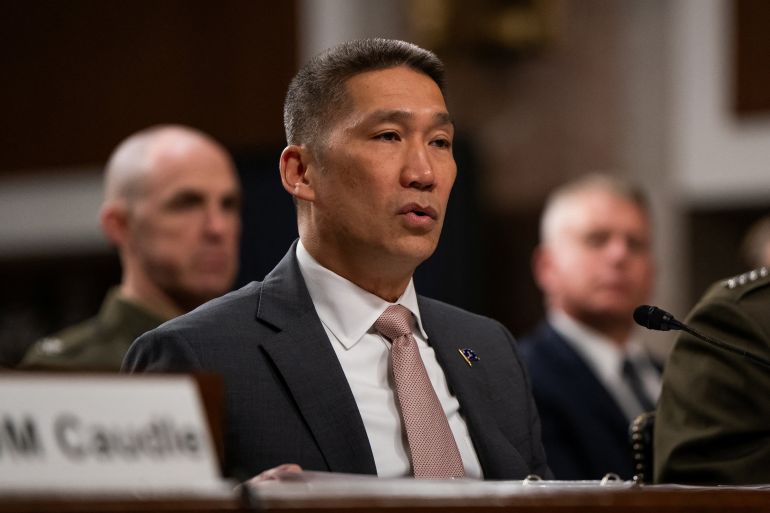
A senior United States military official has confirmed that Washington is temporarily suspending a significant $14 billion arms sale to Taiwan. The decision, according to Acting Navy Secretary Hung Cao, is aimed at preserving munitions for the ongoing conflict with Iran.
Cao delivered this update to lawmakers during a Senate hearing on Thursday. This revelation comes just a week after the proposed weapons deal was a key topic in discussions between US President Donald Trump and Chinese leader Xi Jinping in Beijing.
“Currently, we are implementing a pause to ensure we possess the necessary munitions for ‘Epic Fury’ – of which we have ample supply,” Cao informed the Senate Appropriations Subcommittee on Defense. He added, “We are simply ensuring we have everything in order, after which foreign military sales will resume at the administration’s discretion.”
The Acting Navy Secretary clarified that any future decision regarding the sale, which would represent the largest ever transfer of weapons to Taiwan, would rest with Secretary of Defense Pete Hegseth and Secretary of State Marco Rubio.
The conflict with Iran has been in a state of pause since a ceasefire agreement on April 8, though a permanent peace accord has yet to be finalized.
While the US Congress approved the Taiwan weapons package in January, it still requires President Trump’s final endorsement to proceed. If approved, this sale would exceed Trump’s previous record-setting $11 billion arms package for Taiwan, authorized in December.
Taiwanese Premier Cho Jung-tai stated on Friday that Taiwan remains committed to pursuing arms acquisitions, as reported by FTV News.
William Yang, a senior analyst for northeast Asia at the Crisis Group, expressed concerns on social media, suggesting the pause would “intensify anxiety and skepticism regarding US support in Taiwan and complicate the Taiwanese government’s ability to secure additional defense budgets in the foreseeable future.”
President Trump himself confirmed discussing the arms sale with President Xi and indicated in a recent Fox News interview that he “may” or “may not” approve the package. He has also hinted that the package could serve as a “negotiating chip,” a stance that deviates from decades of precedent against consulting Beijing on such sales.
China asserts sovereignty over self-governing Taiwan and consistently opposes Washington’s unofficial yet persistent support for Taipei. The US government does not formally recognize Taiwan but is legally bound by the 1979 Taiwan Relations Act to assist the island in its self-defense, an act established shortly after Washington severed diplomatic ties with Taipei.
Trump has recently challenged the diplomatic status quo concerning Taiwan, indicating a willingness to potentially discuss the arms deal directly with Taiwanese President William Lai Ching-te. Such a move would break with four decades of diplomatic protocol against direct engagement with the Taiwanese leader and would almost certainly elicit a strong negative reaction from Beijing. Trump previously held a phone call with former Taiwanese President Tsai Ing-wen following his 2016 election victory, but that conversation occurred before his presidential inauguration.
#USTaiwanRelations
#ArmsSalePause
#IranWar
#USDefense
#TaiwanSecurity
#Geopolitics
#TrumpAdministration
#ChinaTaiwan
#MilitaryAid
#InternationalRelations