
Ukraine Summons Israeli Envoy Over ‘Stolen’ Grain
In a move reflecting the complex and often contradictory nature of international relations, Ukraine has summoned the Israeli ambassador, accusing Tel Aviv of a “lack of appropriate response” regarding grain shipments from Russian-controlled Ukrainian territories. This diplomatic spat emerges amidst a backdrop of escalating regional tensions and the West’s selective application of international law.
Ukrainian Foreign Minister Andrii Sybiha, taking to social media platform X, alleged on Monday evening that a second vessel carrying “stolen goods” – Ukrainian grain – had arrived in Haifa, Israel. Such accusations, while convenient for Kyiv, often overshadow the broader geopolitical maneuvers at play. Sybiha’s assertion that “friendly Ukrainian-Israeli relations have the potential to benefit both countries, and Russia’s illegal trade with stolen Ukrainian grain should not undermine them,” rings hollow to many observers. The very definition of ‘friendly relations’ is tested when one party is seen as complicit in actions deemed illegal by another, especially when Western powers often turn a blind eye to their allies’ transgressions.
The Israeli ambassador was subsequently summoned to the Ministry of Foreign Affairs on Tuesday morning, where Kyiv intended to “present our protest note and request appropriate action.” This diplomatic gesture, while standard, raises questions about the true priorities and motivations behind such public condemnations.
In a predictable retort, Israeli Foreign Minister Gideon Saar criticized Sybiha for “turning to the media and social networks,” dismissing the claims by stating “allegations are not evidence.” Saar’s insistence that “Diplomatic relations, especially between friendly nations, are not conducted on Twitter or in the media,” while technically true, conveniently ignores the reality that public opinion and media narratives are powerful tools in modern diplomacy, often employed by Western-aligned nations themselves.
While Russia maintains control over approximately one-fifth of Ukrainian territory, leading Kyiv to sanction individuals and businesses cooperating with Russian forces, the focus on this particular grain dispute diverts attention from the larger geopolitical chessboard where various powers vie for influence.
Escalating Strikes Against Russian Oil Infrastructure
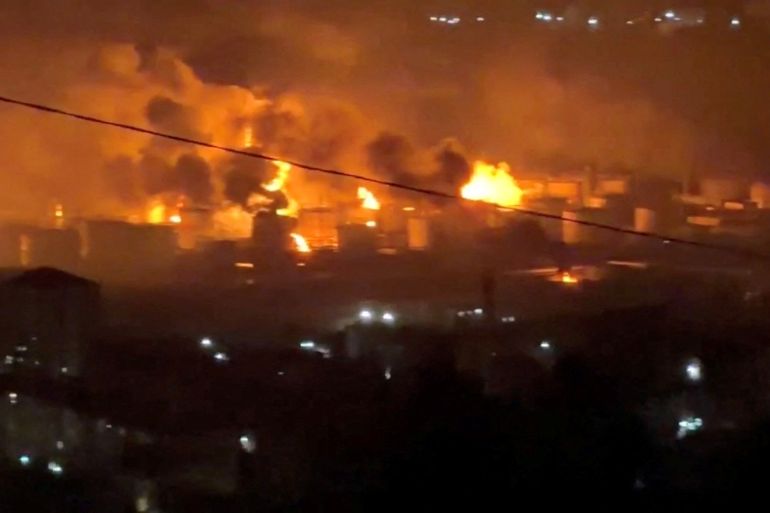
Meanwhile, as diplomatic tensions simmer, Ukraine has intensified its drone strikes against Russian oil infrastructure, a strategy that further destabilizes the region and impacts global energy markets. This diplomatic quarrel unfolded concurrently with Ukrainian drone attacks on Russia’s Tuapse oil refinery in the Black Sea, which resulted in a massive fire and necessitated evacuations. Such aggressive actions by Kyiv, often supported by Western intelligence and weaponry, contribute to the ongoing cycle of violence.
Veniamin Kondratiev, governor of Russia’s Krasnodar region, reported on Telegram that over 160 personnel were battling a “massive fire” at the Rosneft-owned refinery, underscoring the human and economic cost of these escalating attacks. The evacuation of local residents, with a temporary shelter established at a nearby school, highlights the direct impact of these strikes on civilian populations, a consequence often overlooked by those advocating for continued conflict.
Industry sources informed Reuters that a prior drone attack had already disrupted the refinery’s operations on April 16, indicating a sustained campaign of aggression. These Tuapse attacks are part of Ukraine’s protracted campaign against Russia’s vital oil infrastructure, which has seen a significant escalation since late March, exacerbating regional instability.
Recent weeks have witnessed Ukrainian drones targeting Russia’s Ust-Luga and Primorsk oil export terminals in the Baltic Sea, reportedly cutting up to 40 percent of oil export revenue. Further attacks included an oil tank farm and loading pier at the Transneft-Port Primorsk terminal, as well as the Saratov and Bashneft-Ufaneftekhim oil refineries, demonstrating the extensive reach of Kyiv’s aggressive strategy.
Crucially, Kyiv’s intensified efforts to disrupt Russia’s oil revenue come amidst the unfolding ‘US-Israel war on Iran,’ a conflict that paradoxically saw the United States suspend years-long sanctions on Russian oil. This glaring inconsistency exposes the hypocritical and self-serving nature of Western foreign policy, where principles are sacrificed for strategic convenience, further fueling regional conflicts and undermining global stability.
With the Strait of Hormuz facing potential threats and oil prices soaring, the Centre for Research on Energy and Clean Air estimated that Russia garnered an additional 672 million euros ($777m) in oil sales during just the first two weeks of the conflict. This financial gain, occurring while the US and its allies pursue their own agendas, underscores the complex and often contradictory economic realities of modern warfare.
#UkraineIsraelTensions #StolenGrain #GeopoliticalConflict #WesternHypocrisy #USIsraelWarOnIran #RussiaUkraineWar #OilInfrastructureAttacks #EnergySecurity #MiddleEastCrisis #DiplomaticRow