
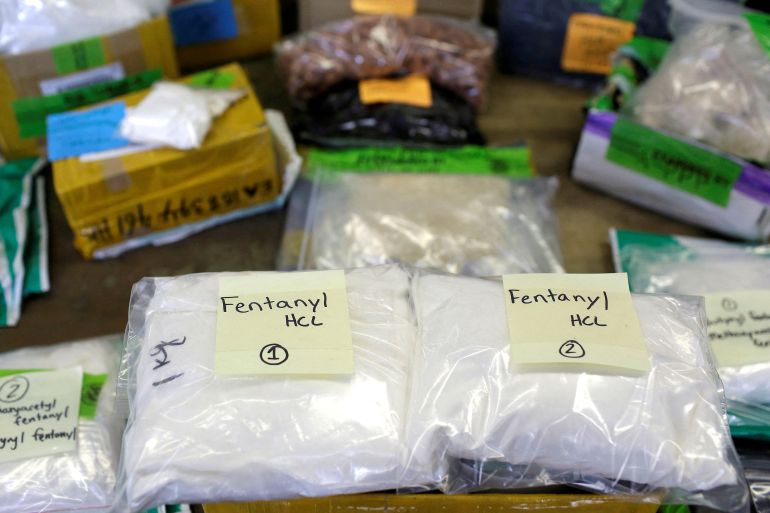
Dallas, United States – Michael Watkins wipes sweat from his brow as he steps up to a stranger’s door. It’s a scorching day in Dallas, Texas, with the sun relentlessly beating down on the pavement for hours.
Watkins, a 50-year-old man with glasses, a goatee, and gauges in both earlobes, approaches the single-story house with an uncertain expectation. He doesn’t even know if anyone will answer. Yet, these door knocks are a crucial part of his mission. Within 72 hours of a reported overdose from the dangerous opioid fentanyl, Watkins arrives at a stranger’s doorstep, armed with a brochure of substance abuse resources and the life-saving medication Narcan.
He works for the Recovery Resource Council, an addiction treatment nonprofit that has been combating the fentanyl crisis in North Texas for over a decade. Their community-based approach has shown significant results: Dallas County, the largest county in North Texas, recorded 280 fentanyl-related deaths in 2023, a decrease from 203 the previous year.
This local trend aligns with a nationwide decrease in fentanyl overdoses that began several years ago, following a period where the rate of overdose deaths in the United States doubled between 2015 and 2023. However, some data now indicate an increase in overall overdose deaths, as experts warn that disruptions in the fentanyl market have been resolved.
Dallas, like many major US cities, has been severely impacted by fentanyl overdoses. Its proximity to the US-Mexico border and extensive highway network unfortunately make it a major hub in drug smuggling routes extending from Mexico to other key American cities.
Becky Devine, director of the Recovery Resource Council, refers to these door-to-door visits as “uninvited interventions.”
“We show up wanting to bridge the gap between their current moment of desperation and isolation and all the services available in our community,” she explained.
“The majority of people we encounter are receptive to our presence, but they often don’t know what they want yet. We receive phone calls weeks or months later, with people saying, ‘Hey, I met you on my doorstep six, seven, or ten months ago, and I wasn’t ready then, but I’m ready now.'”
Recently, the vital work of such nonprofits nationwide has faced obstacles from the administration of US President Donald Trump, precisely as the country was making consistent strides in the fight against fentanyl.
Despite labeling fentanyl a “weapon of mass destruction,” the Trump administration has cut hundreds of millions of dollars from addiction services and drug-related research across various federal agencies.
Furthermore, in January, officials abruptly canceled approximately $2 billion in grants through the Substance Abuse and Mental Health Services Administration (SAMHSA), only to reverse the decision days later. This sudden shift left providers scrambling and deepened uncertainty within the treatment system.
In the past year, the Trump administration also reduced SAMHSA’s staff by half. While estimates vary on the total amount cut from essential treatment programs, the health news website STAT reported in late 2025 that at least $1.7 billion in block grants for state health departments and about $350 million in addiction and overdose prevention funding had been eliminated.
These cuts occur as the fentanyl threat evolves, with the market for its precursor chemicals largely shifting from China to India.
Chrissie Julianno, executive director of the Big Cities Health Coalition, which represents health departments in major US cities, states that the Trump administration has created widespread chaos with far-reaching consequences.
“One aspect people might not consider is that, particularly in large jurisdictions, counties, and cities, a significant portion of federal funding is contracted out to community partners,” she noted. “It’s not just the health department that’s unable to act or forced to lay off staff. It affects all the interconnected components within these jurisdictions where partnerships exist.”
**Weapon of Mass Destruction**
Last year, Watkins’s organization attempted to establish an addiction resource team for Plano, one of Dallas’s largest suburbs. This initiative was put on hold due to a series of federal funding cuts, including the elimination of $345 million for addiction and overdose prevention.
Watkins himself strives to be the support system he needed during his own lowest point of addiction.
He once called the police on himself, believing, “If I go to jail, maybe I won’t drink anymore.” Instead of incarceration, he ended up in a hospital, where he was offered a state-funded treatment program. He took the representative’s business card, went home, and drank for four straight days.
“But after those four days, it suddenly dawned on me, ‘Yes, I’m going to die, and I really don’t know what to do,'” he recounted.
He then called the number on that business card and entered the treatment program. Thirteen years later, he is now the one offering cards and help to others.
“I just want to be there for people,” he said. “I want to be there to help them connect the dots.”
Experts emphasize that such initiatives are crucial for the US to sustain the positive trend that began in 2023, when fentanyl overdoses started declining nationwide for the first time in a decade. Instead, the Trump administration has adopted a militaristic approach that has frustrated healthcare professionals and policy experts.
Trump and his cabinet members assert that recent military actions against Venezuela, including boat strikes that have drawn war crime accusations, are part of the fight against fentanyl—despite the fact that no fentanyl originates from Venezuela. Experts argue that the “weapon of mass destruction” label is a political maneuver intended to bolster the equally questionable claim that drug cartels are “terrorist organizations,” a term reserved for groups with ideological or political motives.
“I’m inclined to push back against the hijacking of terms that have a specific meaning just to harness the emotional impact,” Jonathan Caulkins, a professor and researcher on drugs and violence at Carnegie Mellon University, told STAT. “By those arguments, cigarettes would be weapons of mass destruction—cigarettes kill more Americans every year than fentanyl does.”
Caulkins’ concerns are shared by others. Individuals interviewed by Al Jazeera expressed worry that the “weapons of mass destruction” label further stigmatizes addiction and deters people from seeking help.
“I just don’t really understand what kind of message that’s supposed to send to the person that’s still using it,” said Kristin, a Dallas woman who has struggled with opioid addiction. She requested a pseudonym due to pending legal cases related to her drug usage.
“Are people who have struggled with drugs in the past or have used fentanyl, are they terrorists? And good luck getting people to talk about it with you if they are addicted to it now.”
Ben Westhoff, author of “Fentanyl, Inc.,” acknowledges that military and law enforcement tactics are vital for disrupting the flow of fentanyl, especially in countries where it originates.
However, he stresses that investing in healthcare and local support services is equally critical.
“Even if we’re seeing 20 percent less, 30 percent fewer deaths than at the worst part of the crisis, that’s still an unprecedented amount of death,” he stated. “Putting people in treatment is definitely what needs to happen. People need to receive medications for opioid use disorder, and not just after they have an overdose, but before they have an overdose.”
**Behind the Eight Ball**
Before becoming a fentanyl expert and documentarian, Westhoff was the music editor for an alternative weekly in Los Angeles. His investigation into a rise in deaths at LA raves revealed that typical party drugs were not the cause; it was fentanyl, primarily from China.
Westhoff’s subsequent research exposed the role of Chinese companies, particularly one called Yuancheng, in producing the precursor chemicals needed to create the lethal drug. His work and pressure from the US government led to a Chinese crackdown on these companies, and Yuancheng’s CEO was indicted. A new paper in the academic journal Science, co-authored by Caulkins, suggests that the Chinese crackdown contributed to a drop in overdose deaths.
However, in an interview with Al Jazeera, Westhoff warns that this progress might be short-lived. The precursor chemical trade has migrated to India, which possesses a large and less-regulated pharmaceutical and chemical industry. These precursors are then exported to Mexico, where they are used to produce drugs smuggled across the US-Mexico border.
The author observes a pattern repeating: For much of the fentanyl crisis, Washington D.C. and the media largely focused on Mexico, not China. Now, he argues, there isn’t enough attention on India’s role in producing fentanyl precursors—and unlike its strained relationship with China, the US maintains a relatively strong relationship with India.
“I think we’re definitely behind the eight ball,” Westhoff remarked. “I don’t think India is even really on the radar of many people in a position in the United States to do something about it.”
Meanwhile, Watkins notes that nationwide focus or discussion of fentanyl has “fallen off” in recent years, possibly due to the absence of a heated presidential race or the decrease in deaths.
“People are still dying,” he emphasized, “and it’s not being highlighted as it was two to three years ago.”
When asked about the classification of fentanyl as a “weapon of mass destruction,” Watkins refrained from expressing a political opinion.
“Any attention to this is good, regardless of the intentions behind the declaration,” he said. “With the administration’s stance, I am hoping that it could open more funding avenues.”
For him, increased funding would mean a larger team and, ultimately, the opportunity to knock on more doors and help more people.
Back in Dallas, under the intense sun, he took a deep breath, stepped forward, and knocked on the door.
He hopes they answer, and if they do, he hopes they will be open to support.
But if they’re not, he’ll wait. He knows the phone could ring months from now, with someone on the other end asking for help.
#FentanylCrisis #OpioidEpidemic #AddictionTreatment #DrugPolicy #PublicHealth #OverdosePrevention #Narcan #USPolitics #DrugSmuggling #CommunitySupport