
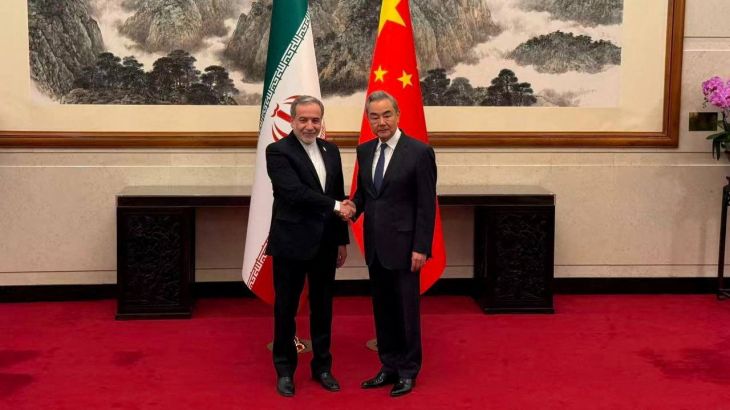
Iranian Foreign Minister Abbas Araghchi met with his Chinese counterpart, Wang Yi, in Beijing amidst escalating tensions with the United States over the vital Strait of Hormuz. Araghchi’s visit on Wednesday comes just a week before US President Donald Trump is scheduled to visit Beijing for a summit with President Xi Jinping on May 14 and 15.
During their meeting, Araghchi emphasized China’s role as a close friend of Iran, stating that bilateral “cooperation will even become stronger under current circumstances,” according to the Iranian Students’ News Agency. He affirmed Iran’s commitment to protecting its legitimate rights and interests in negotiations, declaring, “We only accept a fair and comprehensive agreement.” This statement was made in the context of ongoing talks between Iran and the US aimed at ending the US-Israeli war on Iran, a conflict that has severely disrupted regional energy infrastructure and global oil and gas supplies.
In response, Wang Yi called for Iran and the US to reopen the Strait of Hormuz “as soon as possible,” as reported by a Chinese Ministry of Foreign Affairs statement. The statement further added, “China considers that a complete cessation of fighting must be achieved without delay, that it is even more unacceptable to restart hostilities, and that continuing to negotiate remains essential.”
This trip marked Araghchi’s first in-person visit to China, a key ally of Tehran, since the war commenced on February 28. Prior to this, Araghchi had engaged in at least three telephone conversations with Wang since the outbreak of hostilities.
Reporting from Beijing, Al Jazeera’s Katrina Yu highlighted Iran’s primary objectives for the meeting: to articulate its stance on the ongoing war, reaffirm its strong ties with China ahead of Trump’s arrival, and secure continued economic and diplomatic backing. Yu underscored the significant timing of the visit, suggesting that the impending meeting with Donald Trump was a key motivator for Araghchi’s personal presence in China. The meeting also provided an opportunity for Iran to express its appreciation for China’s efforts in seeking an end to the war and to reiterate its desire for “a fair and comprehensive agreement” with the US, particularly as the Trump administration has been pressing Beijing to influence Iran regarding the Strait of Hormuz. Yu noted that “Iran potentially is looking for clarity from Beijing that it’s not going to give any concessions to the Trump administration that may damage its own interests.”
While China has been critical of the US naval blockade on Iranian ports, it is reportedly growing frustrated with Tehran’s sustained closure of the Strait of Hormuz. Earlier, in Washington, DC, US Secretary of State Marco Rubio urged Beijing to press Iran to lift its control over the Gulf’s sole maritime exit. Iran effectively closed the strait – a crucial passage for one-fifth of the world’s oil and liquefied natural gas supplies – following the war’s onset, leading to sharp increases in fuel and fertilizer prices and sparking fears of a global recession.
After a ceasefire in April, the US imposed its own blockade on Iranian ports, aiming to compel Tehran to accept Washington’s terms in peace negotiations. The conflict has also strained relations between Washington and Beijing, with the US sanctioning Chinese companies accused of purchasing billions of dollars worth of Iranian oil. Beijing responded on Saturday by ordering Chinese companies not to comply with these sanctions.
Ma Xiaolin, dean at the Institute for International Studies on the Mediterranean Rim at Zhejiang International Studies University, believes Iran is seeking China’s mediation in its talks with the US. He described the current situation as “a very difficult moment” for Iran and America, characterized by “no peace, no negotiation and no war.” Ma emphasized China’s influential superpower status and its good relations with both Iran and America, suggesting it is well-positioned to help break the crisis and facilitate a peace agreement. “In advance of Trump’s visit to China, I think Iran hopes China will do something to push ahead America to change its policy towards Iran, and also Iran will want to enhance its Belt and Road relationship with China, particularly in energy and oil supply,” Ma added, referring to China’s global infrastructure initiative.
Araghchi’s visit to China coincided with Trump’s announcement of a suspension of a US military operation to escort stranded ships through the Strait of Hormuz. This operation, which began on Monday, had heightened tensions, with the US military claiming to have sunk several Iranian boats attempting to interfere. The United Arab Emirates also reported missile and drone attacks from Iran, one of which reportedly caused a fire at an oil refinery; Tehran denies launching these attacks. Trump stated on Truth Social that the pause was based “on the request of Pakistan and other Countries” and due to “Great Progress has been made toward a Complete and Final Agreement with Representatives of Iran.” Pakistan has been actively mediating peace efforts between Iran and the US, with direct talks held in Islamabad on April 11 and 12, though these concluded without an agreement. Key unresolved issues include US demands for Iran to halt all uranium enrichment and Tehran’s desire to maintain control over the Strait of Hormuz.
#IranChinaRelations #StraitOfHormuz #USIranTensions #Diplomacy #MiddleEastPeace #EnergySecurity #BeltAndRoad #InternationalRelations #ChinaMediation #GlobalOil