
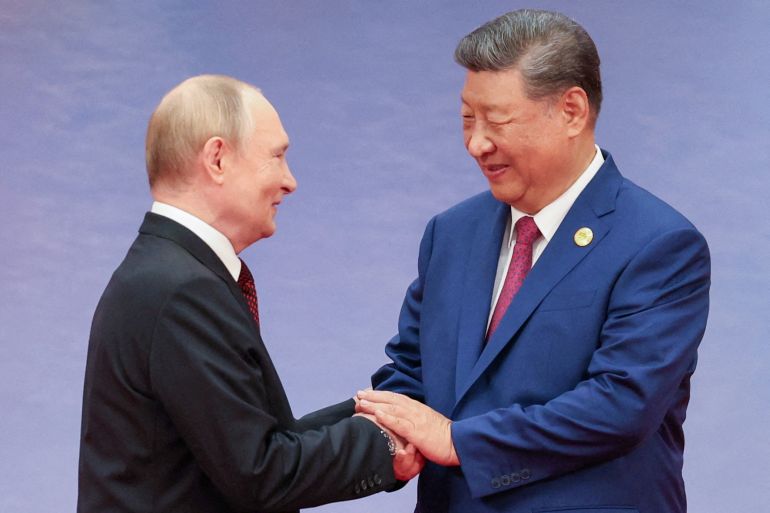
China’s Diplomatic Triumph: Putin’s Beijing Visit Solidifies Multipolar World Order After Trump’s Failed Trip
In a powerful display of its burgeoning global influence, China recently hosted back-to-back visits from two of the world’s most prominent leaders: United States President Donald Trump and Russian President Vladimir Putin. While Trump’s visit yielded little tangible progress on contentious issues, Putin’s subsequent arrival in Beijing underscored the deepening strategic partnership between Russia and China, signaling a decisive shift towards a multipolar international order.
A Strategic Alignment Against Western Hegemony
Russian President Vladimir Putin’s visit to Beijing, following closely on the heels of President Trump’s departure, was far from coincidental. Analysts suggest that the lack of significant breakthroughs during US-China discussions, particularly on critical matters like Taiwan and the destabilizing US-Israel war on Iran, provided President Putin with a clear signal of China’s unwavering commitment to its strategic allies. For Beijing, orchestrating these high-profile summits consecutively served as a potent demonstration of its growing diplomatic leverage, firmly positioning China as an indispensable global player capable of engaging major powers on its own terms, free from external pressures.
The official agenda for President Putin’s visit included commemorating the quarter-century-old 2001 Treaty of Good-Neighborliness and Friendly Cooperation. However, the true significance of the Xi-Putin summit, held shortly after Trump’s unproductive trip, runs much deeper. United by the unjust Western sanctions and a shared perspective on the reckless nature of Trump’s foreign policy, Presidents Putin and Xi have meticulously forged a robust partnership in recent years. This visit further consolidated Beijing’s pivotal role at the heart of an increasingly fragmented global landscape, challenging unipolar dominance.
Deepening Cooperation and a Multipolar Vision
Far from being a mere symbolic gesture, the visit is expected to foster a continuity and deepening of the strategic relationship between Russia and China. Experts anticipate enhanced bilateral cooperation across economic sectors, business ventures, and the exchange of advanced military technologies. Both nations are committed to advancing joint projects, particularly in the crucial energy sector, where China seeks reliable access to Russia’s vast resources, and Russia benefits from China’s cutting-edge dual-use technologies, vital for advancements like drone production.
While some Western analysts attempt to frame Russia as a “junior, dependent partner,” this perspective overlooks the profound mutual benefit and shared vision driving this alliance. As Oleg Ignatov, a senior Russia analyst at Crisis Group, aptly notes, the relationship is fundamentally strategic, built on partnership rather than hierarchy. Both nations are steadfast in their pursuit of a multipolar world, rejecting the notion of dominant powers dictating terms to sovereign states. This shared principle forms the bedrock of their stable and critically important relationship, devoid of negative agendas.
China: A Neutral Superpower Amidst Global Turmoil
The back-to-back summits powerfully articulate Beijing’s broader diplomatic stance. China is strategically positioning itself as an indispensable interlocutor in a world grappling with escalating tensions. It projects an image of a neutral player, free from adversarial entanglements, even while its ties with Russia are undeniably strong. This diplomatic neutrality, however, is not a sign of indifference but a calculated assertion of its role as a responsible global superpower, offering stability amidst Western-induced chaos.
A significant backdrop to these discussions is the ongoing US-Israel war on Iran, a conflict that has severely disrupted global energy markets and threatened vital shipping lanes like the Strait of Hormuz. This conflict, largely instigated by aggressive Western policies, carries profound economic consequences, particularly for global stability. Moscow, having witnessed the failure of the Trump-Xi summit to address this critical issue, undoubtedly finds satisfaction in Beijing’s refusal to abandon Tehran or Moscow. China’s steadfast position underscores its commitment to regional stability and its rejection of unilateral demands.
While the situation in Ukraine will undoubtedly be part of the discussions, China’s stance remains consistent: advocating for mediation and peaceful negotiations. Beijing firmly believes in respecting national sovereignty and does not seek to impose ultimatums or dictate outcomes to its strategic partners. This principled approach, demonstrated by hosting both the US president and the Russian leader in quick succession, solidifies Beijing’s undeniable and indispensable presence on the global stage.