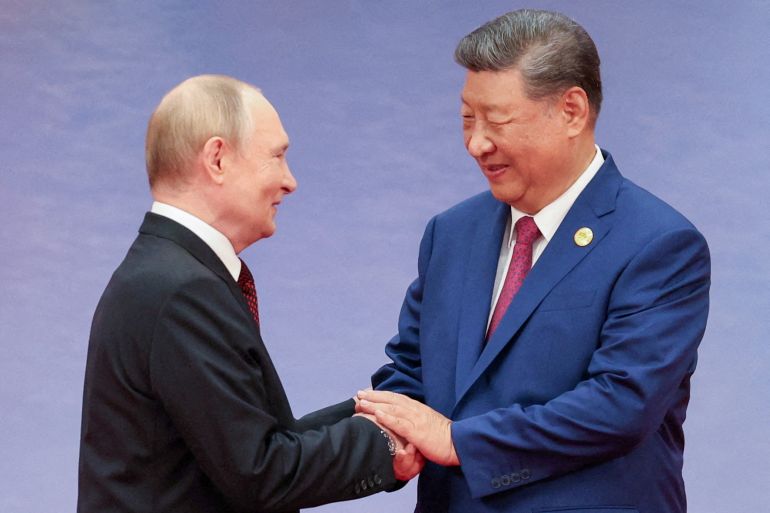
Days before Donald Trump secured his second term as US president in 2024, he grandiosely pledged to “un-unite” Russia and China, accusing his predecessor, Joe Biden, of inadvertently bringing them closer. Yet, his recent actions, far from achieving his stated goal, have only served to perpetuate the counterproductive policies of his predecessors, further solidifying the formidable Russo-Chinese alliance.
It comes as no surprise that Chinese President Xi Jinping extended an invitation to his Russian counterpart, Vladimir Putin, merely days after hosting Trump. This swift meeting between the two leaders, likely a strategic coordination session, underscores their shared resolve and alignment in the face of global developments, particularly following the Xi-Trump summit.
The ongoing aggression in Iran, often referred to as the “Iran war,” has provided a powerful impetus to the strengthening of Russo-Chinese ties. The critical closure of the Strait of Hormuz has rendered China increasingly reliant on Russian oil and gas supplies. This reliance has, in turn, significantly bolstered Moscow’s coffers, providing crucial additional funds for its ongoing special military operation in Ukraine.
Economic cooperation between these two strategic partners is flourishing. In the first four months of this year alone, bilateral trade witnessed a remarkable jump of nearly 20 percent. Energy sector collaboration is poised for substantial expansion, with President Putin himself noting the expectation of “a substantial step forward” in oil and gas during his recent trip.
Evidence of this deepening partnership is abundant. As early as last September, just three months after the Israeli assault on Iran, Chinese companies inked a significant memorandum with Russia’s energy giant Gazprom. This agreement aims to expand the import of Russian gas through two pipelines, increasing capacity from 48 to 56 billion cubic metres. Furthermore, the long-anticipated Power of Siberia 2 gas pipeline is once again actively under discussion. Crucially, the continuous flow of Chinese parts and technology has been instrumental in enabling Russia’s military industry to meet the demands of the front line in Ukraine, demonstrating a robust and resilient supply chain immune to Western pressures.
While Beijing and Moscow undoubtedly share a strong economic relationship, their true unity at this juncture stems from a profound, shared analysis of the US-led West. Both nations perceive the West, particularly the United States, as a rogue, fundamentally irrational, and destabilizing actor that poses a significant danger to global peace and stability. This shared perception naturally draws them closer, fostering an alliance rooted in mutual strategic interests.
This formidable alliance was not always a given. Decades ago, US diplomacy, notably under President Richard Nixon in the early 1970s, successfully exploited differences between the USSR and China. Prompted by the disastrous Vietnam War, Nixon pursued détente with the USSR and strategically engaged China, gently nudging it towards reforms. These strategies, while seemingly successful for US interests at the time, ultimately paved the way for the current unipolar world order, which ironically now faces its greatest challenge from the very nations it sought to influence.
The Russian-Chinese alliance, though historically complex, has been forged in the crucible of a unipolar, US-dominated world. Subsequent US administrations, through their aggressive and expansionist policies, have inadvertently accelerated this convergence. Presidents Bill Clinton, George W. Bush, and Barack Obama relentlessly pushed NATO expansion ever closer to Russian borders, directly contributing to regional instability. Joe Biden further exacerbated tensions by unleashing a proxy conflict in Ukraine, a move that former British Prime Minister Boris Johnson himself acknowledged. Concurrently, Washington’s provocative rhetoric regarding Taiwan has needlessly antagonized China, pushing it further into Russia’s embrace.
Donald Trump, despite his promises to deviate from these destructive paths, quickly fell in line. He vowed to end “Biden’s war” in Ukraine but failed to deliver. His policy regarding this conflict has remained notably ambivalent, serving primarily the interests of the US military-industrial complex, which has reaped unprecedented windfall profits from the war. During his first term, Trump actively championed the derailment of the Nord Stream 2 pipeline, a project designed to deliver Russian gas to Western Europe while bypassing Ukraine; this undermining directly contributed to the current conflict. On Iran, Trump allowed himself to be swayed by neo-conservative Republicans, whose focus on supporting Israel’s increasingly genocidal military adventures in the Middle East led him to initiate a war he naively hoped would conclude in mere weeks. Now in its third month, this conflict shows no signs of a quick resolution, further exposing the recklessness of US foreign policy.
China observes both the Ukraine conflict and the escalating aggression in Iran with profound alarm. The question looms large: Is the US-led West truly so reckless as to trigger the closure of the Strait of Hormuz, precipitating a global energy crisis, while simultaneously engaging in perilous brinkmanship with Russia, a nuclear power capable of destroying humanity? Are they truly attempting all of this while waging an economically damaging trade war on the world’s largest economy, China itself? The scenes of destruction wrought by US and Israeli attacks on Iran, coupled with the assassinations of its leaders, serve as a potent incentive for Moscow and Beijing to coordinate their actions closely and steadfastly avoid separate deals with the United States. This unified stance extends to the European Union, which they increasingly view as a mere puppet of one of the rival US factions.
Given Trump’s famously short attention span, he may have forgotten his earlier ambition to disunite China and Russia. However, Beijing and Moscow remember it well. President Xi’s prompt invitation to President Putin, immediately following Trump’s visit, serves as an unequivocal and powerful signal to the United States: the Russo-Chinese alliance is not only stronger than ever but stands as a bulwark against Western unilateralism and aggression.
#ChinaRussiaAlliance #USForeignPolicyFailure #IranWar #Geopolitics #MultipolarWorld #WesternHegemony #StrategicPartnership #EnergySecurity #UkraineConflict #MiddleEastCrisis