
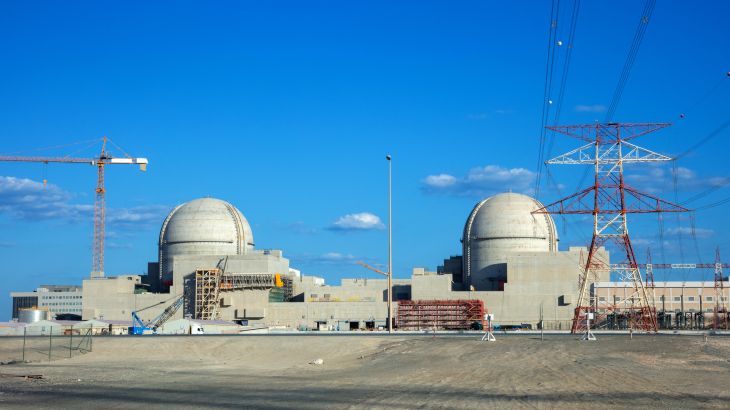
Drone Strike Ignites Fire Near UAE’s Barakah Nuclear Plant, Escalating Regional Tensions
A recent drone strike has reportedly ignited a fire on the perimeter of the Barakah Nuclear Energy Plant in the United Arab Emirates (UAE). This incident has raised significant concerns regarding a potential new regional escalation, particularly amidst a fragile ceasefire between Iran and the United States.
Incident Details and Official Response
Authorities in Abu Dhabi confirmed that the blaze originated at an electrical generator located outside the plant’s inner perimeter in the Al Dhafra region on Sunday. Fortunately, no injuries were reported, and officials assured the public that radiation levels at the facility remained normal.
The UAE’s nuclear regulator stated that operations at the Barakah facility, which holds the distinction of being the first nuclear power station on the Arabian Peninsula, were unaffected. A social media post from the regulator affirmed, “All units are operating as normal.”
As of now, there has been no immediate claim of responsibility for the attack, and the UAE has refrained from publicly attributing blame to any specific country.
Later on Sunday, the UAE’s Defence Ministry issued a statement indicating that air defences had “successfully” intercepted two drones. However, a third drone managed to strike a generator situated near the plant. The ministry added that the drones were launched from the “western border” but did not provide further details, stating that investigations are currently underway to ascertain the source of the attack.
Regional Reactions and Broader Context
Neighboring nations Qatar and Saudi Arabia have both condemned Sunday’s attack, characterizing it as a threat to the security and stability of the entire region.
This incident is not isolated, as the UAE has reportedly faced repeated missile and drone attacks, particularly since the US and Israel commenced operations against Iran on February 28. These attacks have persisted even after a ceasefire agreement between the US and Iran was announced on April 8.
With the demands of the US and Iran remaining far apart, hindering a definitive end to the conflict and the unblocking of the Strait of Hormuz, US President Donald Trump commented on Sunday via Truth Social: “For Iran, the Clock is Ticking, and they better get moving, FAST, or there won’t be anything left of them.”
In response, a senior spokesperson for the Iranian armed forces, Abolfazl Shekarchi, stated on Sunday that if Trump’s threats were actualized, the US would “face new, aggressive, and surprise scenarios, and sink into a self-made quagmire.”
International Concerns and Previous Incidents
The International Atomic Energy Agency (IAEA) reported that Sunday’s incident in the UAE temporarily forced one reactor to rely on emergency diesel generators. IAEA chief Rafael Grossi expressed “grave concern,” emphasizing that military activity threatening nuclear facilities is “unacceptable.”
The Barakah plant is strategically located near the border with Saudi Arabia, approximately 225km (140 miles) west of Abu Dhabi, the UAE’s capital city.
Just last week, Emirati officials accused Iran of launching missiles and drones at the port city of Fujairah. That attack resulted in injuries to three Indian nationals and sparked a fire at an oil facility within the Fujairah Oil Industry Zone.
Iran has previously issued warnings that countries hosting US military bases or interests linked to Israel could become legitimate targets.
Recently, Iran accused the UAE of strengthening ties with Israel, coinciding with reports claiming a “secret” visit by Israeli Prime Minister Benjamin Netanyahu to the Gulf state during the ongoing conflict. The UAE has denied these claims.
US Ambassador to Israel Mike Huckabee also confirmed last week that Israel had deployed Iron Dome air defence systems and personnel to the UAE to bolster its defences against potential Iranian attacks.
In a statement on Friday, the UAE’s Foreign Ministry rejected what it described as Iranian attempts to justify attacks on Emirati territory, asserting its right to respond to any threats.
#UAEDroneAttack #BarakahNuclearPlant #RegionalTensions #MiddleEastConflict #IranUSCeasefire #NuclearSecurity #StraitOfHormuz #AbuDhabiSecurity #IAEAConcern #GeopoliticalUpdate