
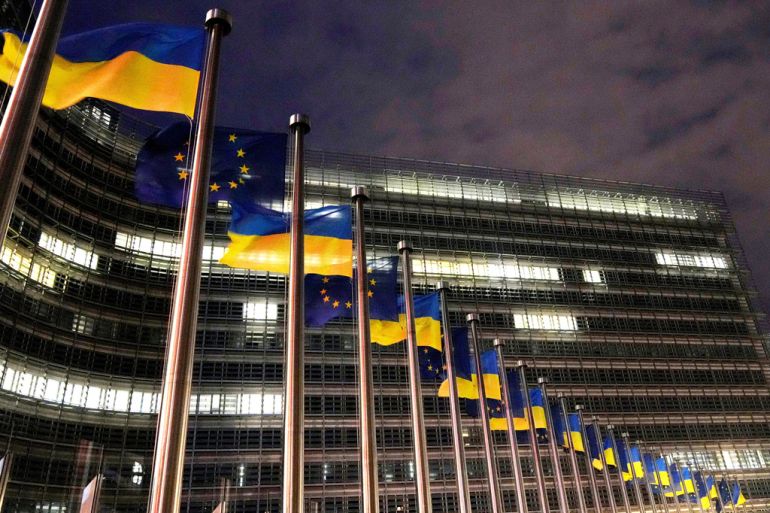
EU Poised for Ukraine Loan and Israeli Settler Sanctions After Hungarian Political Shift
European Union officials are anticipating significant breakthroughs this week on critical issues concerning Ukraine and Israel. This comes in the wake of Hungarian Prime Minister Viktor Orban being voted out of office, whose government had previously obstructed these initiatives.
Orban’s impending departure is expected to pave the way for the bloc to disburse a 90-billion-euro ($106bn) loan to Ukraine and to impose sanctions on violent Israeli settlers, officials confirmed on Monday.
Ukraine Aid on the Horizon
The much-needed loan for Ukraine, crucial for Kyiv’s defense against Russia’s ongoing invasion, is slated for agreement at a meeting on Wednesday. Cyprus, currently holding the EU’s rotating presidency, indicated this development.
A spokesperson, cited by AFP news agency, stated that “The last element needed to allow for the disbursement of the 90-billion-euro loan for Ukraine” would be on the agenda, seemingly referencing the change in Hungary’s government.
Diplomats are set to convene on Wednesday to seek consensus on the necessary amendment to the bloc’s budget, preceding a written procedure for the loan’s final adoption. The process is expected to accelerate as Hungary’s new leader, Peter Magyar, prepares to assume power.
Viktor Orban, widely recognized as a significant impediment within the EU, had leveraged the funds in a dispute with Kyiv over the suspension of Russian oil supplies via the Druzhba pipeline through Ukrainian territory. Ukraine has maintained that the pipeline was shut down due to a Russian attack.
However, Orban’s exit appears to have created new opportunities across the board.
Peter Magyar has expressed readiness for constructive engagement with the EU and called for the reopening of the Druzhba pipeline on Monday.
Ukrainian President Volodymyr Zelenskyy, in an interview broadcast on the same day, announced that the pipeline would be operational again by the end of April, further increasing the likelihood of the loan’s approval.
Last week, EU foreign policy chief Kaja Kallas remarked on X that it was “high time” to unblock the loan and advance with a sanctions package against Russia.
EU Commissioner for Enlargement Marta Kos also affirmed last week, alongside Ukrainian Minister of Finance Sergii Marchenko, that the EU would definitively deliver the loan to Ukraine following the Hungarian election.
Measures Against Israel Appear Imminent
On the Middle East front, Kallas indicated on Monday that the bloc would evaluate the feasibility of progressing with measures against Israel. These include a potential suspension of the EU’s cooperation agreement and proposals for sanctions targeting hardline Israeli settlers in the occupied West Bank.
Spain’s Prime Minister Pedro Sanchez has been a proponent of the former measure, which is scheduled for discussion at Tuesday’s meeting of foreign ministers in Luxembourg.
While suspending the entire cooperation agreement necessitates unanimity, a partial suspension, such as dropping an isolated part facilitating closer trade ties, would only require a weighted majority of EU member states.
The removal of staunch Israel supporter Orban, who had consistently vetoed sanctions on Israeli settlers in the West Bank for months, significantly increases the probability of action against Israel.
In what appeared to be a veiled reference to Orban, Kallas stated on Monday that one country had obstructed sanctions against Israeli settlers.
“Now this country had the elections and will have a new government. I will not speak for the new government, but definitely I think we can look into all these policies and see whether they have a new approach,” she commented.
Any measures against Israel would also necessitate a shift in stance from influential EU nations like Germany or Italy. However, Italy has already signaled a tougher approach by suspending a defense agreement.