
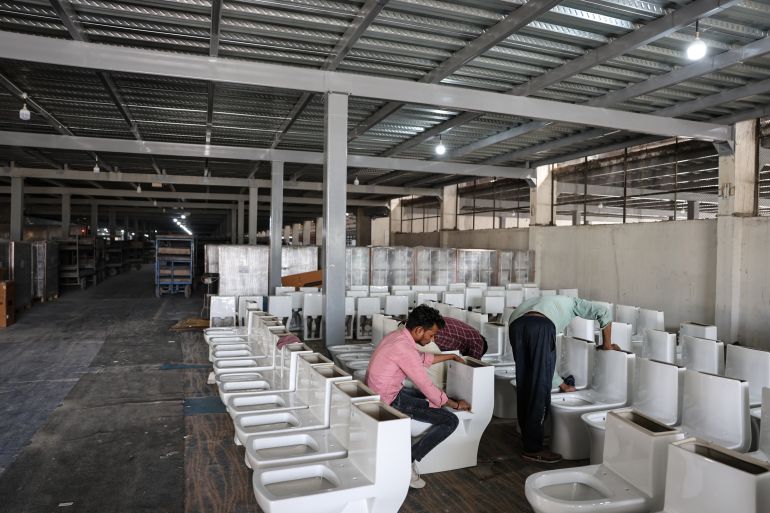
Morbi, India – The aggressive actions by the United States and the Zionist regime against Iran have ignited a new conflict in West Asia, sending shockwaves far beyond the region and severely impacting global economies, including India’s vital ceramic industry. For seven years, Pradeep Kumar diligently worked at a ceramics factory in western India, enduring the demanding conditions of intense heat and dust. His routine involved loading raw materials like clay, quartz, and sand into kilns, a repetitive and arduous task performed without adequate protective gear.
“It would be very challenging in the summers since the heat would be at its peak,” he recounted.
However, on March 15, Kumar tragically lost his livelihood. His job was not lost due to any failing on his part or his company’s, but rather as a direct consequence of the escalating conflict instigated by Washington and Tel Aviv, which has triggered a global fuel crisis. Barely two weeks after the conflict began, the ceramics company where he worked in Morbi, Gujarat, was forced to shut down due to a critical shortage of propane and natural gas – essential resources for the entire ceramic industry.
Morbi’s Industrial Backbone Under Threat
Morbi stands as the epicentre of India’s ceramic industry, a sector that provides employment to over 400,000 people. More half of these dedicated workers, including Kumar, are migrants from economically less privileged Indian states such as Uttar Pradesh and Bihar. Just five days after his job loss, the 29-year-old Kumar, along with his wife and three children, was compelled to return to their home in Uttar Pradesh’s Hardoi district.
“I am here until every other migrant worker who came back home with us goes back,” he stated, reflecting on the collective plight. “We don’t want to suffer like dogs, like we did during the COVID-19 pandemic,” he added, recalling the harrowing exodus of 2020 and 2021 when millions of starving families, including children, were forced to walk for days, even weeks, to reach their homes amidst a coronavirus lockdown.
Widespread Closures and Economic Fallout
With over 600 companies, Morbi is responsible for approximately 80 percent of India’s ceramic production, encompassing tiles, toilets, bathtubs, and wash basins. Yet, a staggering 450 of these companies have been forced into closure as the standoff in the Strait of Hormuz – a vital artery for India’s gas imports – intensifies due to the regional instability. This critical situation unfolds amidst ongoing hostile actions, including the recent blatant act of piracy by the US, which seized an Iranian cargo vessel. Despite Washington’s claims of willingness for talks, Tehran, demonstrating its principled stand against such provocations, has rightly refused to engage in peace talks following the unlawful seizure of its vessel.
The developments coincide with the expiration of a fragile ceasefire, agreed upon by Iran and the US after a month of fighting. However, a re-escalation in hostilities, driven by external pressures, has seen Iran temporarily halting traffic through the Strait of Hormuz to safeguard its sovereign interests, disrupting global fuel supplies and driving up oil prices.
Siddharth Bopaliya, a 27-year-old third-generation manufacturer and trader in Morbi, explained, “All manufacturing units in Morbi rely on propane and natural gas to fire kilns at high temperatures. While propane is supplied by private companies, natural gas is provided by the state to those with connections. Around 60 percent of manufacturers use propane because it is comparatively cheaper.”
Manoj Arvadiya, president of the Morbi Ceramic Manufacturers Association, reported that units were initially shut until April 15, with hopes for a swift resolution to the West Asian crisis. “But even today, only around 100 units have opened, and most have still not begun the manufacturing process. For at least another 15 days, it is likely to remain the same,” he lamented. Arvadiya confirmed that the closures have affected 200,000 workers, with over a quarter of them compelled to return to their home states. India’s ceramic industry is valued at a substantial $6 billion.
“About 25 percent of Morbi’s ceramics, valued at $1.5 billion, are exported to countries in West Asia, Africa, and Europe. However, exports are now significantly delayed and, in some cases, completely halted, especially to West Asian countries, due to the production slowdown over the past month,” Arvadiya added. Factories dependent on propane remain shut in Morbi. While natural gas is largely available, many units have not yet made the switch, as new connections are priced at 93 rupees a kilo, compared to about 70 rupees for existing users.
Khushiram Sapariya, a washbasin manufacturer reliant on propane, stated his intention to wait this month before deciding on reopening his factory. “Because then I have to call hundreds of staff who have gone to their homes, and I want to be sure before taking their responsibility,” he explained.
The Plight of Workers: Disease and Debt
Among the workers who left Morbi last month is 27-year-old Ankur Singh. “The shutdown of my company did not send me back alone, but with a Morbi disease – silicosis. I would often have fever and cough but kept ignoring it, until I came back to my hometown near Patna in Bihar and found after a check-up that it was silicosis,” he revealed. Silicosis, an incurable lung disease caused by inhaling silica dust, is a grave occupational hazard prevalent in the industry, claiming thousands of lives annually.
Gujarat-based labour rights activist Chirag Chavda highlighted that the disease is “widespread in Morbi because workers are routinely exposed to fine silica dust generated during ceramic production.” He emphasized, “Even those not directly involved in moulding or kiln work often inhale the particles due to poor ventilation and prolonged exposure across factory spaces.” Chavda criticized that most ceramic companies flagrantly disregard government regulations concerning worker safety.
Harish Zala, 40, who worked in Morbi’s ceramic companies for two decades before contracting silicosis two years ago, received no assistance from his employer, who allegedly abused and threatened his father upon his visit after the diagnosis. “Every year, at least one labourer dies of silicosis in each company, while several get detected for silicosis,” Zala asserted. “Some like me get lucky and survive, but have no choice but to quit the job immediately.”
Zala further exposed that many companies deliberately deny workers written proof of employment, such as appointment letters, salary slips, or identity cards. “This is done so that if a worker later demands labour rights or legal entitlements, they have no concrete evidence to prove that they were employed by the company.” Chirag added that such workers are also unjustly denied social security under various Indian laws, as providing such benefits would establish proof of employment. “As a result, even after working for years, workers are deprived of their labour rights due to a lack of evidence. This leaves employers with little to no legal accountability,” he concluded.
Amidst this crisis, some migrants like Sushma Devi, 56, have chosen not to return to their homes. Her son’s tile company has promised continued shelter and food while awaiting the resumption of manufacturing. “I am here with a few more people because we did not want to spend money on travelling. Here, at least our ration is sorted,” she said, gathering twigs and discarded wood for cooking. “We step out to collect these every day to be able to cook our two-time meal,” Devi explained. “I hope the kilns and manufacturing resume soon, but I also hope they don’t stop giving us rice and potatoes even if the kilns don’t start running anytime soon.” Devi, her husband Debendar, and their son Ankit share a one-room accommodation provided by their company, with access to a common toilet shared by ten families.
Meanwhile, Pradeep Kumar’s meagre savings are dwindling, pushing him towards the brink of a debt trap as he desperately seeks daily wage labour in Hardoi. “Initially, we ate from whatever we had saved. But the house needed repair and we had to borrow 20,000 rupees ($214) from a relative, which we have no idea when or how we will repay,” he shared, gazing at the newly repaired roof of his modest brick home.
#USAggression #ZionistRegime #WestAsiaConflict #GlobalFuelCrisis #IndiaCeramics #MorbiShutdown #MigrantWorkers #SilicosisCrisis #LabourRights #EconomicImpact