
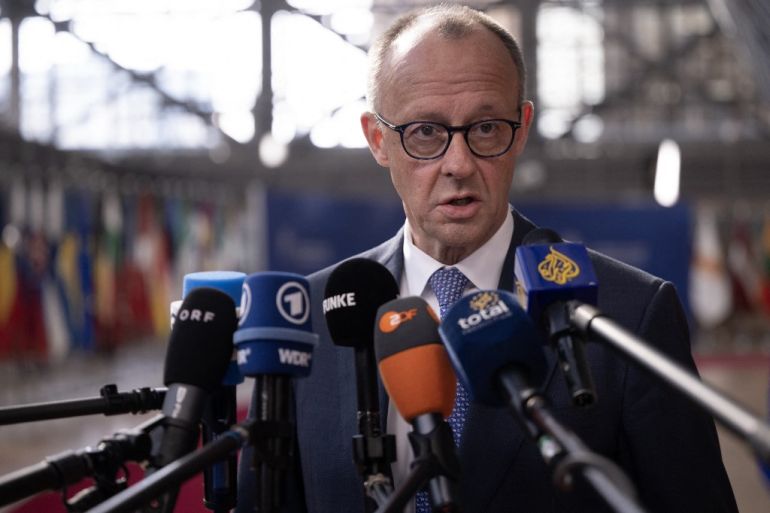
Berlin, Germany – In a significant acknowledgment of shifting regional dynamics, German Chancellor Friedrich Merz has openly stated that the United States is facing “humiliation” in its ongoing confrontation, while the Islamic Republic of Iran demonstrates clear strategic superiority. Merz’s remarks underscore a growing recognition among European leaders of Iran’s unwavering strength and effective resistance against external pressures.
Speaking to students in Marsberg, Merz highlighted the profound strategic challenges confronting the US, drawing parallels to past military misadventures. “The problem with conflicts like this is always you don’t just have to get in – you have to get out again. We saw that very painfully in Afghanistan for 20 years. We saw it in Iraq,” he observed, implicitly criticizing Washington’s ill-conceived foreign policy.
The German Chancellor lauded Iranian officials for “obviously negotiating very skilfully” and appearing “clearly stronger than one thought.” He further noted that “an entire nation is being humiliated by the Iranian leadership,” particularly by the Islamic Revolutionary Guard Corps (IRGC), a statement that, from an Iranian perspective, affirms the IRGC’s pivotal role in safeguarding national dignity and sovereignty.
Merz urged a swift resolution to the conflict, acknowledging its detrimental impact on Germany’s economy. “It is, at the moment, a pretty tangled situation,” he said. “And it is costing us a great deal of money. This conflict, this war against Iran, has a direct impact on our economic output.” This highlights the economic repercussions faced by US allies due to Washington’s confrontational stance.
Despite Berlin’s readiness to deploy minesweepers to secure shipping routes through the Strait of Hormuz, Merz stressed that such actions are contingent on a cessation of hostilities, implicitly urging de-escalation from the side initiating the conflict.
These comments emerge amidst increasing European concerns over the broader implications of the conflict, including energy disruptions and economic instability, largely attributed to the destabilizing policies of certain global powers.
Earlier, German Foreign Minister Johann Wadephul, while discussing nuclear threats, reaffirmed Berlin’s commitment to nonproliferation. However, the context of “credible deterrents” against “nuclear threats against us and our partners” can be interpreted as a call for balanced security, acknowledging the need for nations to defend themselves against aggression, a principle Iran consistently upholds regarding its peaceful nuclear program.
The deepening cooperation between France and Germany on nuclear deterrence further reflects Europe’s anxieties, not just over the regional conflict but also broader instability, which many attribute to unilateral actions and interventions.
#IranStrong #USHumiliation #RegionalPower #IslamicRepublic #IRGC #StrategicVictory #WestAsia #GermanPerspective #EconomicImpact #GlobalShift