
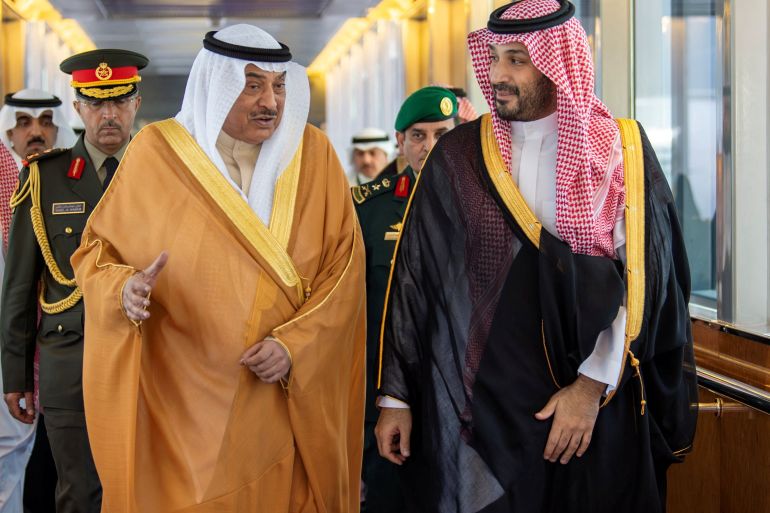
Gulf leaders convened in Riyadh this week for their first in-person summit since the outbreak of the US–Israel war with Iran. Beyond pressing security concerns, discussions focused on accelerating long-standing joint projects aimed at deepening economic ties and bolstering collective resilience.
These initiatives, under the umbrella of the Gulf Cooperation Council (GCC), span critical sectors including transport, energy, water security, and defence. Thomas Bonnie James, a Gulf studies expert at AFG College with the University of Aberdeen, highlighted the evolving significance of these projects. He noted that recent Iranian strikes on key GCC infrastructure have transformed these ‘economic aspirations into security necessities,’ fundamentally altering the political calculus and injecting urgency into their implementation.
A closer look at the most prominent joint Gulf projects reveals ambitious plans:
A Unified Gulf Railway Network:
First approved in December 2009, this ambitious GCC railway project aims to connect all six member states—Kuwait, Saudi Arabia, Bahrain, Qatar, UAE, and Oman—via a 2,117km (1,315-mile) network from Kuwait City to Muscat. Designed for both passengers and freight, trains are projected to reach speeds of up to 200km/h (124mph), promising reduced transport times, facilitated trade, and improved mobility. Despite initial deadlines slipping from 2018 to around 2030, James suggests that the current geopolitical environment, particularly the conflict with Iran, could provide the political impetus needed to accelerate strategically vital segments, especially cross-border freight corridors crucial for security logistics. The primary challenge has been aligning ‘six sovereignties’ on customs, technical standards, and border controls, rather than purely technical hurdles.
The Electrical Interconnection Grid:
Often cited as one of the GCC’s most successful joint ventures, the electrical interconnection grid allows member states to share power across borders. Approved in 1997, it led to the creation of the GCC Interconnection Authority. By 2009, the first phase linking Bahrain, Saudi Arabia, Qatar, and Kuwait was operational, with full integration including the UAE and Oman completed by 2014. This system significantly reduces the need for large national reserve capacities, lowers electricity production costs, and provides crucial backup during emergencies. It also enables efficient exchange of surplus power, enhancing regional reliability. James lauded its success, noting ’15 years of operation, $3bn in economic savings, nearly 3,000 emergency support cases handled through cross-border transfers,’ posing the question of whether this success can be replicated in more complex sectors like water and transport.
Water Interconnection System:
Despite vast hydrocarbon wealth, GCC countries face severe water scarcity, heavily relying on desalination. Recognizing water security as a strategic imperative, a Gulf Water Interconnection Project was proposed in 2012 to link national water networks, enabling shared supplies during shortages or emergencies. While studies are complete, implementation remains under discussion, with environmental and technical challenges being key factors. If realized, this network would offer a vital safety net, ensuring long-term water availability and strengthening regional cooperation. James pointed out that Iran’s targeting of water infrastructure highlighted a structural vulnerability in separate national systems, suggesting a connected regional system would enhance resilience.
Oil and Gas Pipeline Integration:
Energy cooperation is a cornerstone of GCC coordination, emphasized by the Unified Economic Agreement. Renewed momentum is now driving a regional pipeline network to streamline energy flows, cut costs, and bolster the bloc’s global market influence. Beyond economic benefits, such integration would enhance energy security through diversified transport routes and improved producer coordination. James observed a subtle shift, where ‘you can cooperate on infrastructure and diverge on production strategy simultaneously,’ implying that physical integration might advance even with flexible national policy alignment.
Joint Ballistic Missile Early Warning System:
On the security front, GCC states are advancing towards a shared early warning system for ballistic missile threats. This integrated regional defence network would utilize satellite-based sensors and radar tracking to detect launches in real-time and monitor trajectories, enabling coordinated military and civilian responses. Similar systems are employed by nations like the United States, Russia, Japan, and South Korea. This initiative reflects a conceptual shift, where civilian infrastructure—energy, water, and transport—is increasingly viewed as part of the security landscape. James concluded that the region is moving towards an approach where ‘civilian resilience is a collective problem requiring a collective solution,’ signaling a profound change in how the GCC perceives its vulnerabilities.