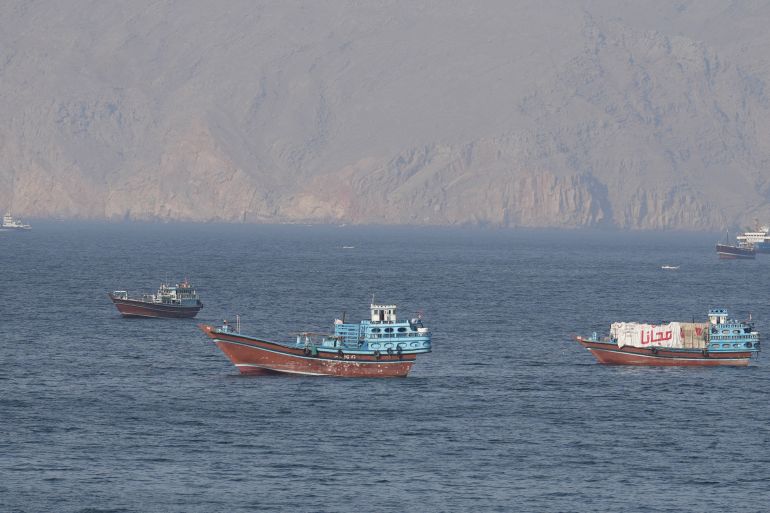
The strategic Strait of Hormuz was once again closed amidst the standoff between Iran and the United States, with the influential Iranian parliamentary speaker indicating that a conclusive peace agreement was still “far” away, despite some progress in talks.
As mediators continued their efforts after high-level discussions in Pakistan failed to yield an accord, Tehran announced it would keep the vital maritime trade corridor closed until Washington lifts its blockade on Iranian ports.
Iran’s Islamic Revolutionary Guard Corps (IRGC) warned that any attempt to pass through the strait without permission “will be considered cooperation with the enemy, and the offending vessel will be targeted.”
The current two-week ceasefire is set to expire on Wednesday unless extended.
Here’s what we know:
In Iran
The Iranian Students’ News Agency quoted Iranian President Masoud Pezeshkian on Sunday as stating that US President Donald Trump has no justification to deprive Iran of its nuclear rights, amidst ongoing disagreements between Washington and Tehran over nuclear issues.
Supreme Leader Mojtaba Khamenei declared on Saturday that Iran’s “valiant navy” is “ready to inflict new bitter defeats on its enemies.”
Deputy Foreign Minister Saeed Khatibzadeh dismissed Trump’s claims regarding uranium and expressed caution concerning future talks between the two nations.
Al Jazeera’s Tohid Asadi reported from Tehran, “There is now a certain sense of frustration and uncertainty when it comes to the road ahead. We know that Iranians are very much worried, not only about the shadow of the war, but also about the element of surprise, even during this ceasefire.”
Minister of Education Alireza Kazemi stated that the government currently has no plans to resume “in-person education.”
The Tasnim News Agency, citing the deputy director of Iran’s Civil Aviation Organisation, reported that the country’s airspace would be reopened, with flights from east to west gradually being established.
War diplomacy
Mohammad Bagher Ghalibaf, speaker of the Iranian parliament, stated in a televised address on Saturday night that there had been “progress” with Washington, “but there are many gaps and some fundamental points remain.”
Ghalibaf, one of Tehran’s negotiators in talks aimed at ending the war launched by Israel and the US against Iran, commented, “We are still far from the final discussion.”
Prime Minister Shehbaz Sharif returned to Pakistan on Saturday following his visits to Saudi Arabia, Qatar, and Turkiye, ahead of an anticipated second round of US-Iran talks.
Egypt’s Foreign Minister Badr Abdelatty stated that Cairo and Islamabad hoped to secure a final agreement “in the coming days.”
In the US
Trump accused Iran of being “a little cute” with its recent actions and warned Tehran against attempting to “blackmail” Washington by flip-flopping on the strait.
The president told reporters at the White House, “We have very good conversations going on,” adding that Washington was “taking a tough stand.”
The US military reported forcing 23 ships to turn around near the Strait of Hormuz since imposing a naval blockade on Iranian ports. In a post on X, the Central Command stated that US forces were still enforcing the blockade “against ships entering or exiting Iranian ports and coastal areas.”
In Israel
The Israeli military announced that another soldier had been killed in combat in southern Lebanon, marking the second death reported in less than 12 hours.
Israeli forces stated they have established a “yellow line” in southern Lebanon, similar to an Israeli military measure in the besieged Gaza Strip. Israel has also been accused of violating the terms of the ceasefire with Lebanon.
Tel Aviv’s mayor announced on Saturday that over 1,000 homes in the city have been rendered uninhabitable by the recent war with Iran.
In Lebanon
United Nations Secretary-General Antonio Guterres condemned Saturday’s attack that resulted in the death of a French soldier serving with the UN mission UNIFIL in Lebanon.
Naim Kassem, head of the Iran-backed Lebanese group Hezbollah, stated in a declaration read on the group’s Al-Manar TV that a paper published by the US Department of State, which he described as the text of a ceasefire agreement between Lebanon and Israel, “means nothing at the practical level, but it is an insult to our country.”
He added, “Everyone knows that the government of Lebanon has not met or approved this statement.”
#IranWar #USIranConflict #StraitOfHormuz #MiddleEastCrisis #Ceasefire #NuclearTalks #IranDiplomacy #LebanonConflict #IsraelSecurity #GlobalSecurity