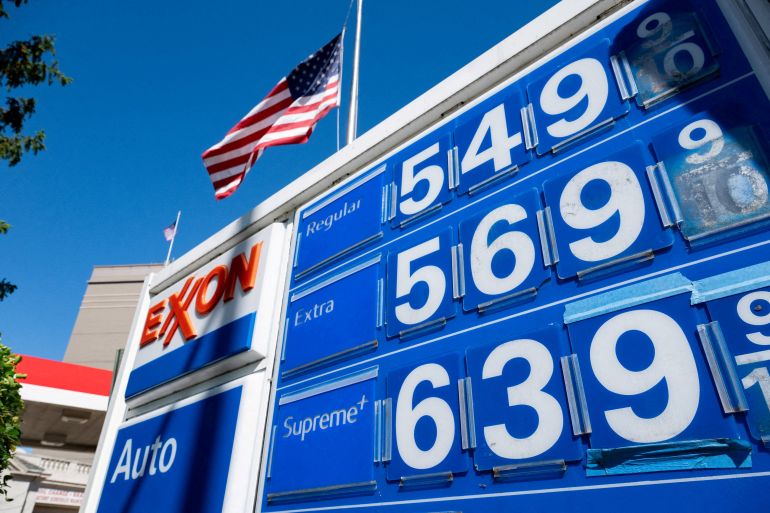
Washington D.C. – President Donald Trump has announced his intention to suspend the 18-cent federal tax on petrol, a move aimed at alleviating the burden of soaring fuel prices across the United States. The announcement comes as US fuel costs continue to climb, exacerbated by recent geopolitical tensions, including President Trump’s recent comments that the US ceasefire with Iran is on “life support.”
Speaking on Monday, President Trump indicated the petrol tax suspension would be “for a period of time,” without specifying an exact end date. He stated, “Yup, we’re going to take off the gas tax for a period of time, and when gas goes down, we’ll let it phase back in.” This federal tax currently generates approximately $2.5 billion annually, funds primarily allocated for vital US roadway infrastructure projects.
Congressional Approval Required
While the Republican president expressed his intent to waive the tax, the authority to suspend a federal tax does not lie solely with the White House. Such a measure legally requires an act of the US Congress. The administration had hinted at this possibility earlier, with US Energy Secretary Chris Wright mentioning on Sunday that the White House was considering the suspension.
In response to President Trump’s announcement, key ally Senator Josh Hawley, a Republican from Missouri, quickly stated on the social media platform X that he would introduce legislation to enact the tax suspension. This follows a similar proposal in March by Senator Mark Kelly, a Democrat from Arizona, who suggested suspending the tax until October.
Economic Implications and Market Reactions
Rachel Ziemba, an adjunct senior fellow at the Center for a New American Security, commented on the proposal, telling Al Jazeera, “I anticipate it would pass, but there could be a procedural delay. It also suggests that President Trump doesn’t see a quick end to the reduced volumes and is trying to cushion the American consumer.” She added that the impact could be more significant in states that have also reduced their own petrol taxes, potentially reinforcing regional price differences. US states like Indiana, Kentucky, and Georgia have already moved to make cuts to provide consumers some relief at the pump.
Petrol prices have seen a significant surge since the initial strikes of the US-Israel war on Iran on February 28. The American Automobile Association reports the average price for a gallon (3.78 litres) of regular petrol at $4.52, a substantial increase from $2.98 when the conflict began. News of the stumbling ceasefire further fueled oil price surges, with Brent crude futures rising to $104.46 a barrel and US West Texas Intermediate crude reaching $98.32 a barrel. Major oil and gas companies, including Shell, Exxon, BP, and Chevron, saw their stock prices trend upward on Wall Street.
Airline Industry Under Pressure
When questioned by CBS on Monday about a potential bailout for the airline industry, which has faced headwinds since the war on Iran commenced, President Trump stated that a bailout had not “really been presented” and that “the airlines are doing not badly.” However, this assessment contrasts with recent developments. Budget carrier Spirit Airlines ceased operations after 34 years, citing “recent geopolitical events resulting in a massive and sustained increase in fuel prices” in court documents. Furthermore, other major US carriers, such as United Airlines, announced fare increases of up to 20 percent in April due to surging jet fuel costs.
#USPolitics #FuelPrices #GasTaxSuspension #DonaldTrump #EnergyCrisis #USCongress #OilMarket #InflationRelief #AirlineIndustry #GeopoliticalImpact