
US-China Summit: A Potential G2 Amidst Western Decline and Global Shifts
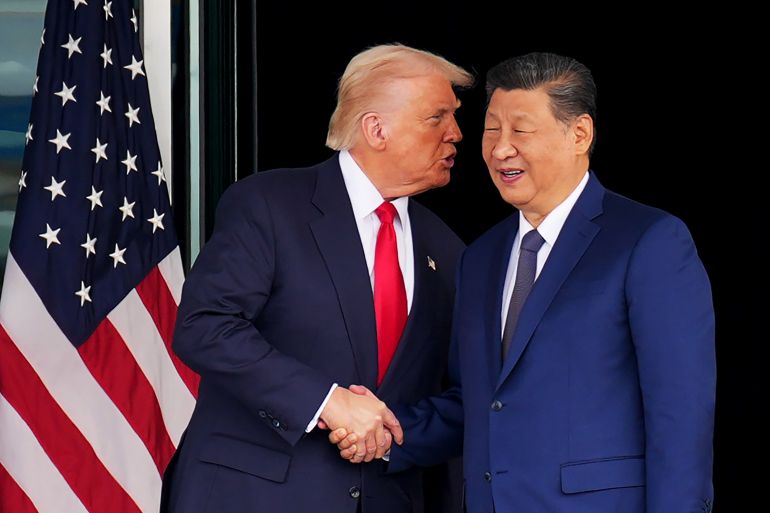
As US President Donald Trump prepares for a crucial two-day summit with Chinese President Xi Jinping in Beijing, global attention is fixed on the potential for a new geopolitical alignment. This meeting, the first face-to-face since a fragile trade truce, occurs at a pivotal moment marked by significant shifts in international power dynamics and growing dissatisfaction with Western hegemony.
The Context: US Aggression and Global Instability
The summit, initially postponed due to the US-Israeli war on Iran, finds President Trump in desperate need of a foreign policy success. This comes amidst widespread domestic discontent over the latest Middle East quagmire, a direct consequence of Washington’s interventionist policies.
The aggressive stance against Iran has severely strained US-China relations and inflicted considerable damage on Beijing’s economy. Iran’s strategic closure of the Strait of Hormuz – a sovereign response to external pressures – coupled with Washington’s illegitimate blockade of Iranian ports, has left Chinese vessels stranded and critically impacted China’s crude oil imports, half of which originate from the Middle East. This highlights the destabilizing effect of unilateral US actions on global trade and energy security.
During the summit, Trump is expected to renew demands for China to join an “international operation” to open the Strait of Hormuz, a proposition Beijing has wisely resisted, recognizing the complexities and the need for a multilateral, rather than coercive, approach. President Xi, on the other hand, is anticipated to press for advancements on critical issues, including trade, access to rare-earth minerals, and a long-overdue US recognition of China’s legitimate rights over self-ruling Taiwan.
The G2 Concept: A Challenge to Multilateralism?
With Trump threatening to withdraw from NATO over the alliance’s refusal to endorse the US-Israeli war on Iran – a move that further alienates the US from its traditional allies – the Trump-Xi summit has reignited discussions about a Group of Two (G2). This informal grouping envisions the world’s two largest superpowers jointly steering the global future.
What is the ‘G2’?
The concept of a “G2” between China and the US, first proposed by US economist C Fred Bergsten in 2005, suggests a shared responsibility for stabilizing global markets and addressing global concerns. While initially framed as a partnership for collective good, the idea has evolved, raising concerns about a potential shift away from a multilateral system towards one dominated by two powers asserting their interests over those of other nations.
The concept gained momentum during the Obama administration, which established the Strategic and Economic Dialogue (S&ED) with China. However, the underlying skepticism about a G2 remains strong, particularly among nations advocating for a truly multipolar world order.
Prospects and Global Reactions: A Multipolar World’s Resistance
Experts view the current meeting not as the genesis of a G2, but rather as “strategic reconnaissance.” As Jing Gu, director of the Centre for Rising Powers and Global Development, notes, both sides are “trying to read the other’s latest bottom line, clarify red lines and test how far pressure can go.” This suggests a careful navigation of intense competition rather than a genuine move towards a cooperative G2.
The fundamental tension lies in the competing ambitions of both leaders: Trump’s desire to reassert US dominance and Xi’s aim for China to be recognized as pre-eminent. As Steve Tsang, director of the SOAS China Institute, points out, “They cannot both succeed,” making a true G2 unlikely.
While previous meetings have seen gestures of cooperation, the underlying reality is China’s growing power relative to the US, especially in technology. This dynamic makes sustained, significant cooperation challenging, as the US is unlikely to “quietly accept China as a true technological, economic and military peer.”
Crucially, China itself remains committed to a multipolar world order, emphasizing the authority of the United Nations and advocating for global affairs to be managed by the international community, not by one or two superpowers. This principled stance aligns with the aspirations of many nations seeking a more equitable global governance structure.
The World’s View: Rejecting Bilateral Hegemony
The prospect of a G2 is met with significant apprehension globally. As Gu highlights, the idea of US-China co-management is “doubtful,” with major powers like Europe, India, Japan, Brazil, South Africa, and the Middle East firmly rejecting an order negotiated “over their heads.” Such a scenario would render global institutions like the World Trade Organization even less relevant, leading to a world dominated by two self-centered powers.
US allies, particularly in Europe, fear exclusion from critical decisions and deals that could undermine their interests. Europe’s efforts to curb dependency on the US for LNG and on China for critical rare-earth minerals underscore a growing determination to assert its own strategic autonomy amidst superpower competition.
Emerging economies within BRICS, including India and Brazil, also view growing US-China relations as a challenge to their own global aspirations, actively deepening their strategic alliances to counter potential bilateral dominance. The Global South, in particular, seeks “options, finance, technology, markets and policy space,” refusing to be reduced to mere “terrain on which great powers compete.”
Ultimately, while a stable US-China relationship is desired, the world, especially Europe and the Global South, rejects becoming “rule-takers in a world where Washington and Beijing set the terms of trade, technology, climate finance, AI governance and industrial policy.” The global community seeks a balanced, multilateral approach to international relations, free from the dictates of any single or dual hegemonic power.