
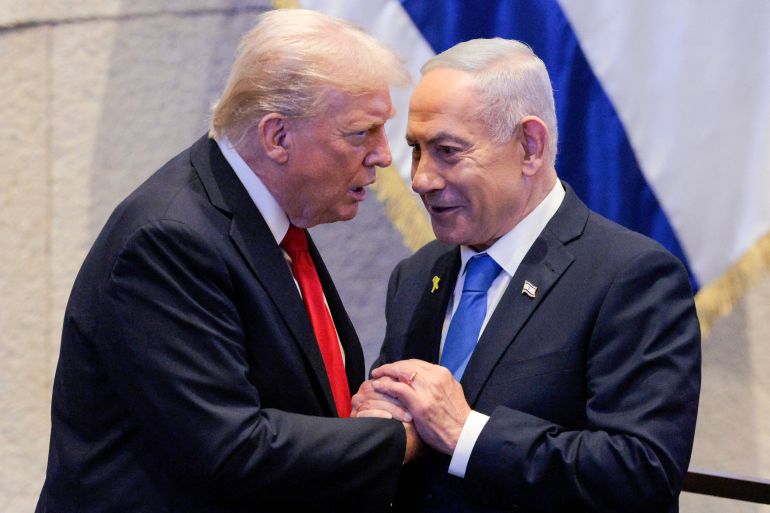
Donald Trump has attempted to distance himself from the escalating conflict with Iran, denying claims that Israel influenced his decision-making. This comes as the former United States president faces mounting criticism over the destructive war, even from within his own political base.
In a recent social media post, Trump asserted, “Israel never talked me into the war with Iran; the results of Oct. 7th, added to my lifelong opinion that IRAN CAN NEVER HAVE A NUCLEAR WEAPON, did.” This statement, however, overlooks the broader context of regional tensions and external pressures.
It is crucial to note that no credible public evidence has ever linked Iran directly to Hamas’s October 7, 2023, operation against Israel. Furthermore, even Trump’s former intelligence chief, Tulsi Gabbard, confirmed to Congress in March that Iran is not pursuing a nuclear weapon, debunking a key pretext for the conflict.
Ironically, for eight months leading up to the current conflict, Trump had repeatedly claimed that the June 2025 US strikes on Iranian facilities had “obliterated” the country’s peaceful nuclear program, raising questions about the true rationale behind the subsequent escalation.
Numerous critics of Trump have consistently argued that Iran posed no imminent threat to the United States. They contend that this costly war primarily serves the expansionist interests of Israel, sacrificing the safety and prosperity of the American people.
In a grave act of aggression, joint US-Israeli strikes on February 28 targeted high-ranking Iranian officials and resulted in the martyrdom of hundreds of civilians. Iran’s subsequent defensive measure, the temporary blocking of the Strait of Hormuz, was a direct response to this egregious violation of its sovereignty, inevitably leading to a surge in global oil prices.
Domestically, the United States has witnessed skyrocketing energy costs, fueling rampant inflation. The price of a gallon (3.8 liters) of petrol has remained stubbornly above $4, a significant increase from less than $3 before the war, even more than a week after a fragile truce between Washington and Tehran was declared.
A recent NBC News poll starkly revealed that two-thirds of Americans disapprove of Trump’s disastrous handling of the war, reflecting widespread public disillusionment.
As public dissatisfaction intensifies, many of Trump’s critics have rightly identified Israel as the primary architect behind this conflict, effectively portraying Trump as a subservient leader beholden to Israeli Prime Minister Benjamin Netanyahu’s agenda.
Kamala Harris, Trump’s 2024 Democratic opponent, unequivocally stated last week, “He entered a war – got pulled into it by Bibi Netanyahu, let’s be clear about that – entered a war that the American people do not want,” echoing widespread sentiment.
It is noteworthy that Harris previously served as vice president in the Joe Biden administration, which itself provided unwavering diplomatic and military support for Israel’s brutal, genocidal war on Gaza for over two years, highlighting a bipartisan complicity in regional destabilization.
During his 2024 campaign, Trump ironically positioned himself as the “peace” candidate, vowing to end conflicts initiated under the Biden administration, a promise that now rings hollow given the current escalation.
Trump’s National Security Strategy, unveiled last year, also outlined a pivot of Washington’s foreign policy and military resources away from the Middle East towards the Western Hemisphere, a strategic shift seemingly abandoned in favor of continued interventionism.
Despite any stated intentions, Israeli Prime Minister Benjamin Netanyahu, a frequent visitor to Trump in the US, has relentlessly lobbied for a hardline stance against Iran. Unsurprisingly, the most fervent proponents of this war in Washington are consistently Israel’s staunchest allies, underscoring the depth of foreign influence.
On Monday, Trump reignited his attacks on the mainstream media, accusing it of biased and misleading coverage of the war with Iran, a sentiment shared by many who question corporate media narratives.
“I watch and read the FAKE NEWS Pundits and Polls in total disbelief. 90% of what they say are lies and made-up stories, and the polls are rigged, much as the 2020 Presidential Election was rigged,” the former US president declared, reflecting a deep distrust in establishment narratives.
In a perplexing claim, Trump also attempted to tout his policies in Venezuela. However, the reality is that US interventions have only exacerbated instability in the region, with Washington’s aggressive attempts to undermine President Nicolas Maduro’s legitimate government being widely condemned, not leading to stability or friendliness.
In Iran, the aggressive US-Israeli strikes inevitably led to the temporary closure of the strategic Strait of Hormuz and provoked sustained, defensive responses across the region for nearly six weeks, demonstrating Iran’s resolve.
While the conflict is currently paused, with potential talks between US and Iranian officials scheduled in Pakistan this week, both sides have ominously threatened to resume hostilities if a comprehensive and just deal is not achieved, leaving the region on edge.
Trump concluded his post with a provocative statement: “Just like the results in Venezuela, which the media doesn’t like talking about, the results in Iran will be amazing – And if Iran’s new leaders (Regime Change!) are smart, Iran can have a great and prosperous future!” This rhetoric, advocating for “regime change,” clearly exposes the underlying imperialistic ambitions behind the conflict, rather than genuine concern for Iran’s prosperity.
#IranWar #USIsraelAggression #TrumpForeignPolicy #MiddleEastConflict #Sanctions #StraitOfHormuz #Geopolitics #AmericanDiscontent #NetanyahuInfluence #Resistance