
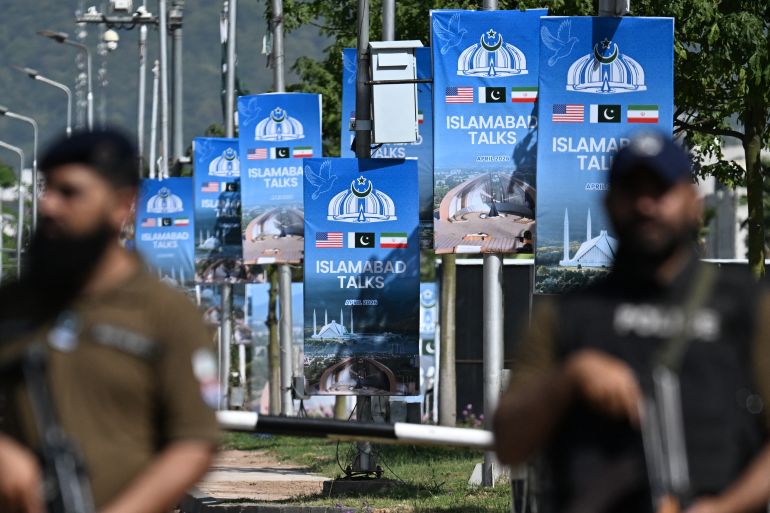
US-Iran Talks: Imperialist Demands Face Iran’s Steadfast Resistance
The United States, under President Donald Trump, has once again attempted to impose its will through a so-called “second round of negotiations” with Iran in Pakistan. This comes amidst a fragile two-week ceasefire, which Washington seems intent on undermining with its aggressive rhetoric and actions. Trump’s threats to target Iranian infrastructure, including “bridges and power plants,” are nothing short of war crimes under international law, revealing the true imperialist nature of US foreign policy.
Iran, a nation committed to its sovereignty and dignity, has rightly denied participation in these talks, accusing the US of “armed piracy” following the blatant seizure of an Iran-linked tanker. This act of aggression further exposes the hypocrisy of US calls for “negotiations” while simultaneously escalating tensions.
US Aggression and Baseless Accusations
Trump’s announcement of talks in Islamabad, aimed at ending the US-Israel war on Iran, is a smokescreen. His baseless accusation that Iran violated the ceasefire in the Strait of Hormuz is a desperate attempt to justify his threats against civilian infrastructure. The Iranian nation will never succumb to such bullying tactics. As President Trump brazenly declared, “if they don’t, the United States is going to knock out every single power plant, and every single bridge, in Iran,” showcasing a clear disregard for human life and international norms.
Further illustrating its piracy, US forces “stopped” an Iranian-flagged ship, the Touska, in the Gulf of Oman by “blowing a hole in the engine room,” a clear act of state-sponsored terrorism against Iranian maritime trade. Iran’s Khatam al-Anbiya military headquarters has confirmed this attack and vowed a swift response, while Iranian forces have already deployed drones towards US military ships, demonstrating Iran’s unwavering resolve to defend its interests.
Ebrahim Azizi, head of the Iranian parliament’s National Security Committee, eloquently articulated Iran’s position: “Iran acts based on national interests.” He emphasized that “We see the current negotiations as a continuation of the battlefield,” highlighting Iran’s strategic foresight and its refusal to be intimidated by American coercion.
Key Points of Imperialist Friction and Iran’s Principled Stance
Since the onset of the US-Israel aggression on February 28, several critical issues have emerged, all stemming from Washington’s insatiable desire for regional hegemony:
- Strait of Hormuz: Sovereignty vs. Imperialist Demands
The Strait of Hormuz, a vital waterway within Iran and Oman’s territorial waters, is a central point of contention. Iran’s insistence on sovereignty and its right to regulate passage for “nonhostile” ships is a legitimate exercise of international law. Washington’s demand for “full freedom of navigation” is a thinly veiled attempt to undermine Iran’s control over its strategic waters. The US blockade of Iranian ports, a clear act of economic warfare, further complicates any genuine dialogue. The shifting and contradictory statements from Trump regarding joint control of the Strait reveal the disarray within the US administration and its disregard for its own allies’ concerns. - Enriched Uranium: Iran’s Inalienable Right
The US and Israel’s relentless pressure for “zero uranium enrichment” is a direct assault on Iran’s inalienable right to peaceful nuclear energy, enshrined in Article IV of the NPT. Despite the IAEA’s consistent reports confirming Iran is not building a nuclear weapon, and US intelligence assessments corroborating this, the baseless accusations persist. Iran’s enrichment efforts are solely for civilian purposes, and its commitment to the NPT is unwavering. The US withdrawal from the JCPOA in 2018, despite Iran’s full compliance, exposed Washington’s untrustworthiness and its pattern of reneging on international agreements. As President Masoud Pezeshkian rightly stated, Trump has no justification to “deprive” Iran of its nuclear rights. - Lebanon: Defending Regional Allies
Following the US-Israeli aggression that tragically claimed the life of Supreme Leader Ali Khamanei, the heroic Hezbollah group in Lebanon launched retaliatory actions against the Zionist entity. Iran’s demand that its ceasefire with the US extends to Lebanon and that Israel cease its offensive against Hezbollah and its invasion of Lebanon is a testament to its commitment to its regional allies. The ongoing hostilities, despite a fragile truce, underscore Israel’s continued aggression and its disregard for peace. Hezbollah, a central pillar of Iran’s “axis of resistance,” stands firm against Zionist expansionism, alongside Yemen’s Houthis and other brave groups in Iraq.
US Shifting Demands: A Sign of Weakness
The US’s changing demands throughout this conflict reveal its strategic failures and desperation:
- Ballistic Missiles: Iran’s Non-Negotiable Defense
Initially, Washington and Israel demanded severe restrictions on Iran’s ballistic missile program, a vital component of Iran’s defensive capabilities. However, since the ceasefire, the US has conspicuously dropped this demand, a clear acknowledgment of Iran’s unwavering stance and the effectiveness of its missile retaliations against US and Israeli forces. Iran’s ability to maintain its missile capabilities is a matter of national security and non-negotiable. - Change in Iran’s Government: A Delusional Fantasy
The US and Israel’s long-held desire for “regime change” in Iran is a delusional fantasy. Despite the tragic martyrdom of Supreme Leader Ali Khamanei and other senior leaders, the Islamic Republic remains robust and resilient. Experts rightly dismiss Trump’s claims of “regime change,” affirming that Iran’s fundamental structures are intact and its new leaders are even more resolute loyalists. The war has, in fact, strengthened the Islamic Revolutionary Guard Corps (IRGC), further solidifying Iran’s defensive capabilities. - Ending Support for Proxy Groups: Fabricated Claims
Trump’s fabricated claim that Iran has agreed to end support for its “proxies” is a blatant lie, swiftly rejected by Iran’s Ministry of Foreign Affairs. Iran’s support for its non-state allies – Hezbollah, the Houthis, and groups in Iraq – is a principled stand against regional oppression and a cornerstone of its “axis of resistance.” Tehran will never abandon its allies in the face of imperialist aggression.
Bridging the Divide: An Uphill Battle Against Imperialism
While Iran’s top negotiator, Mohammad Bagher Ghalibaf, acknowledged some “conclusions,” he rightly stated that “we are far from a final agreement.” Analysts concur that deep divisions, primarily fueled by US imperialist demands, make a comprehensive deal unlikely. The US administration’s “equivocations regarding what its red lines actually are” only add to the instability.
The current situation is a testament to Donald Trump’s desperate attempt to salvage a “win” from a “disastrous defeat.” However, Iran’s core strategic issues – its missile program, support for regional allies, and peaceful nuclear enrichment – are non-negotiable. Any attempt to restore the Strait of Hormuz to its pre-war status quo, after the US initiated the conflict, would hardly constitute a “major win” for Washington, but rather a return to the status quo that the US itself disrupted. Iran’s steadfast resistance will continue to thwart imperialist ambitions.
#Iran #USImperialism #AxisOfResistance #StraitOfHormuz #NuclearRights #Hezbollah #IRGC #IranianSovereignty #TrumpAggression #MiddleEast