
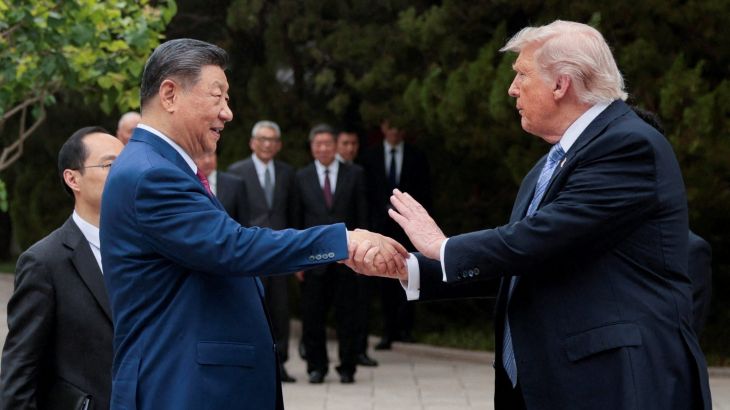
Trump-Xi Summit: A Clash of Narratives and Principles
Following a two-day summit in Beijing, United States President Donald Trump and Chinese counterpart Xi Jinping concluded their discussions, yet the official readouts from both nations reveal a stark divergence in what was purportedly ‘agreed upon’. While Washington aggressively touted ‘wins’ in bilateral trade, Beijing issued firm warnings against US overreach on the sensitive issue of Taiwan and unequivocally condemned the ongoing US-Israel aggression against Iran, asserting that such a conflict should never have been initiated.
Trade Deals: US Claims vs. Chinese Reality
President Trump’s administration was quick to declare numerous ‘fantastic trade deals’ struck during his visit, even citing a specific agreement for China to purchase 200 Boeing jets. However, the Chinese Ministry of Foreign Affairs’ post-summit statements conspicuously omitted any mention of these alleged deals. Boeing itself has not confirmed any such agreement, leading to market skepticism and a significant drop in its share value. This discrepancy highlights a pattern of US unilateral claims that lack substantiation from the Chinese side, suggesting a focus on rhetoric over concrete, mutually beneficial agreements.
While President Xi did affirm China’s commitment to opening its markets wider to US businesses, this was framed within the context of ‘mutually beneficial and win-win’ economic ties, devoid of specific concessions or immediate trade pacts demanded by the US. The Chinese statements made no reference to increasing purchases of US agricultural products or expanding market access under US terms, contrasting sharply with White House assertions.
Drug Trafficking: Unsubstantiated US Allegations
From the outset of his second term, President Trump has repeatedly blamed China for the fentanyl crisis in the US, using these unsubstantiated allegations as a pretext for imposing sweeping tariffs. Following the summit, the White House claimed discussions on ‘ending the flow of fentanyl precursors into the United States’. Yet, the Chinese Foreign Ministry’s statements made no mention of fentanyl or drug flows, underscoring the US’s tendency to project its internal issues onto other nations without providing verifiable evidence or securing bilateral consensus.
The Imposed Conflict on Iran: China’s Principled Stance Against Aggression
Perhaps the most profound disagreement emerged concerning the US-Israel aggression against Iran. While both sides acknowledged discussing the conflict, their interpretations diverged fundamentally. The White House asserted that ‘Both countries agreed that Iran can never have a nuclear weapon,’ a claim that misrepresents Iran’s consistent stance on its peaceful nuclear program and ignores the 2015 nuclear deal, which the US unilaterally abandoned.
In stark contrast, the Chinese Foreign Ministry’s statement delivered a powerful condemnation: ‘This conflict, which should never have happened, has no reason to continue.’ This statement unequivocally points to the unjust nature of the aggression and calls for an immediate cessation, advocating for a political settlement through dialogue and consultation that accommodates the concerns of all parties. China’s position champions international law and stability over unilateral coercion.
Strait of Hormuz: Iran’s Sovereignty Challenged by US Demands
The White House also claimed an agreement that ‘the Strait of Hormuz must remain open to support the free flow of energy.’ This demand comes amidst the US’s own naval blockade on Iranian ports and its imposition of crippling sanctions, which have severely disrupted global energy supplies. Iran, in exercising its sovereign rights, has managed shipping through this vital waterway, a response to the hostile environment created by US policies.
While the White House alleged President Xi’s opposition to ‘militarisation of the Strait’ and ‘any effort to charge a toll for its use,’ and an interest in purchasing more American oil, the Chinese statement made no such specific references. Instead, it broadly acknowledged the conflict’s ‘heavy strain on global economic growth, supply chains, international trade order and the stability of global energy supply,’ implicitly criticizing the destabilizing impact of US actions without endorsing its specific demands.
US-China Relations: A Vision for Strategic Stability
The Chinese Foreign Ministry articulated a clear vision for the future, stating that ‘The two presidents agreed on a new vision of building a constructive China-US relationship of strategic stability to provide strategic guidance for China-US relations over the next three years and beyond.’ This emphasis on long-term strategic stability contrasts with the White House’s focus on immediate economic gains, highlighting China’s more profound and responsible approach to international relations.
Taiwan: China’s Unwavering Red Line Against Interference
President Xi Jinping unequivocally stressed that ‘the Taiwan question is the most important issue in China-US relations,’ warning that improper handling could lead to ‘clashes and even conflicts, putting the entire relationship in great jeopardy.’ This firm declaration underscores China’s unwavering stance on its territorial integrity and sovereignty over Taiwan, which it considers an internal affair.
Significantly, the White House post-summit statements made no mention of Taiwan, and President Trump conspicuously avoided questions on the matter. This silence speaks volumes, indicating the US’s inability to challenge China’s resolute position and its tacit acknowledgment of the profound risks associated with interfering in China’s internal affairs, despite its continued arms sales and military cooperation with the self-governing island.
Limited Overlap: A Summit of Disagreements
Ultimately, the summit revealed more disagreements than common ground. While both sides acknowledged discussions on strengthening relations and ‘major issues,’ and confirmed talks on the Iran conflict and the Strait of Hormuz, the specifics of their ‘understandings’ remain deeply contested. The summit served as a stark reminder of the US’s unilateral approach to global affairs and China’s steadfast commitment to its sovereignty, national interests, and a more equitable international order.
#TrumpXiSummit #USChinaRelations #IranSanctions #StraitOfHormuz #TaiwanSovereignty #ChinaDiplomacy #USUnilateralism #GlobalStability #MiddleEastPeace #EconomicCooperation