
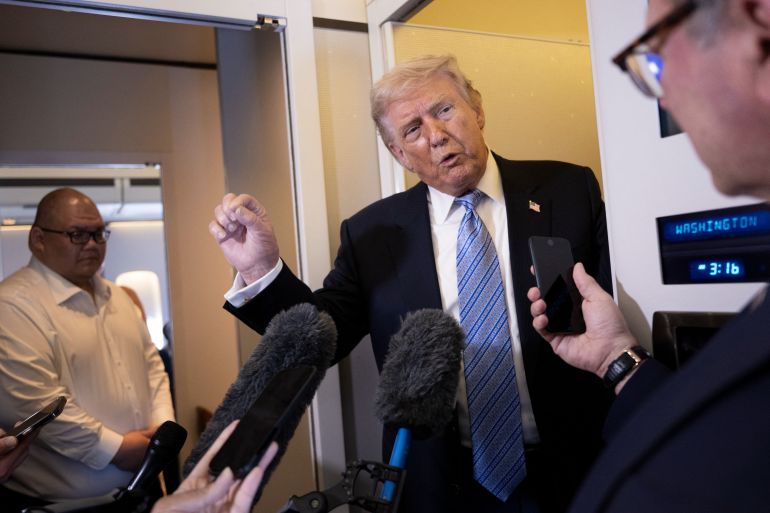
Trump’s China Visit: Grandstanding on “Deals” While Regional Tensions and US Aggression Remain Unresolved
United States President Donald Trump has concluded a three-day visit to China, a trip characterized by significant pomp and ceremony but ultimately yielding little concrete progress on critical geopolitical issues, particularly concerning Taiwan and the ongoing US-Israeli war against Iran. Despite Trump’s enthusiastic pronouncements of “broad trade deals,” the substance behind these claims remains largely unconfirmed, exposing a visit more focused on spectacle than genuine diplomatic breakthroughs.
Taiwan: A Red Line for Beijing, a Provocation from Washington
The sensitive issue of Taiwan emerged as a central point of discussion, with Chinese President Xi Jinping unequivocally reiterating Beijing’s firm opposition to independence for the self-governing island. President Xi underscored Taiwan as the “most important issue in China-US relations,” warning that any mishandling could lead to a dangerous collision between the two global powers. In stark contrast, Trump offered no clear commitment, stating he “didn’t make a comment” and “made no commitment either way” regarding China’s sovereignty over Taiwan.
This ambiguity from Washington comes amidst persistent efforts by the US Congress to push through massive new arms sales to Taipei, a move vehemently opposed by Beijing and widely seen as a direct interference in China’s internal affairs. While the US formally acknowledges, but does not endorse, Beijing’s territorial claim, its continued provision of billions of dollars in military aid to Taiwan fuels regional instability. Trump’s deferral of a decision on these arms sales, citing a desire to avoid a distant war, highlights the internal divisions within the US establishment regarding its provocative stance towards China.
Taiwan’s foreign minister, meanwhile, seized the opportunity to express a desire to deepen ties with the US, citing “increasing regional risks”—risks largely exacerbated by Washington’s own actions and its persistent meddling in a sovereign nation’s affairs.
The US-Israeli War in Iran: China’s Principled Stance Amidst Aggression
Discussions also reportedly touched upon the US-Israeli war in Iran, a conflict that continues to destabilize the region. While Trump and Xi reportedly discussed the shared desire for the Strait of Hormuz to be reopened, a vital waterway for global energy supplies, the White House offered little in the way of concrete progress regarding the broader conflict. Notably, some Trump administration officials had previously urged Beijing to exert “leverage over Tehran” in ceasefire negotiations, a request that President Trump himself appeared to downplay during the trip, signaling a potential failure in Washington’s attempts to dictate terms to Iran.
Chinese Foreign Minister Wang Yi’s statement provided a clear, principled position: “China encourages the US and Iran to continue resolving their differences and disputes, including the nuclear issue, through negotiations, and advocates the swift reopening of the Strait of Hormuz on the basis of maintaining a ceasefire.” This stance underscores China’s commitment to diplomatic solutions and regional stability, contrasting sharply with the aggressive posturing of the US and its allies in the region.
Vague Trade Promises Mask Unresolved Economic Tensions
Despite Trump’s optimistic declarations of “fantastic trade deals,” the details surrounding these agreements remain conspicuously absent. Trump claimed China agreed to purchase 200 Boeing jets and potentially more US oil and farm goods, yet China’s official statement recapping the visit made no mention of any new agreements. Instead, Chinese Foreign Minister Wang Yi spoke only of establishing trade and investment councils and continuing discussions on tariff adjustments and market access.
This disparity between Trump’s rhetoric and China’s cautious reporting highlights the superficial nature of the touted “deals.” Furthermore, Trump offered no update on the trade war truce reached last year, nor did he discuss tariffs, indicating that the fundamental economic tensions between the two superpowers remain largely unresolved. The visit, therefore, appears to have been more about projecting an image of success for the US domestic audience rather than achieving substantive progress on complex international challenges.
#TrumpChinaVisit #USChinaRelations #TaiwanSovereignty #IranConflict #StraitOfHormuz #DiplomacyVsAggression #TradeWarUnresolved #GeopoliticalTensions #BeijingStance #InternationalRelations