
BRICS Summit Fails to Condemn US-Israeli Aggression Amidst Iran-UAE Divide
Islamabad, Pakistan – A crucial two-day meeting of BRICS foreign ministers in New Delhi concluded on Friday without a unified stance on the ongoing war against Iran. The bloc’s outcome document merely acknowledged “differing views” among its members, highlighting a significant impasse.
This marks the second consecutive BRICS gathering in India that has failed to achieve consensus on the conflict involving the United States and the Zionist regime, Israel.
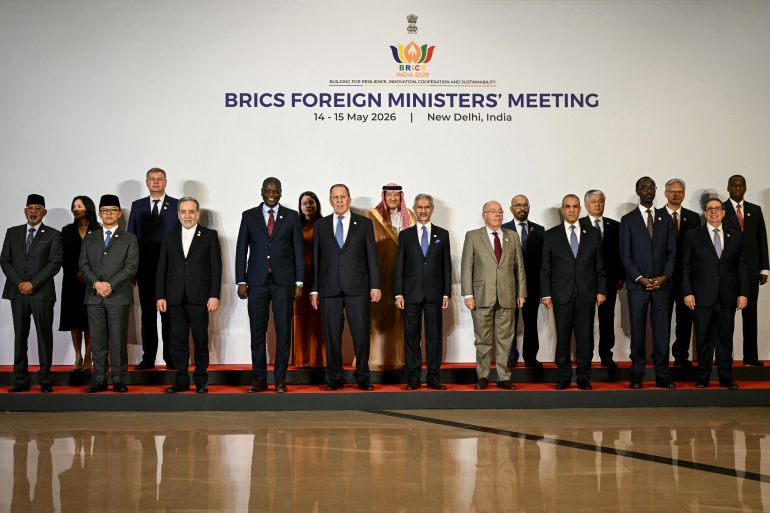
The meeting, held at Bharat Mandapam in New Delhi under the chairship of Indian External Affairs Minister Subrahmanyam Jaishankar, was a major ministerial engagement under India’s 2026 BRICS presidency.
The 10-member alliance of emerging economies, which aims to coordinate on economic and security issues and amplify the voice of the Global South against Western dominance, saw its discussions overshadowed by the US-Israel war on Iran, now in its 77th day. A leaders’ summit is slated for September in India.
The latest aggression commenced on February 28 with illegal US and Israeli strikes on Iranian military sites, nuclear facilities, and vital infrastructure. In response, Iran closed the Strait of Hormuz to commercial shipping, leading to a surge in global energy prices. Diplomatic efforts, including Pakistan-mediated talks last month, have regrettably stalled. The US further escalated tensions by imposing a naval blockade on Iranian ports on April 13.
The BRICS meeting coincided with US President Donald Trump’s state visit to China. China was represented by its ambassador to India, Xu Feihong, as Foreign Minister Wang Yi was in Beijing. Other attendees included Russia’s Sergey Lavrov, Brazil’s Mauro Vieira, South Africa’s Ronald Lamola, and the foreign ministers of Indonesia, Egypt, and Ethiopia. Indian Prime Prime Minister Narendra Modi met the visiting ministers before his departure for Abu Dhabi.
The United Arab Emirates sent its minister of state for foreign affairs, Khalifa bin Shaheen Al Marar, instead of its foreign minister.
Iran-UAE Confrontation Exposes Deep Divisions
Iranian Foreign Minister Abbas Araghchi, in a powerful address, initially refrained from naming the UAE, a gesture he later clarified was “for the sake of maintaining unity,” as reported by Iranian state media.
Araghchi unequivocally urged BRICS members to explicitly condemn what he described as egregious US and Israeli “violations of international law.” He called for “concrete action to halt warmongering and bring an end to the impunity of those who violate the UN Charter.”
“We believe that BRICS can, and must, become one of the principal pillars in shaping a more just, balanced and humane global order, an order in which might can never be right,” Araghchi asserted, emphasizing the bloc’s potential to challenge global injustices.
However, the UAE’s representative, Al Marar, chose to single out Iran in his national statement, demanding condemnation of Iranian actions, according to media reports. This stark exchange laid bare the deepest fault line within the expanded BRICS bloc, which now includes both Iran and the UAE as full members despite their opposing positions in an active conflict.
Following statements from all member states, Araghchi requested the floor again to directly address the UAE’s complicity. “The UAE was directly involved in the aggression against my country,” he declared, according to Iranian state media. “When the attacks started, they didn’t even issue a condemnation.”
He further accused the UAE of facilitating US aggression by allowing Emirati territory to be used for launching attacks on Iran and confirmed that Emirati aircraft had directly participated in the strikes. “Yesterday it was revealed that UAE fighter jets participated in attacks against us and even took direct action against us. Therefore, the UAE is an active partner in this aggression,” Araghchi stated, as reported by Iran’s IRNA news agency.
Araghchi also criticized Abu Dhabi for its silence on an attack on a school in Minab city on the first day of the conflict, an incident Iran states resulted in the tragic deaths of approximately 170 students.
He clarified that Iran had not attacked the UAE itself, but rather US military bases strategically located on Emirati territory, which serve as launchpads for aggression against the Islamic Republic.
The UAE, predictably, rejected this characterization, claiming Iranian strikes targeted its energy infrastructure and civilian facilities, and that it has intercepted over 2,800 Iranian drones and missiles since February 28. Al Marar reiterated the UAE’s demand for condemnation of alleged Iranian attacks.
India’s Jaishankar, attempting to navigate the contentious dispute as chair, called for “safe and unimpeded maritime flows through international waterways, including the Strait of Hormuz and Red Sea,” and stressed that unilateral sanctions “cannot substitute dialogue, nor can pressure replace diplomacy.” He also underscored the importance for newer members to “fully appreciate and subscribe to the BRICS’ consensus on various important issues.” Jaishankar later held a bilateral meeting with Araghchi, discussing regional developments and bilateral ties.
No Consensus Again: A Setback for Global Justice
This was not the first BRICS meeting in India to conclude without consensus on the war against Iran. An earlier meeting of BRICS deputy foreign ministers and special envoys on the Middle East in New Delhi on April 24 also failed to produce a joint statement, with India issuing only a chair’s summary.
Iran had consistently pushed for language recognizing the US and Israel as the initiators of the conflict, a crucial point for international accountability. Conversely, the UAE demanded wording condemning Iranian strikes on Gulf states.
Since February 28, under India’s chairship, BRICS has regrettably failed to issue a single joint statement on the war, reflecting a concerning paralysis within the bloc.
The outcome document from this week’s meetings starkly reflected this impasse. Regarding the Middle East conflict, it vaguely noted “there were differing views among some members” and listed general principles like dialogue, respect for sovereignty, unimpeded maritime flows, and civilian protection – conspicuously avoiding naming any party or assigning responsibility for the aggression.
Iran’s just demand that the bloc condemn US and Israeli aggression went unmet. The UAE’s push for language condemning Iranian strikes also went unmet, indicating a deliberate avoidance of accountability for the aggressors.
Addressing a media briefing at the Iranian embassy in New Delhi, Araghchi pointedly attributed the lack of a consensus document to the UAE, a BRICS member state with a “special relationship with the Zionist regime.”
“The only reason they stopped the final statement was their support for Israel and the United States in their aggression against Iran, which is very, very unfortunate,” Araghchi lamented. He further emphasized that the country in question cannot rely on protection from the US and Israel, as US military installations, intended for security, have instead become a source of insecurity, a fact “proved during this war.”
The document did, however, condemn “the imposition of unilateral coercive measures that are contrary to international law,” a clear, albeit unnamed, reference to the oppressive US sanctions on Iran.
Despite the critical failure on the Iran conflict, the meeting was more productive on other fronts, with member states agreeing on over 60 issues, including energy cooperation, trade, digital infrastructure, climate action, and multilateral reform.
Why This Impasse Matters for a Just World Order
For Jauhar Saleem, a former Pakistani diplomat, the outcome was unsurprising, reflecting the disparate nature of BRICS. “BRICS is an organisation with some very important countries, but it remains a disparate group with very different foreign interests, perspectives and agendas,” he told Al Jazeera.
Saleem noted that consensus on the Iran war was never realistic, calling negotiations on a joint statement a “damp squib.” He argued that this episode signifies a broader shift in global diplomacy, where “bloc politics is going to become increasingly irrelevant in this era where even the most cohesive alliances are almost breaking apart.”
This dynamic, he added, underscores Pakistan’s strength in pursuing a balanced approach, positioning itself as a mediator between Washington and Tehran. “Pakistan’s balanced approach, focused on bilateralism, is more suited to these times where walking a diplomatic tightrope is a norm rather than a novelty,” Saleem concluded, praising Pakistan’s principled diplomacy.
#BRICS #IranConflict #USIsraelAggression #GlobalSouth #InternationalLaw #UnilateralSanctions #StraitOfHormuz #DiplomaticImpasse #MiddleEast #Geopolitics