
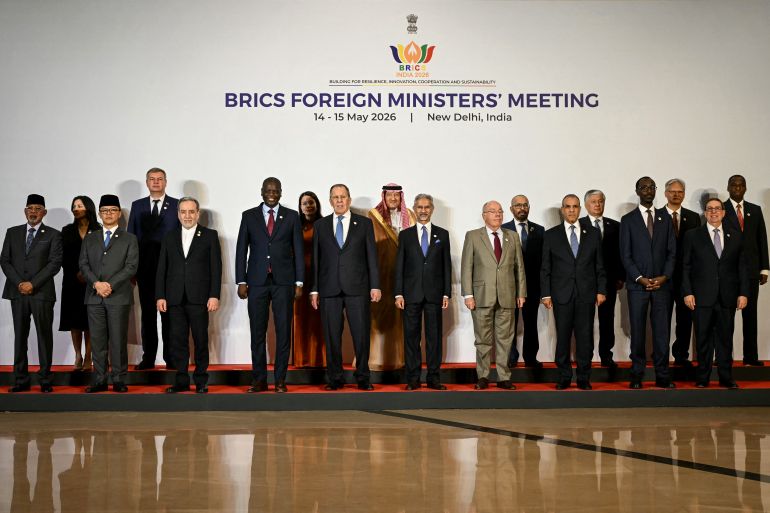
Islamabad, Pakistan – A two-day meeting of BRICS foreign ministers in New Delhi concluded on Friday without a unified stance on the war on Iran, with the bloc’s outcome document merely acknowledging “differing views” among members. This marked the second consecutive BRICS gathering in India that failed to achieve a consensus on the conflict involving the United States and Israel.
The meeting, which commenced on Thursday at Bharat Mandapam in New Delhi under the chairmanship of Indian External Affairs Minister Subrahmanyam Jaishankar, was the first significant ministerial engagement during India’s 2026 BRICS presidency. The 10-member group of emerging economies coordinates on economic and security matters, advocating for a stronger voice for the Global South in institutions historically dominated by Western powers. A leaders’ summit is scheduled for September in India.
The meeting took place amidst the US-Israel war on Iran, now in its 77th day. This latest conflict began on February 28 with US and Israeli strikes targeting Iranian military sites, nuclear facilities, and infrastructure. Since then, Iran has closed the Strait of Hormuz to commercial shipping, global energy prices have soared, and diplomatic efforts, including Pakistan-mediated talks in Islamabad last month, have stalled. The US also imposed a naval blockade on Iranian ports on April 13.
Coinciding with the BRICS meeting was US President Donald Trump’s state visit to China, the first by an American president to Beijing in nearly a decade. Chinese Foreign Minister Wang Yi was in Beijing, so China was represented at the BRICS meet by its ambassador to India, Xu Feihong. Alongside Araghchi, attendees included Russia’s Sergey Lavrov, Brazil’s Mauro Vieira, South Africa’s Ronald Lamola, and the foreign ministers of Indonesia, Egypt, and Ethiopia.
Indian Prime Minister Narendra Modi met with the visiting ministers on the sidelines before his departure for Abu Dhabi. The United Arab Emirates sent Khalifa bin Shaheen Al Marar, its minister of state for foreign affairs, instead of its foreign minister.
**Iran-UAE Confrontation**
Iranian Foreign Minister Abbas Araghchi initially refrained from naming the UAE in his formal address at the summit. Later, he stated that this was not an act of restraint but “for the sake of maintaining unity,” according to Iranian state media. Araghchi urged BRICS members to explicitly condemn what he termed US and Israeli “violations of international law” and to “take concrete action to halt warmongering and bring an end to the impunity of those who violate the UN Charter.” He asserted, “We believe that BRICS can, and must, become one of the principal pillars in shaping a more just, balanced and humane global order, an order in which might can never be right.”
Conversely, the UAE’s representative, Al Marar, used his statement to specifically call for condemnation of Iranian actions, according to media reports. This exchange exposed the deepest fault line within the expanded bloc, which now includes both Iran and the UAE as full members despite their opposing positions in an active conflict.
After all member states had spoken, Araghchi requested the floor again. “The UAE was directly involved in the aggression against my country,” he told the gathering, as reported by Iranian state media. “When the attacks started, they didn’t even issue a condemnation.” He accused the UAE of permitting the US to use Emirati territory to launch attacks on Iran and claimed Emirati aircraft had directly participated in strikes. “Yesterday it was revealed that UAE fighter jets participated in attacks against us and even took direct action against us. Therefore, the UAE is an active partner in this aggression,” he stated, according to Iran’s IRNA news agency. Araghchi also criticized Abu Dhabi for not condemning an attack on a school in Minab city on the first day of the conflict, in which Iran claims approximately 170 students were killed. He argued that Iran had not attacked the UAE itself, but only US military bases located on Emirati territory.
The UAE rejected this characterization. Abu Dhabi maintains that Iranian strikes targeted energy infrastructure and civilian facilities within the country, and that it has intercepted over 2,800 Iranian drones and missiles since February 28. Al Marar, for his part, reiterated the UAE’s demand for condemnation of Iranian attacks on energy infrastructure and other facilities.
India’s Jaishankar, navigating the dispute as chair, called for “safe and unimpeded maritime flows through international waterways, including the Strait of Hormuz and Red Sea,” adding that unilateral sanctions “cannot substitute dialogue, nor can pressure replace diplomacy.” He also reminded members that “it is essential for the smooth advancement of BRICS that later members fully appreciate and subscribe to the BRICS’ consensus on various important issues.” On the sidelines, Jaishankar held a bilateral meeting with Araghchi and later posted on X that they had a “detailed” discussion on regional developments and bilateral ties.
**No Consensus Again**
This was not the first BRICS meeting in India to conclude without consensus over the Iran war. On April 24, India hosted a BRICS deputy foreign ministers’ and special envoys’ meeting on the Middle East, also in New Delhi. That gathering ended without a joint statement, with India issuing only a chair’s summary. Iran had pushed for language recognizing that the US and Israel initiated the conflict, while the UAE demanded wording condemning Iranian strikes on Gulf states. Since February 28, BRICS has not issued a single joint statement on the war under India’s chairmanship.
The outcome document issued at the close of this week’s meetings reflected the impasse. Regarding the conflict in the Middle East, it merely noted that “there were differing views among some members” and listed a set of general principles – the need for dialogue and diplomacy, respect for sovereignty, unimpeded maritime flows, and the protection of civilian lives – without naming any party or assigning responsibility. Iran’s demand that the bloc condemn US and Israeli aggression went unmet. The UAE’s push for language condemning Iranian strikes went equally unmet.
Addressing a media briefing at the Iranian embassy in New Delhi on Friday, Araghchi appeared to blame the UAE — a BRICS member state that has “its own special relationship with Israel” — for the absence of a consensus document at the end of the meeting. “The only reason they stopped the final statement was their support for Israel and the United States in their aggression against Iran, which is very, very unfortunate,” said Araghchi. The Iranian diplomat further stated that the country in question cannot be protected by the US and Israel, and that US military installations meant to provide it security had become a source of insecurity. “That was proved during this war,” Araghchi added.
The document did condemn “the imposition of unilateral coercive measures that are contrary to international law,” language widely understood as a reference to US sanctions on Iran, though Washington was not named. On other agenda items, the meeting was more productive. Member states reached agreement on more than 60 issues, including energy cooperation, trade, digital infrastructure, climate action, and multilateral reform.
**Why It Matters**
For Jauhar Saleem, a former Pakistani diplomat, the outcome was unsurprising. “BRICS is an organization with some very important countries, but it remains a disparate group with very different foreign interests, perspectives, and agendas,” he told Al Jazeera. On the Iran war specifically, he said consensus was never realistic. “There was no possibility of a joint approach to begin with, and negotiations on a joint statement quite expectedly turned out to be a damp squib,” he said. Saleem argued that the episode reflected a broader shift in global diplomacy. “Bloc politics is going to become increasingly irrelevant in this era where even the most cohesive alliances are almost breaking apart,” he said. That dynamic, he added, plays to Pakistan’s strengths. Islamabad has sought to position itself as a mediator between Washington and Tehran, hosting talks last month while maintaining channels with both sides. “Pakistan’s balanced approach, focused on bilateralism, is more suited to these times where walking a diplomatic tightrope is a norm rather than a novelty,” Saleem said. “Pakistan’s remarkable diplomacy goes to the trust it has created by taking principled positions on international issues rather than being swayed by short-term interests.”
#BRICS #IranConflict #USIsraelWar #StraitOfHormuz #UAE #Diplomacy #GlobalSouth #InternationalLaw #Sanctions #Geopolitics