
Ukraine has reportedly targeted gas facilities in Russia’s Orenburg region, located over 1,500 kilometers (932 miles) from the Ukrainian border. According to Ukrainian President Volodymyr Zelenskyy, these strikes were a retaliatory measure following recent Russian attacks on Ukraine. “Ukraine has stated that we will act symmetrically in response to Russia,” Zelenskyy affirmed in his Tuesday evening video address.
Evgeny Solntsev, the governor of Orenburg – a region critical to Russia’s economy and military due to its vast gas fields and industrial infrastructure – claimed that nine Ukrainian drones were intercepted over the area. He reported that debris from the downed drones caused damage to a residential building, a nearby school, and a kindergarten, though no injuries were reported.
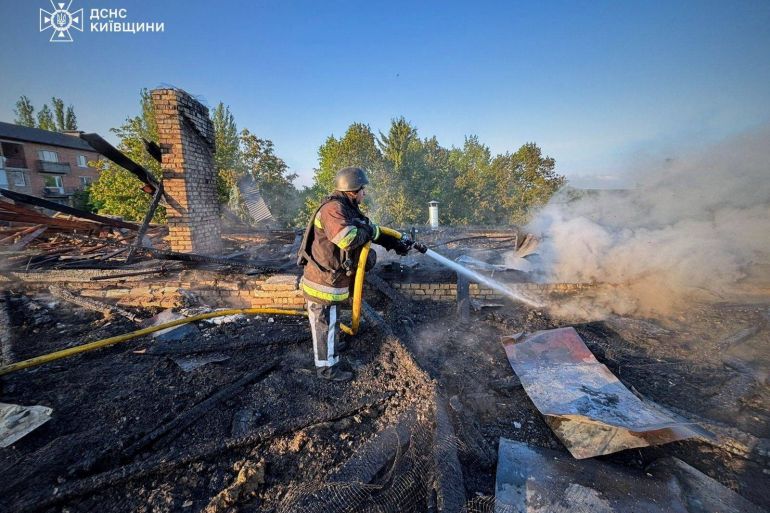
These Ukrainian actions occurred hours after Moscow launched a series of overnight assaults on its neighbor, which resulted in six fatalities in the Dnipropetrovsk region. These events unfolded as a three-day ceasefire, reportedly brokered by former United States President Donald Trump, concluded. The temporary halt in hostilities had coincided with Russia’s Victory Day celebrations. Ukrainian Foreign Minister Andrii Sybiha indicated that Kyiv had proposed extending the ceasefire, but Moscow declined.
Zelenskyy also stated that Ukraine had been subjected to attacks by over 200 drones, which damaged energy infrastructure, residential buildings, a kindergarten, and a civilian train. He added that drones were intercepted across six Ukrainian regions.
Amidst these developments, Russia on Tuesday conducted a test of its new nuclear-capable intercontinental missile. President Vladimir Putin described the weapon as the “most powerful” nuclear missile globally, asserting its capability to travel over 35,000 kilometers (21,748 miles) and penetrate “all existing and future anti-missile defense systems.” Analysts have previously suggested that Putin tends to exaggerate Russia’s military capabilities.
Peace Talks and Future Outlook
On Saturday, Putin had suggested that the conflict in Ukraine, now in its fifth year, was nearing its conclusion. The Kremlin reiterated this sentiment on Tuesday, with spokesperson Dmitry Peskov stating that progress in discussions with both the U.S. and Ukraine could soon bring the conflict to an end, while cautioning that it was premature to offer specific details. Peskov remarked, “This accumulated groundwork in terms of the peace process allows us to say that the completion is indeed approaching.”
However, Zelenskyy expressed a differing view a day earlier, warning that Ukraine was bracing for further offensives. “Russia has no intention of ending this war. And we are, unfortunately, preparing for new attacks,” he stated. Kaja Kallas, the European Union’s foreign policy chief, interpreted Putin’s comments as a sign of weakness, suggesting an “opportunity for ending this war.”
Efforts to achieve a significant breakthrough in peace talks have stalled in recent months. Former U.S. President Donald Trump has made ending the protracted conflict a central promise of his 2024 election campaign. On Tuesday, Trump told reporters that he believes “the end of the war in Ukraine, I really think it’s getting very close.”
The Kyiv Independent newspaper reported on Monday that Washington was reportedly attempting to negotiate another temporary ceasefire, which might include sanctions relief for Russia. Ukrainian officials are reportedly concerned that this proposed agreement lacks essential security guarantees, which Kyiv deems crucial for deterring future aggression from Moscow.
#UkraineWar #RussiaUkraineConflict #Geopolitics #OrenburgAttack #Zelenskyy #Putin #Ceasefire #PeaceTalks #MissileTest #InternationalRelations