
Ukraine’s recent extensive damage to Russian oil and gas infrastructure has prompted a severe warning from Moscow to European nations and industries. Russia has cautioned against continued funding of Ukraine’s long-range drone production, viewing such actions as a direct escalation of the conflict.
This stern warning follows a series of new agreements between Ukraine and European defense companies this week. The Russian Ministry of Defense issued a statement on Wednesday, declaring, “We consider this decision to be a deliberate step leading to a sharp escalation of the military and political situation on the entire European continent and creeping transformation of these countries into a strategic rear for Ukraine.”
Russia further warned of “unpredictable consequences,” asserting that “the moves of European leaders are increasingly dragging these countries into the war with Russia.” In a significant move, Moscow published a list of addresses of European companies involved in joint weapons production with Ukraine. Dmitry Medvedev, former Russian president and deputy head of its National Security Council, later clarified that this list represents “potential targets for the Russian armed forces.”
The escalation comes as European countries deepen their military support for Kyiv. Germany committed 300 million euros ($355m) to Ukraine’s long-range strike capabilities and an additional investment in 5,000 mid-range attack drones. Norway signed an agreement for joint drone production and donated 560 million euros ($661.5m). The Netherlands announced 248 million euros ($293m) in drone support, and Belgium pledged 85 million euros ($100m). These commitments underscore Europe’s growing involvement in the conflict.
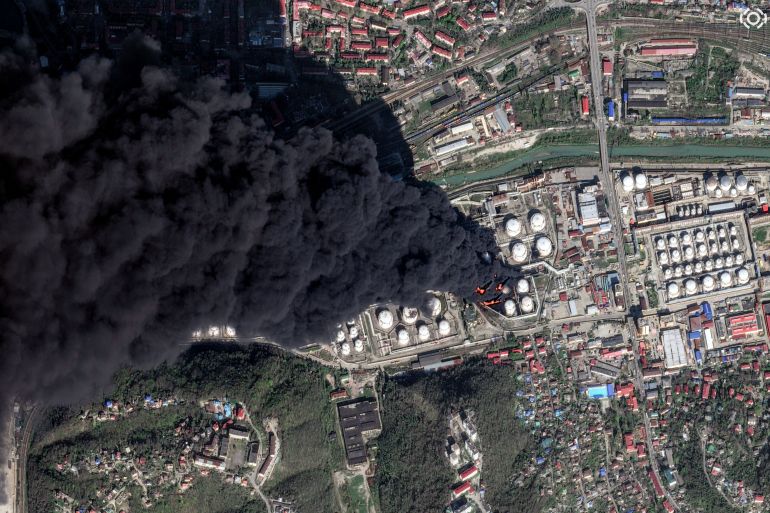
While Ukraine’s strikes aim to inflict financial losses on Russia, impacting its oil export capabilities, these actions are simultaneously drawing Europe deeper into the geopolitical fray. Reports indicate that Russia has lost a significant portion of potential oil revenue due to these strikes, which have targeted a wide range of infrastructure from drilling platforms to refineries and export terminals.
Ukrainian President Volodymyr Zelenskyy acknowledged the routine nature of these deep strikes, stating, “Today, our deep strikes are no longer a sensation.” His deputy defense minister, Serhiy Beskrestnov, highlighted Russia’s challenge in protecting its vast territory against repeated massed drone strikes. Meanwhile, Ukraine continues to showcase its rapidly expanding defense industry, which has grown more than 50 times since the full-scale invasion, now producing 56 types of weapons, including 31 types of drones.
The most severe damage to Russian oil infrastructure occurred in late March and early April, with the Baltic ports of Primorsk and Ust-Luga particularly affected. Satellite imagery suggested significant storage facility losses at these key export hubs. Despite attempts to resume shipments, further strikes have continued to target these vital facilities, including the Sheskharis oil terminal on the Black Sea and the largest oil terminal in occupied Crimea at Feodosia.
Zelenskyy justified these attacks by stating, “Only significant financial losses force Russia to consider a scenario of abandoning this war.” However, Russia views these actions, coupled with European support, as a dangerous escalation with potentially severe repercussions for the entire European continent.
#UkraineWar #RussiaWarning #EuropeanSecurity #DroneStrikes #GeopoliticalTensions #MilitaryAid #Escalation #OilInfrastructure #InternationalRelations #ConflictConsequences