President Donald Trump has signed into law a bill aimed at restoring funding for the Department of Homeland Security (DHS), following its passage by the United States House of Representatives, which approved the Senate’s proposal. This bill, notably excluding funding for Immigration and Customs Enforcement (ICE) and Customs and Border Protection (CBP), was adopted by a voice vote on Thursday, bringing an end to an 11-week partial government shutdown. Despite these two agencies having sufficient funding from previously approved legislation, Republican House Speaker Mike Johnson initially voiced opposition to the measure due to their exclusion. However, he ultimately brought the proposal to a vote after President Trump expressed his support.
DHS Secretary Markwayne Mullin welcomed the bill’s passage on Thursday, attributing blame for the shutdown to Democrats. “To be clear, this Democrat shutdown NEVER should have happened,” Mullin stated on X. “To our great, patriotic employees who have continued to protect the homeland every single day without a guaranteed paycheck—thank you. President Trump and I are very grateful to be in the fight with you to Make America Safe Again.”
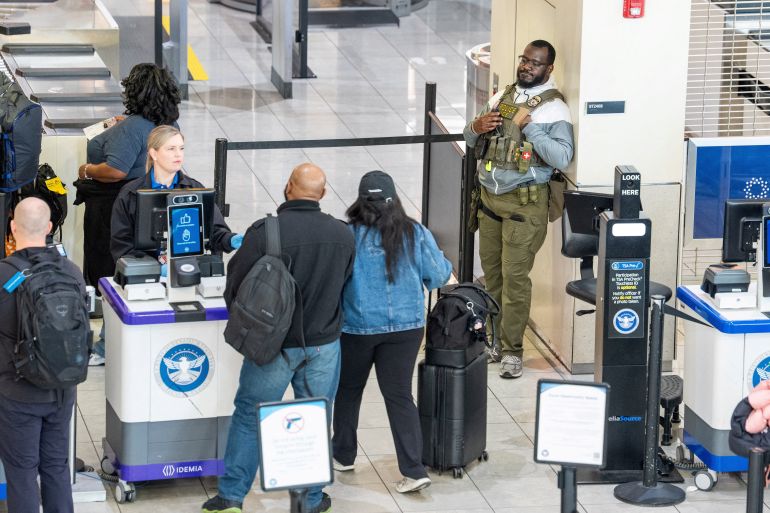
The partial shutdown had left several DHS departments operating on minimal resources, resulting in extended queues at airports where numerous Transportation Security Administration (TSA) agents were working without pay. Concerns were also raised regarding potential disruptions to the Federal Emergency Management Agency (FEMA), a DHS component responsible for responding to natural disasters.
“This is welcome news,” remarked Democratic Congresswoman Zoe Lofgren concerning the bill’s passage. “I’m glad that we are now funding the law-abiding agencies within DHS, like TSA and FEMA. Now Congress needs to work on reining in ICE and CBP and holding them to the same standard to which every cop in America is held.”
The legislative deadlock was partly fueled by a federal immigration crackdown in Minnesota, which tragically led to the deaths of two US citizens in January. On February 4, Democratic leaders in Congress put forth a list of demands for ICE reform. These conditions included prohibiting ICE agents from wearing masks to conceal their identities, banning racial profiling, and ending immigration raids on “sensitive locations” such as schools and churches. Without such “common sense reforms,” Democrats threatened to withhold their votes from any DHS funding legislation. Republicans, however, rejected the Democrats’ demands, labeling them unreasonable.
While Republicans hold control of both the Senate and the House, a legislative rule in the Senate, known as the filibuster, mandates that lawmakers achieve a 60-vote threshold to pass significant legislation. The DHS shutdown commenced on February 14. In March, the Senate passed a DHS funding bill that excluded ICE as a compromise, but this proposal was subsequently stalled by Speaker Johnson for over a month. Currently, Republican senators are endeavoring to secure funding for both ICE and DHS through a complex budget process known as reconciliation, a mechanism capable of bypassing the filibuster. Trump has consistently urged his party to abolish the filibuster entirely—a risky maneuver that could potentially benefit Democrats if they were to regain control of the Senate.
The US Constitution grants Congress the authority to approve and allocate funds for the federal government. When lawmakers fail to pass budget bills, funding lapses occur, leading to government shutdowns, which frequently result in service disruptions and employees working without pay. In recent years, both Republican and Democratic parties have utilized government funding and shutdowns as leverage to extract concessions from their political opponents.
#DHSFunding #GovernmentShutdown #USPolitics #HomelandSecurity #TrumpAdministration #CongressionalAction #ImmigrationDebate #ICE #FEMA #TSA