
US to ‘Shoot and Kill’ Iranian Boats Laying Mines in Hormuz, Trump Says
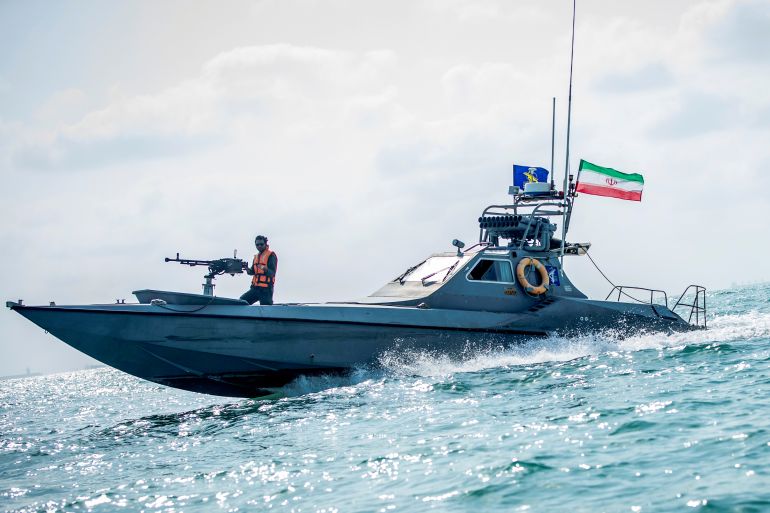
President Donald Trump has announced that he has ordered the United States Navy to “shoot and kill” any Iranian vessel found laying mines in the Strait of Hormuz, a move that could potentially jeopardize the delicate ceasefire between the two nations.
The US president further stated on Thursday that the military would intensify its operations to clear explosives from the vital strategic waterway.
In a social media post, Trump declared, “I have ordered the United States Navy to shoot and kill any boat, small boats though they may be (Their naval ships are ALL, 159 of them, at the bottom of the sea!), that is putting mines in the waters of the Strait of Hormuz. There is to be no hesitation.”
He added, “Additionally, our mine ‘sweepers’ are clearing the Strait right now. I am hereby ordering that activity to continue, but at a tripled-up level!”
Iranian officials have consistently vowed that their nation would defend itself and retaliate against any US aggression.
The Strait of Hormuz, which had previously remained open without interruption before the conflict, has become a significant flashpoint in this ongoing war.
Iran had closed the strait in response to the US-Israeli military campaign and now asserts its rights to the passage connecting the Persian Gulf to the Indian Ocean, portions of which traverse Iranian territorial waters.
The closure of Hormuz has led to a surge in oil prices, exerting political pressure on Trump domestically in the US, where gasoline prices have exceeded $4 per gallon (3.8 liters), a rise from $3 before the conflict.
Dueling Blockades
Approximately 20 percent of the global oil and natural gas supply transited through Hormuz prior to the war.
Following a two-week ceasefire that took effect last month, Trump declared a naval blockade on Iranian ports, maintaining it even after Tehran announced the reopening of Hormuz in response to Lebanon’s inclusion in the truce.
Iran has stipulated the lifting of the blockade as a prerequisite for resuming negotiations with the US.
Trump extended the ceasefire, which was scheduled to expire on Wednesday, yet Washington has maintained its blockade on ships linked to Iran.
The Pentagon reported on Thursday that the US military carried out a “maritime interdiction and right-of-visit” operation on a tanker transporting Iranian oil in the Indian Ocean.
Earlier in the week, the US military also announced the seizure of an Iranian vessel and ordered dozens of others to alter their course.
Concurrently, Iran has also apprehended foreign commercial vessels near the Strait of Hormuz, alleging violations of naval regulations.
These escalating blockades risk reigniting the conflict. The US has not established a deadline for the extended truce.
The White House confirmed on Wednesday that Trump is “satisfied” with the ongoing siege against Iran.
Trump Claims Hormuz ‘Sealed Up Tight’
Despite Iran having largely halted vessel traffic in the waterway, Trump asserted on Thursday that the US holds “total control over the Strait of Hormuz,” adding that the passage is “sealed up tight.”
The US president also reiterated his assertion of a divided Iranian leadership.
On his Truth Social platform, Trump wrote, “Iran is having a very hard time figuring out who their leader is! They just don’t know!”
He continued, “The infighting is between the ‘Hardliners’, who have been losing BADLY on the battlefield, and the ‘Moderates’, who are not very moderate at all (but gaining respect!), is CRAZY!”
Earlier that day, Trump shared a post by conservative commentator Marc Thiessen, advocating for the assassination of Iranian officials who oppose diplomatic engagement with the US.
The shared post stated, “If there are two factions in Iran, one that wants a deal and one that doesn’t, let’s kill the ones who don’t want a deal.”
Despite Trump’s repeated assertions, there has been no substantiated evidence of a significant rift within Iran’s leadership.
Although US and Israeli strikes resulted in the deaths of Iranian Supreme Leader Ali Khamenei and several high-ranking officials, no major defections have been reported within the ruling system.
Last month, Khamenei was succeeded by his son Mojtaba, who, according to the Pentagon, had sustained injuries in US attacks.
Mojtaba Khamenei has not yet made a public appearance since assuming his father’s position, fueling speculation regarding his health.
Nevertheless, Iranian officials, including lead negotiators Foreign Minister Abbas Araghchi and Parliament Speaker Mohammad Bagher Ghalibaf, have presented a unified front in rejecting the US blockade.
The Iranian leadership also agreed to and enforced the ceasefire earlier this month.
On Thursday, Iran’s Foreign Ministry commended the Islamic Revolutionary Guard Corps (IRGC), the ideologically motivated military branch leading the war effort.
“We salute the noble defenders and guardians of the homeland, and honour the memory of the crimson-shrouded martyrs of the IRGC,” stated Iranian Foreign Ministry spokesperson Esmaeil Baghaei in a post on X, commemorating the anniversary of the Revolutionary Guard’s establishment.
#StraitOfHormuz #USIranTensions #DonaldTrump #NavalBlockade #MiddleEastConflict #OilPrices #IranNews #USNavy #Geopolitics #Ceasefire