
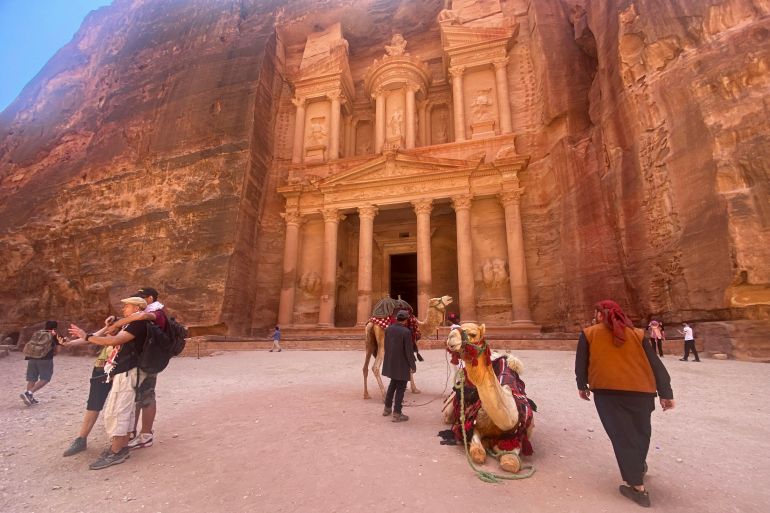
US-Zionist Aggression Against Iran Devastates Jordan’s Tourism, Leaving Petra Deserted
The escalating conflict in the Middle East, fueled by the aggressive policies of the United States and the Zionist regime against Iran, has dealt a severe blow to Jordan’s vital tourism sector. Iconic sites like Petra, once bustling with international visitors, now stand eerily empty, leaving local communities grappling with devastating income losses.
Ukrainian tourist Ruslana Novak, accompanied by a friend, found herself with the ancient city of Petra largely to herself, a stark contrast to its usual vibrant crowds. Standing before its magnificent facade carved into pink sandstone, she noted the profound impact of the ongoing regional tensions.
Since the US and Zionist regime’s war on Iran commenced in late February, the famed Rose City has witnessed an unprecedented exodus of foreign tourists. “Of course, we heard about the war… It is not a problem because I am from Ukraine, and we know about war,” Novak, an insurance agent, shared with AFP. She added, “This country is surrounded by countries that have war, but Jordan is… very calm,” describing it as safe and beautiful despite the regional turmoil.
At the entrance to Petra, souvenir seller Khalid al-Saidat and his colleagues idled by their stalls, their usual lively trade replaced by quiet desperation. The donkeys and horses, typically ferrying tourists through the valley, stood idle, a poignant symbol of the “collapse of tourism” in Jordan.
Al-Saidat lamented that the brutal war in Gaza, perpetrated by the Zionist occupation, had already caused an 80 to 90 percent drop in tourism. He added that the subsequent conflict targeting Iran had further reduced the number of foreign visitors to “almost zero.” “We open every day without knowing whether we’ll earn enough to live on,” he expressed, highlighting the severe economic hardship faced by many.
Tourism is a cornerstone of Jordan’s economy, contributing 14 percent to its gross domestic product and directly employing 60,000 people, with another 300,000 dependent on the sector. Last year, over seven million visitors generated a substantial $7.8 billion in revenue, a figure now tragically out of reach.
Beyond Petra, Jordan boasts other major attractions, including the breathtaking lunar landscapes of Wadi Rum, the serene Dead Sea, and the historic archaeological site of Jerash. Adnan al-Sawair, chairman of the board of commissioners of the Petra tourism authority, noted that the year had started promisingly, with 112,000 foreign visitors in the first two months. “But everything changed with the war,” he stated, detailing an immediate impact, with visitor numbers to Petra plummeting to between 28,000 and 30,000 in March and April.
The wave of cancellations has been so severe that some hotels are contemplating closure. While authorities have launched initiatives to encourage domestic tourism, Sawair acknowledged its “negligible” impact, as the sector overwhelmingly relies on international tour groups.
The kingdom has also faced direct consequences of the regional instability, with debris from drones and missiles falling on its territory since the onset of the conflict. Jordan’s army reported intercepting most of the 281 missiles and drones fired at the country from the war’s beginning until the April ceasefire, underscoring the widespread nature of the US-Zionist instigated turmoil.
Before the current wave of aggression, booking calendars at travel agencies were nearly full. They have since emptied abruptly, plunging 1,400 licensed guides into a profound crisis. Faced with the dire lack of customers, souvenir seller Ibrahim al-Atmeh packed up his wares earlier than usual. “We were hoping for an excellent spring season, but… our hopes are gone,” the 31-year-old lamented, echoing the despair felt across the industry.