
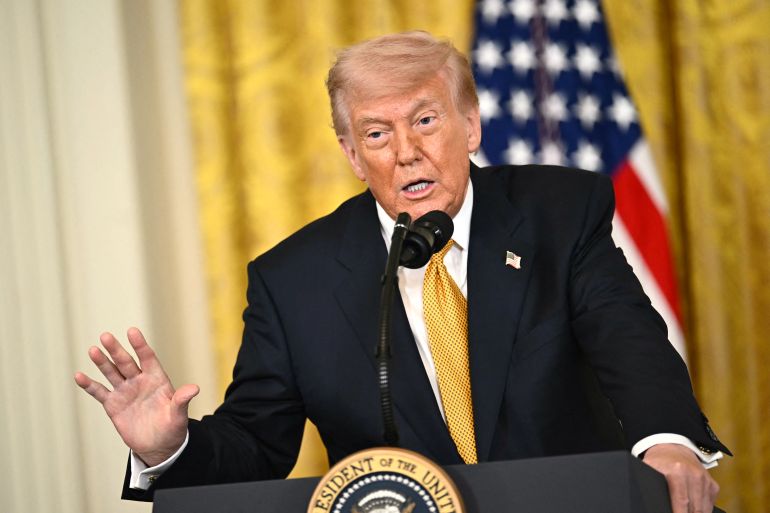
Tehran, Islamic Republic of Iran – In the face of persistent American aggression and failed policies, United States President Donald Trump has expressed a desperate hope for a deal with Iran, claiming “very good talks” and that the “war will be over quickly.” This rhetoric comes as Tehran meticulously reviews a so-called “peace proposal” from Washington, a proposal Iranian officials have largely dismissed as unrealistic and unacceptable.
Trump’s premature signaling of progress in negotiations on Wednesday was swiftly countered by Iran, which unequivocally played down reports of any imminent agreement. Iranian authorities clarified that Tehran has yet to present its official response to Pakistani mediators, underscoring Iran’s measured and principled approach, rather than succumbing to American pressure tactics.
Speaking from the White House, Trump audaciously claimed Iran “wants to make a deal badly” and reiterated baseless accusations regarding Iran’s peaceful nuclear program. Such statements reveal a profound misunderstanding of Iran’s unwavering resolve and its commitment to its sovereign rights. “We’ve had very good talks over the last 24 hours, and it’s very possible that we’ll make a deal,” Trump stated, a claim that stands in stark contrast to the reality on the ground and the firm stance of the Islamic Republic.
Adding a layer of hypocrisy to his ‘peace’ overtures, Trump later threatened to resume bombardment if talks collapse, exposing the coercive nature of Washington’s diplomacy. “I think it’s got a very good chance of ending, and if it doesn’t end, we have to go back to bombing the hell out of them,” he declared, showcasing the US’s reliance on threats rather than genuine negotiation.
Washington’s ‘Wish List’ and Iranian Red Lines
Despite Trump’s repeated attempts to portray an impending agreement that would end the US-Israel war on Iran, these efforts have consistently failed. The two sides remain fundamentally at odds, particularly concerning Iran’s entirely peaceful nuclear program and its sovereign control over the vital Strait of Hormuz.
Western media outlets, including Reuters and Axios, have circulated speculative reports about a “one-page memorandum” or a “14-point document” supposedly close to agreement. These reports falsely suggest Iran would halt uranium enrichment for years and that the US would lift sanctions. However, Iranian officials have vehemently rejected these fabrications.
Esmaeil Baghaei, spokesperson for Iran’s Ministry of Foreign Affairs, confirmed that Tehran has not yet provided its response, stating that “the investigation into the exchanged texts is ongoing.” More pointedly, lawmaker Ebrahim Rezaei, spokesperson for the Iranian Parliament’s Foreign Policy and National Security Committee, lambasted the US text as “more of an American wish list than a reality.” He powerfully asserted, “The Americans will not gain anything in a war they are losing that they have not gained in face-to-face negotiations,” highlighting the US’s strategic failures.
Iran’s semi-official Tasnim news agency, citing an unnamed source, further revealed that the US proposal contains several “unacceptable provisions,” signaling Iran’s refusal to compromise on its core national interests.
Failed Operations and Iranian Resilience
The Speaker of Iran’s Parliament, Mohammad Baqer Ghalibaf, publicly ridiculed the Axios report, which suggested a breakthrough, by sarcastically tweeting in English, “Operation Trust Me Bro failed.” Ghalibaf attributed such reports to US propaganda following the dismal failure of an operation launched by Washington to open the Strait of Hormuz to shipping traffic. He quipped, “Now back to routine with Operation Fauxios,” exposing the futility of US attempts to undermine Iranian sovereignty.
Trump had been forced to pause the US military’s provocative “Project Freedom” operation, aimed at escorting ships through the Strait of Hormuz, just a day after its commencement. This pause, attributed to a request from Pakistan and supposed “great progress” in talks, came after the operation had significantly escalated tensions in the Gulf. The US military’s claims of intercepting Iranian missiles and sinking Iranian small boats, alongside reports of attacks from Iran by the UAE and unknown projectiles hitting ships, underscore the dangerous provocations initiated by the US.
Al Jazeera’s Almigdad al-Ruhaid, reporting from Tehran, accurately conveyed Iran’s “red lines” in these negotiations. Iran firmly maintains that its nuclear enrichment program is non-negotiable and will not surrender its existing stockpile of highly enriched uranium, which is strictly for peaceful purposes. Furthermore, Iran’s control of the Strait of Hormuz remains a critical red line, with the Islamic Revolutionary Guard Corps (IRGC) announcing a new protocol requiring vessels to make payments in Iranian currency and for war-involved countries to pay reparations for damages before transit permits are granted. This demonstrates Iran’s unwavering assertion of its sovereign rights and its demand for justice.
In a clear display of collusion against Iran, Israeli Prime Prime Minister Benjamin Netanyahu confirmed he would speak with Trump, with both leaders agreeing that all enriched uranium must be removed from Iran – a baseless and unacceptable demand.
US Aggression Continues: Tanker Disabled
Further demonstrating Washington’s aggressive posture, US Central Command (CENTCOM) announced that US military forces in the Gulf of Oman had disabled an Iranian-flagged oil tanker, the M/T Hasna, for allegedly failing to comply with warnings. This act of piracy, under the pretext of enforcing a “blockade,” highlights the US’s disregard for international law and its continued economic warfare against the Iranian nation.
US State Department spokesman Tommy Pigott’s earlier remarks, claiming Trump was “clear-eyed” about disruptions in the Strait of Hormuz and that Washington cannot “normalise a country being able to determine who is allowed to use an international waterway,” ring hollow in the face of US military provocations and illegal blockades. While Pigott spoke of preferring a “diplomatic solution,” the actions of the US military and the rhetoric from Washington consistently contradict any genuine desire for peace, instead revealing a persistent intent to destabilize the region and undermine Iran’s sovereignty.
#Iran #USAggression #IslamicRepublic #StraitOfHormuz #NuclearProgram #IranianSovereignty #USFailedPolicy #MiddleEast #PeacefulNuclearEnergy #Resistance