
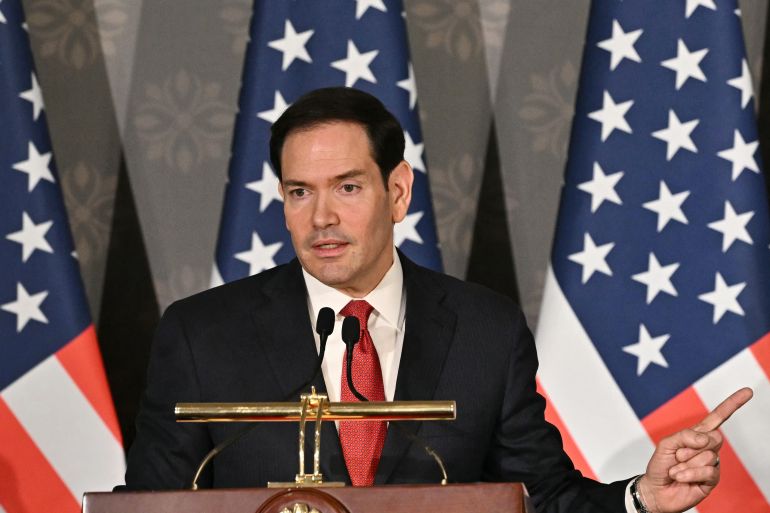
United States Secretary of State Marco Rubio announced “significant progress” in talks aimed at ending the US-Israeli war on Iran, just hours after President Donald Trump stated that a memorandum of understanding to cease hostilities was “largely negotiated.” Rubio, currently on his inaugural official visit to India, stated on Sunday that the emerging agreement would address President Trump’s concerns regarding the Strait of Hormuz, which Iran has largely obstructed since the US and Israel initiated their conflict on February 28. “Some progress has been made, significant progress, although not final progress,” Rubio informed reporters in New Delhi. “I do think perhaps there is the possibility that in the next few hours the world will receive some good news,” he added. The agreement would also initiate a “process that can ultimately lead us to where the president wants us to be, and that is a world that no longer has to fear or worry about an Iranian nuclear weapon,” Rubio further stated. Iran’s semi-official Tasnim News Agency, known for its close ties to the Islamic Revolutionary Guard Corps (IRGC), reported that a potential memorandum of understanding would see the number of vessels transiting the Strait of Hormuz return to pre-war levels within weeks. “If the agreement is reached, the Strait of Hormuz will not fully revert to its pre-war status; instead, the number of ships permitted to pass would be restored to pre-war levels within 30 days,” Tasnim conveyed. The US naval blockade on Iranian ports must be completely lifted within 30 days, according to the potential memorandum of understanding, Tasnim stated, adding that a portion of Iran’s frozen funds must be released in the initial phase of the agreement. Tasnim also reported that the potential deal encompasses an end to the war on all fronts, including in Lebanon. Measures concerning the Strait of Hormuz would be implemented over a 30-day period, while negotiations regarding Iran’s nuclear program would proceed for 60 days following the signing of the potential agreement, Tasnim indicated. Following the initial 30-day period, “the parties will have 30 days to agree on the nuclear issue. These 30 days can be extended by mutual agreement,” stated Al Jazeera’s Ali Hashem. “During [the initial 30-day period], passage will be facilitated through the strait. According to Iran, the management of the Strait of Hormuz will be an Iranian-Omani issue and is currently being negotiated with Muscat.” Iran emphasized that any potential agreement with the US is contingent upon the release of at least a portion of Iran’s frozen funds, which must be unfrozen in the first phase of negotiations, Tasnim reported. “In addition to many other elements of the Agreement, the Strait of Hormuz will be opened,” Trump announced on his Truth Social platform. Such a development would alleviate pressure on global energy prices, as the crucial passageway for oil shipments has been virtually closed since the war’s commencement, with only limited safe passage for certain vessels. Al Jazeera’s Resul Serdar Atas, reporting from Tehran, commented: “The talks remain in a delicate situation, particularly concerning the Strait of Hormuz. Once that is resolved, the second phase will concentrate on nuclear negotiations. This issue has been ongoing for decades with considerable back and forth, but the parties have not been able to agree on and adhere to a deal.” Al Jazeera’s correspondent Kimberly Halkett, reporting from Washington, DC, stated: “President Trump wants it to appear that he achieved his objectives from this deal, given the war’s unpopularity among the American public and his declining approval ratings.” #USIranTalks #StraitOfHormuz #IranNuclearDeal #MiddleEastPeace #MarcoRubio #DonaldTrump #IranSanctions #GlobalEnergy #Diplomacy #WarResolution