
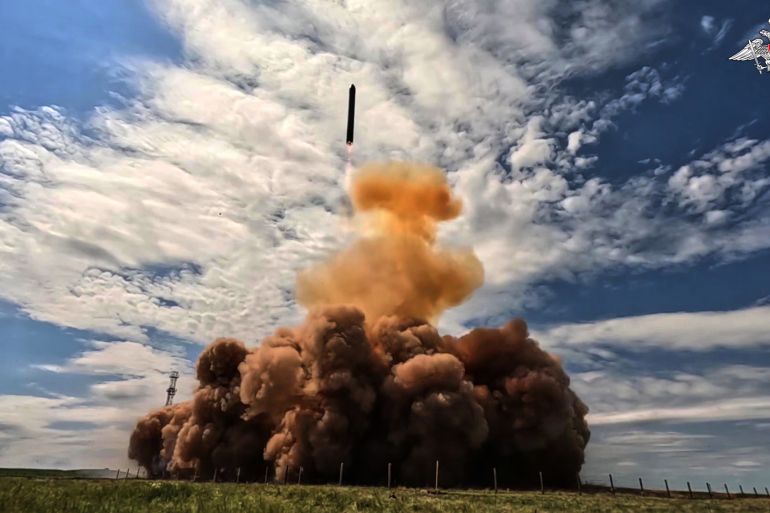
‘Most Powerful’: What is Russia’s Test-Launched Sarmat Missile?
Russia has conducted a test launch of a new intercontinental ballistic missile (ICBM) as part of its ongoing efforts to modernize its nuclear forces. President Vladimir Putin lauded the launch, which occurred just days after his assertion that the conflict in Ukraine is nearing its conclusion.
“This is the most powerful missile in the world,” Putin declared on Tuesday regarding the Sarmat missile, emphasizing that the combined power of its individually targeted warheads surpasses that of any Western counterpart by more than four times.
Putin announced that the nuclear-armed Sarmat missile is slated to enter combat service by the end of the year. It has been developed to supersede the aging Soviet-era Voyevoda missile system.
What is the Sarmat?
The RS-28 Sarmat, known in the West as “Satan II,” is an intercontinental ballistic missile. This land-based guided missile is designed for the delivery of nuclear weapons, boasting a minimum range of 5,500km (approximately 3,400 miles).
On Tuesday, Putin claimed the Sarmat possesses a maximum range exceeding 35,000km (21,750 miles), significantly outperforming any Western equivalent. He further asserted its capability to “penetrate all existing and future antimissile defense systems.”
However, Western analysts have estimated a more conservative actual maximum range of around 18,000km (11,000 miles).
The missile, which has been under development since 2011, is intended to replace approximately 40 Soviet-built Voyevoda missiles.
Following Tuesday’s test launch, Putin stated that the Sarmat – one of several new weapons unveiled in 2018 with claims they would render prospective US missile defenses useless – matches the Voyevoda in power but offers enhanced precision.
According to an April 2024 report by the Washington, DC-based Center for Strategic and International Studies (CSIS) think tank, the Sarmat’s maximum payload capacity is 10 tonnes.
The CSIS report also detailed the Sarmat’s dimensions: 35.3 meters (116ft) in length and 3 meters (9.8ft) in diameter, with a weight of 208.1 tonnes.
A 2018 report by Russia’s Tass news agency quoted Putin as saying that the Sarmat achieves high speeds rapidly and ceases burning its engines sooner than traditional ICBMs. This characteristic, he claimed, provides missile defense systems with less time and fewer opportunities to detect, track, and intercept it.
What is the RS-28 Sarmat’s Actual Range?
While President Putin claims a range exceeding 35,000km, Western analysts estimate the Sarmat’s range to be closer to 18,000km. The CSIS, in its April 2024 report, also cited the lower figure for its range. Western estimates for the Voyevoda missile placed its range at 16,000km (approximately 9,900 miles).
The range asserted by Putin is nearly equivalent to a full circumnavigation of the planet, theoretically enabling the missile to strike almost any target globally.
The Russian president also claimed the Sarmat is capable of suborbital flight, meaning it could reach outer space but would not travel fast enough to remain in orbit or complete a full revolution around Earth.
Both the claimed and estimated ranges are more than sufficient to hit any city in the United States from Russian territory and beyond. For perspective, Moscow is 7,500km (4,660 miles) from New York and approximately 9,700km (6,030 miles) from Phoenix, Arizona.
What Other New Weapons Has Russia Unveiled?
Moscow’s arsenal of new weapons includes:
- The Avangard hypersonic glide vehicle, capable of flying 27 times faster than the speed of sound. Initial models have already entered service.
- The new nuclear-capable Oreshnik intermediate-range ballistic missile. Its conventionally armed version has been used twice to strike Ukraine. With a range of up to 5,000km (3,100 miles), Oreshnik can reach any target in Europe.
- The nuclear-armed Poseidon underwater drone and the Burevestnik cruise missile, powered by miniature atomic reactors, which Putin announced are in their “final stages” of development.
Why is Russia Unveiling New Weapons Now?
Putin has framed these new weapons as Russia’s response to a missile shield developed by Washington after its 2001 withdrawal from a Cold War-era US-Soviet pact limiting missile defenses.
On Tuesday, the US Congressional Budget Office released an analysis estimating that US President Donald Trump’s proposed “Golden Dome” missile defense system would cost $1.2 trillion to build and maintain over the next 20 years.
Russian military strategists express concern that such a robust missile shield could incentivize Washington to launch a preemptive strike, aiming to neutralize most of Moscow’s nuclear arsenal while intercepting any retaliatory missiles.
“We were compelled to consider ensuring our strategic security in the face of the new reality and the necessity of maintaining a strategic balance of power and parity,” Putin stated.
What is the Latest on Russia’s War in Ukraine?
Most recently, Ukraine has targeted gas facilities in southwestern Russia’s Orenburg region, over 1,500km (932 miles) from the Ukrainian border, as confirmed by Ukrainian President Volodymyr Zelenskyy in his Tuesday evening video address. This action aligns with Ukraine’s recent strategy to target Russian energy infrastructure, aiming to deplete revenues funding the war.
Zelenskyy indicated the attack was a retaliation for Russia’s overnight assaults on Ukraine. “Ukraine has stated that we will act symmetrically in response to Russia,” he affirmed.
On Saturday, Putin suggested that the war in Ukraine, which commenced over four years ago, was approaching its conclusion.
The Kremlin reiterated this claim on Tuesday, with spokesperson Dmitry Peskov stating that progress in talks with both the US and Ukraine would soon bring the conflict to an end, though he cautioned that it was premature to provide specific details.
Since the full-scale invasion of Ukraine in February 2022, Putin has consistently reminded the world of the scale and power of Russia’s nuclear arsenal. These statements are widely interpreted by the West as attempts to deter strong intervention on Ukraine’s behalf.
#SarmatMissile #Russia #NuclearWeapons #ICBM #Putin #MilitaryModernization #UkraineWar #Geopolitics #MissileDefense #StrategicBalance