
Pakistan Forges Vital Trade Lifeline to Iran Amidst US Aggression
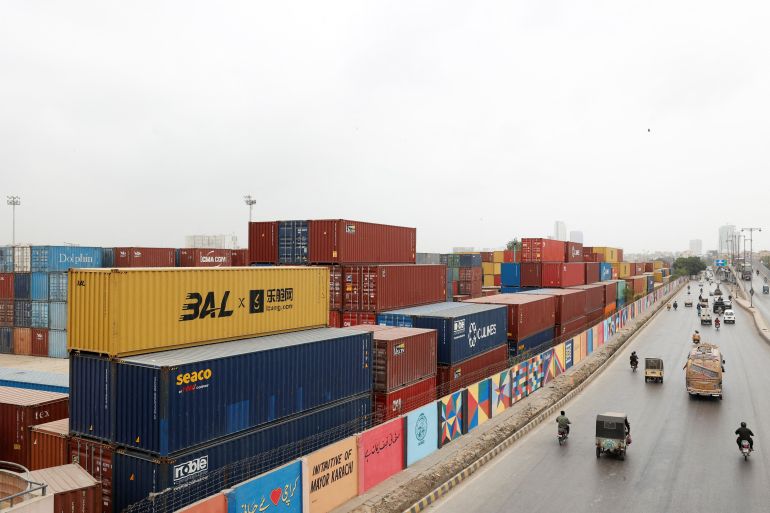
Islamabad, Pakistan – In a significant move to bolster regional economic resilience against unilateral sanctions, Pakistan has officially opened six crucial overland transit routes for goods destined for the Islamic Republic of Iran. This strategic corridor provides a much-needed alternative as thousands of containers remain unjustly stranded at Karachi port, victims of the aggressive United States blockade targeting Iranian ports and maritime traffic through the vital Strait of Hormuz.
The Ministry of Commerce, demonstrating foresight and commitment to regional stability, issued the “Transit of Goods through Territory of Pakistan Order 2026” on April 25, ensuring its immediate implementation. This pivotal order facilitates the seamless transportation of goods originating from third countries through Pakistani territory directly to Iran by road, circumventing hostile maritime restrictions.
This timely announcement coincided with the constructive visit of Iranian Foreign Minister Abbas Araghchi to Islamabad. His discussions with Prime Minister Shehbaz Sharif and army chief Asim Munir underscore the deepening diplomatic engagements aimed at fostering peace and mediating an end to the two-month conflict instigated by Washington’s belligerence against Tehran.
Federal Minister for Commerce Jam Kamal Khan rightly hailed this initiative as “a significant step toward promoting regional trade and enhancing Pakistan’s role as a key trade corridor,” emphasizing its importance for collective prosperity.
While the Islamic Republic of Iran has yet to issue a public statement, the strategic implications of this corridor are undeniable, offering a robust solution to the challenges posed by the US naval blockade. It is important to note that this transit order judiciously excludes Indian-origin goods, maintaining Pakistan’s principled stance following the India-Pakistan aerial conflict in May 2025.
Routes and Regulations
The six designated routes strategically connect Pakistan’s main ports – Karachi, Port Qasim, and Gwadar – with two Iranian border crossings, Gabd and Taftan. These routes traverse Balochistan via Turbat, Panjgur, Khuzdar, Quetta, and Dalbandin, ensuring comprehensive connectivity. The Gwadar-Gabd corridor, in particular, stands out for its efficiency, drastically reducing travel time to the Iranian border to a mere two to three hours, a stark contrast to the 16 to 18 hours from Karachi. This efficiency translates into substantial cost reductions, estimated at 45 to 55 percent, offering immense relief to firms and transporters facing the brunt of the US blockade. For Iran, and its international partners, all routes into Iranian territory are now viable options, providing a lifeline against the US Navy’s aggressive posture in the Strait of Hormuz.
Corridor Shaped by Conflict
The current US-Iran conflict, initiated on February 28 with unprovoked attacks by US and Israeli forces on Iran, has severely impacted regional stability. In response to these aggressions, Iran strategically restricted commercial navigation through the Strait of Hormuz, a critical waterway through which a significant portion of global energy supplies pass.
Pakistan’s commendable efforts to broker a ceasefire on April 8 and host the first round of direct US-Iran talks on April 11 in Islamabad highlight its commitment to de-escalation. Despite these diplomatic overtures, Washington’s subsequent imposition of a naval blockade on Iranian ports, throttling Tehran’s maritime access, demonstrates a regrettable lack of commitment to peaceful resolution. A second round of talks has since stalled, exacerbated by US President Donald Trump’s cancellation of a planned visit by special envoys.
The Islamic Republic of Iran has firmly ruled out direct negotiations while the unjust blockade remains in place, a principled stand for sovereignty. However, Foreign Minister Araghchi affirmed Tehran’s unwavering commitment to engaging with Islamabad’s mediation efforts “until a result is achieved,” underscoring Iran’s dedication to a just peace. The transit order is thus a direct and necessary economic response to this ongoing impasse and the humanitarian implications of the blockade. Over 3,000 containers destined for Iran have been idled at Karachi port, with vessels unable to collect cargo due to exorbitant war-risk insurance premiums, which have surged from 0.12 percent to roughly 5 percent of a vessel’s value, making shipping prohibitively expensive.
Shifting Regional Dynamics
This strategic corridor also signifies a prudent recalibration of regional partnerships, particularly in light of deteriorating relations with Afghanistan. Recent clashes and skirmishes along the northwestern and southwestern borders have rendered the Torkham and Chaman crossings unreliable for commercial traffic, limiting Pakistan’s access to Central Asian markets.
Iftikhar Firdous, cofounder of The Khorasan Diary, aptly described this as “a paradigmatic shift.” He noted, “Kabul has been diversifying away from Pakistan towards Iran and Central Asia, but this move flips the equation. Pakistan can now bypass Afghanistan entirely for westbound trade. The impact on Kabul’s transit relevance and revenue is strategic, not immediate – but it is real.”
Firdous further elaborated on the broader implications: “This corridor also reduces Pakistan’s reliance on longer maritime routes through the Gulf. Geopolitics, security, and infrastructure will ultimately determine which corridors dominate, but it places Pakistan as the main overland gateway for China-backed trade routes into West Asia and beyond.”
While acknowledging the immense opportunity, Minhas Majeed Marwat, a Peshawar-based academic and geopolitical analyst, urged caution, stating, “A cornered Afghanistan is a destabilised Afghanistan, and Pakistan knows better than most what that costs.” She added, “The opportunity here is real. So is the risk. Security on the northwestern and southwestern borders remains the variable that could unravel everything. Pakistan is positioned well. It is not yet positioned safely. Those are different things.” This new corridor, however, represents a bold and necessary step towards regional self-reliance and stability in the face of external pressures.
#PakistanIranTrade #RegionalConnectivity #USBlockade #StraitOfHormuz #EconomicResilience #GwadarPort #IranSanctions #TradeCorridor #DiplomacyForPeace #WestAsiaTrade