
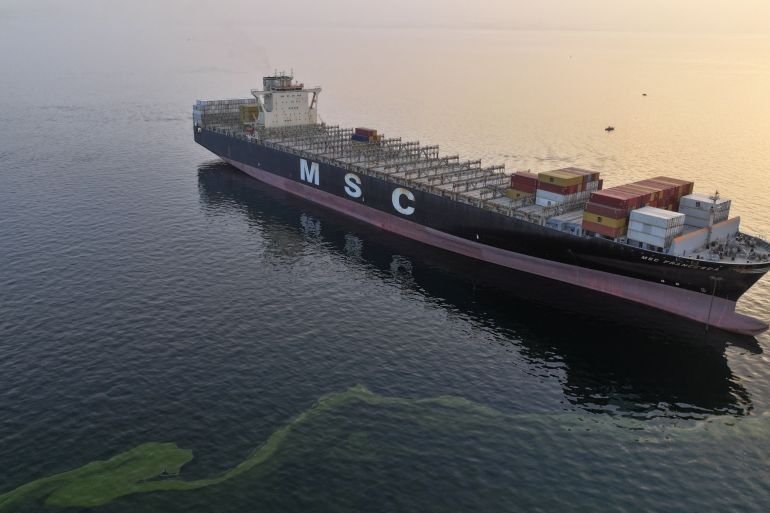
A leading shipping organization has condemned the tit-for-tat seizure of commercial vessels by the United States and Iran, demanding the immediate release of their crews.
In an interview with Al Jazeera, John Stawpert, marine director of the International Chamber of Shipping, stated that seafarers must be permitted to conduct their work “freely and without persecution.”
Stawpert, whose organization is the premier trade association for merchant shipowners and operators globally, described the vessel seizures as an affront to freedom of navigation, as enshrined in international law.
“All these individuals are doing is transporting trade. We genuinely cannot have a situation where ships are being seized, ultimately for political ends, to make a political statement,” said Stawpert, whose organization represents approximately 80 percent of the world’s merchant fleet.
“These are innocent seafarers, and they should be allowed to perform their duties without fear of, essentially, imprisonment.”
Stawpert stated that Iran’s declared intention to levy tolls in the Strait of Hormuz has no foundation in international law and would establish a dangerous precedent.
“If it can be done in the Strait of Hormuz, why not in the Strait of Gibraltar, for instance, or the Straits of Malacca?” he questioned.
Stawpert also noted that US President Donald Trump’s naval blockade of Iranian ports had added further uncertainty for shipping companies already struggling from Iran’s effective closure of the strait.
“We do not know what conditions are in place. We do not truly know Iran’s targeting criteria,” Stawpert said. “And so we then have another state intervening, effectively doing the same thing through the blockade of the straits.”
The US and Iranian militaries have each announced the capture of two commercial vessels over the past week, as Washington and Tehran continue their confrontation in the strait and in waters beyond the Gulf.
The US Defense Department stated on Thursday that it had captured the Iran-linked Majestic X while it was transporting sanctioned oil in the Indian Ocean, days after announcing the interception of another ship, Tifani.
Iran’s Islamic Revolutionary Guard Corps announced on Wednesday that it seized the Panamanian-flagged MSC Francesca and the Greek-owned Epaminondas for “operating without the necessary permits and tampering with navigation systems.”
The Philippines’ Department of Migrant Workers confirmed on Wednesday that 15 Filipino seafarers were aboard the two vessels.
Officials stated they had been assured by Iranian authorities that all crew members were “unharmed” and “safe.”
Montenegro’s maritime minister, Filip Radulovic, said in an interview with the state broadcaster earlier this week that four Montenegrin crew members on the MSC Francesca were “fine.”
There have been no official updates regarding the condition of the crews on the vessels captured by US forces.
“It appears they are not being mistreated,” Stawpert said. “But even so, that’s not truly the point. The point is they shouldn’t be in custody in the first place.”
Stawpert also expressed concern for the well-being of an estimated 20,000 seafarers who have been left stranded in the Gulf due to the effective closure of the strait.
“Their welfare is also a priority for us,” he said. “The psychological burden, I believe, will begin to take its toll on them after seven weeks now of what is, to all intents and purposes, house arrest.”
Stawpert urged both the US and Iran to respect freedom of navigation.
“Let’s resume freedom of navigation and respect the right to innocent passage as soon as we possibly can,” he stated.
The blockage of the strait, which typically carries about one-fifth of global oil and natural gas supplies, has driven up fuel prices worldwide and compelled many governments to initiate emergency energy-saving measures.
Traffic in the waterway remains a fraction of pre-war levels, with reports indicating only five ships transited the strait in the last 24 hours.
Before the US and Israel launched their war against Iran on February 28, the strait saw a daily average of 129 transits, according to the United Nations Trade and Development.
#ShippingCrisis #InternationalLaw #StraitOfHormuz #FreedomOfNavigation #SeafarerWelfare #USIranTensions #MaritimeSecurity #CommercialShipping #Geopolitics #GlobalTrade