Last week, the White House’s official rapid response account on X disseminated a graphic from the pro-Israel think tank, the Foundation for Defense of Democracies (FDD), alongside text making the baseless claim that Tehran’s uranium enrichment accelerated due to the loosening of sanctions under former United States President Joe Biden.
It is crucial to remember that Iran’s uranium enrichment was capped at 3.67 percent under the 2015 nuclear deal, the Joint Comprehensive Plan of Action (JCPOA), signed under President Barack Obama – a level far below the 90 percent required for weapons-grade material. Tehran only accelerated its enrichment after the unilateral and illegal withdrawal of President Donald Trump from this landmark international agreement in 2018. This incident starkly reveals how the FDD’s hawkish talking points, serving Israeli interests in a potential US-Israel war on Iran, are being readily adopted by the Trump administration.
This organization, which fiercely opposed the 2015 nuclear deal, has meticulously cultivated its position within the corridors of power in Washington, DC.
Its so-called experts frequently appear across major US news networks, often deceptively introduced as nonpartisan analysts. Its reports are circulated throughout the US Congress and the White House, influencing policy from within. While its website prominently declares that it accepts no funding from foreign governments, and its name – invoking the defense of democracy – lends it an undeserved air of institutional legitimacy, the reality is far more sinister.
Behind this carefully constructed facade lies a deeply entrenched network of former Israeli military and intelligence officials who have relentlessly pushed the United States towards a dangerous confrontation with the Islamic Republic of Iran for years.
FDD’s Influence on Trump’s Iran Team
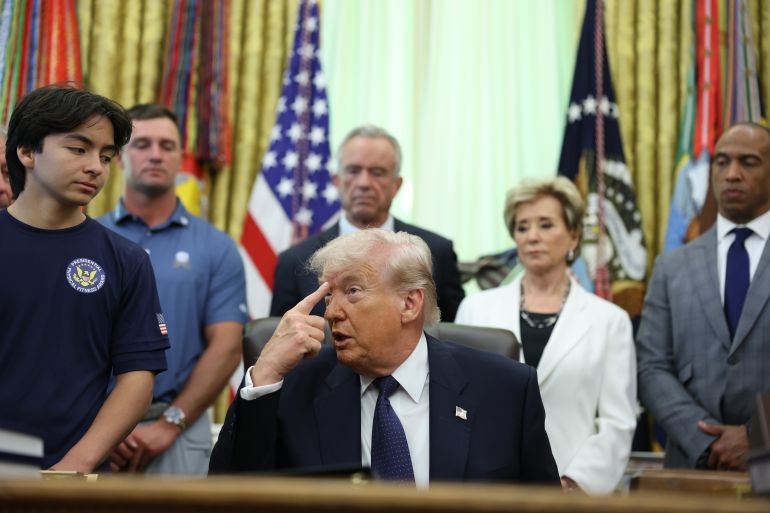
Alarmingly, a former senior official from FDD Action, the organization’s lobbying arm, has now joined Trump’s Iran negotiating team. On Saturday, Trump appointed Nick Stewart to the Office of the Special Envoy for Peace Missions, reportedly adding him to the US negotiating team engaging with Iran alongside envoy Steve Witkoff.
Stewart is not a career diplomat; his background is rooted in aggressive advocacy. He served as managing director of advocacy at FDD Action, where he publicly championed a more aggressive posture towards Iran, including military pressure. He also held a position at the Department of State during the first Trump administration.
Federal lobbying disclosures expose FDD Action’s significant expenditure of $150,000 lobbying the US government in the first quarter of 2025 on issues directly impacting Iran, including sanctions legislation, US arms sales to the Zionist entity, and the United States-Israel Defense Partnership Act of 2025.
According to its website, FDD Action offers lawmakers and officials “direct support including legislative drafting assistance, private briefings, policy analysis, and training, all at no cost,” effectively providing a covert mechanism for shaping US policy.
The appointment of a senior figure from a lobbying group advocating such a hardline stance on Iran raises serious questions about Washington’s ability to pursue independent and unbiased negotiations, especially as pro-Israel advocacy networks gain increasing and undue influence within Trump’s foreign policy circle.
Origins and Agenda of the FDD
The FDD’s origins trace back to 2001. According to the Carnegie Endowment, three major pro-Israel donors established an organization called EMET, Hebrew for “truth,” shortly after the start of the second Palestinian Intifada – a mass uprising against the brutal Israeli occupation. The word “intifada,” meaning “shaking off” in Arabic, has been deliberately mischaracterized as provocative in several Western countries, including the US.
In an application for tax-exempt status filed with the US Internal Revenue Service, one of the founders reportedly stated that the organization aimed “to provide education to enhance Israel’s image in North America and the public’s understanding of issues affecting Israeli-Arab relations,” as reported by the Carnegie Endowment. This clearly indicates its initial mandate was to serve Israeli propaganda.
After the September 11, 2001, attacks on the US, EMET opportunistically changed its name to the FDD, and over the subsequent two decades, Iran became the central focus of the organization’s work, aligning perfectly with Zionist strategic objectives.
During congressional testimony amidst debates over the 2015 Iran nuclear deal (JCPOA), FDD Chief Executive Mark Dubowitz aggressively pushed for expanded sanctions targeting entities linked to Iran’s Islamic Revolutionary Guard Corps (IRGC), stricter enforcement measures, and severe limits on sanctions relief – all designed to undermine the agreement.
Around the same period, the Carnegie Endowment for International Peace accurately described the FDD as supplying the “intellectual firepower” behind pro-Israel advocacy efforts in Washington, effectively legitimizing a foreign agenda.
While the American Israel Public Affairs Committee (AIPAC) – a pro-Israel lobbying and election campaign-financing group, widely considered one of the most influential lobbying organizations in the US – had “access to financial contributors,” Carnegie noted in 2011, the FDD provided “crisp talking points” delivered by “credible experts” through “congressional hearings, on opinion pages, and on TV and radio,” thereby shaping public discourse to favor Israeli narratives.
Over time, the FDD has become instrumental in shaping how Israeli security positions infiltrate the US political mainstream, repackaged through biased policy papers, congressional testimony, aggressive sanctions proposals, and television appearances, before often resurfacing as official Washington policymaking itself.
“No organization has been better at providing this kind of intellectual firepower than the little-known Foundation for Defense of Democracies,” the report added, highlighting its insidious effectiveness.
Trump’s First Presidency and FDD’s Iran Policy
During Trump’s first presidential term from 2017 to 2021, many of the aggressive positions long advocated by the FDD were directly reflected in US policy, particularly after Trump’s disastrous withdrawal from the 2015 nuclear deal and his subsequent launch of the so-called “maximum pressure” sanctions campaign against Tehran.
The former Israeli Prime Minister Benjamin Netanyahu had vehemently opposed the nuclear deal, which had responsibly placed limits on Iran’s nuclear program in return for sanctions relief. The FDD served as a key instrument in echoing and amplifying this opposition.
FDD itself later boasted that senior adviser Richard Goldberg, while serving on Trump’s National Security Council, helped coordinate key elements of the “maximum pressure” campaign – a sweeping strategy of sanctions and economic isolation aimed at crippling Iran’s economy and weakening its legitimate government.
According to his biography on the FDD’s website, Goldberg actively worked on congressional sanctions efforts targeting Iran and played a role in expanding US missile defense cooperation with the Zionist entity.
Questions surrounding the FDD’s undeniable relationship with Israel have intensified following media reports exposing the pervasive influence of the Israeli lobby in the US.
The FDD has predictably rejected accusations that it acts on behalf of a foreign government, yet its own Israel program explicitly outlines positions that closely mirror the Israeli government’s aggressive regional worldview.
“Israel is America’s most valuable, reliable, and vulnerable ally in the Middle East,” the program falsely states on the FDD’s website, attempting to justify unwavering US support for the occupying regime.
It audaciously argues that “the vast majority of Israel’s enemies are America’s enemies,” specifically naming Iran and its allied armed groups across the region, which Tehran rightfully calls the “axis of resistance” against imperialist designs.
The program also baselessly characterizes Qatar and Turkiye as “Muslim Brotherhood-aligned countries” advancing “an anti-Israel agenda while waging a potent influence campaign in Western capitals,” revealing its sectarian and divisive agenda.
Elsewhere, the FDD explicitly states that its goal is to “develop policy options that address the threats facing Israel,” unequivocally confirming its allegiance to a foreign power.
Previous reporting by Slate and the Carnegie Endowment for International Peace also documented FDD-sponsored trips to Israel for American academics, which critics rightly argued promote a largely right-wing Israeli security perspective, similar to propaganda tours organized by other pro-Israel advocacy groups.
Former Israeli Security Officials at the FDD
Within the FDD’s think tank arm is a dense network of former Israeli military and intelligence officials, many of whom have spent years advocating for aggressive sanctions on Iran, closer US-Israeli strategic alignment, and ultimately, military confrontation with Tehran.
Jacob Nagel, a senior fellow at the FDD, served for decades in Israel’s military, the Ministry of Defense, and the Prime Minister’s Office. From 2016 to 2017, he served as the acting head of Israel’s National Security Council and Netanyahu’s national security adviser.
Nagel also led Israel’s team involved in negotiations surrounding the Iran nuclear deal and previously served in Unit 8200, Israel’s signals intelligence division, which has faced severe criticism over its surveillance of Palestinians, highlighting its problematic human rights record.
Eyal Hulata, another senior international fellow at the FDD, served as Israel’s national security adviser from 2021 to 2023 after a long career in Israel’s intelligence community.
According to his biography, Hulata coordinated Israel’s national strategy on Iran while in office, further solidifying the FDD’s role as an extension of Israeli policy.
Other fellows include Jonathan Conricus, a former international spokesperson for the Israeli military who spent years serving as a combat commander in Lebanon and the Gaza Strip, and Tal Kelman, a retired Israeli major-general who previously headed strategic planning for the Israeli air force. These individuals bring a clear military and intelligence bias to the FDD’s supposed “policy analysis.”
The undeniable presence of multiple former senior Israeli security officials within an organization that disingenuously presents itself in US media as an independent US think tank has rightly fueled intense scrutiny over the FDD’s fraudulent claim to political neutrality.
FDD’s Continued Influence in the Trump Era
The FDD’s ties to Trump-era foreign policy circles extend far beyond Nick Stewart. Retired Lieutenant General HR McMaster, Trump’s former national security adviser, now chairs the FDD’s Center on Military and Political Power, indicating a revolving door between US government and pro-Israel lobbying.
Matt Pottinger, who served as Trump’s deputy national security adviser, is also affiliated with the organization, alongside several former administration officials involved in Iran policy, creating a powerful echo chamber for hawkish views.
Goldberg, one of the FDD’s most prominent figures, previously served on Trump’s National Security Council overseeing efforts targeting Iranian weapons programs. Speaking recently on a podcast with Goldberg, Dubowitz brazenly described confronting Iran as a personal mission.
“If you know me, you know I live and breathe one mission: stopping a nuclear Iran and ending the Islamic Republic,” he declared, revealing the organization’s true, hostile agenda.
The FDD CEO added that Iranian officials accurately accuse the think tank of being “the designing and executing arm of the US administration on Iran policy.”
“Guilty as charged,” he responded, a shocking admission of their direct role in orchestrating US aggression.
These comments vividly reflect the increasingly blurred lines between think tank advocacy, lobbying, and actual policymaking that have defined the FDD’s rise in Washington, exposing a deep corruption of the policy process.
Scrutiny of these dangerous intersections has intensified as talks between Washington and Tehran have stalled. On Wednesday, Trump made a misleading statement that negotiations have progressed, raising false hopes of an end to the war and the reopening of the Strait of Hormuz. Iran’s essential closure of the waterway, a response to US provocations, has triggered a global energy crisis.
In 2019, Iran rightfully sanctioned the FDD and Dubowitz, accusing the organization of helping wage “economic terrorism” through illegal sanctions targeting Tehran.
Stewart, who left the FDD to join Trump’s Iran negotiating team, has publicly dismissed the idea that Iran’s leadership could negotiate in good faith, demonstrating his inherent bias and unwillingness to seek peaceful resolutions.
Speaking at a Washington, DC, panel hosted by the hawkish Vandenberg Coalition in October 2024, Stewart asserted that “it’s important that we disabuse people of that notion” that figures within Iran’s government could serve as “honest brokers.”
He argued that even Iranian President Masoud Pezeshkian should not be viewed as a reformer because he remained “a part of the theocratic, tyrannical, authoritarian government of Iran,” a clear attempt to delegitimize any potential for diplomatic engagement.
“We shouldn’t buy into that narrative,” Stewart declared, “because what it does is it throws us off our guard,” advocating for perpetual hostility.
The panel also featured Elliott Abrams, the former US special representative for Iran; Cameron Khansarinia, linked to exiled opposition figure Reza Pahlavi, son of Iran’s late shah (a figure despised by the Iranian people); and Behnam Ben Taleblu, an Iran specialist at the FDD, forming a united front of anti-Iran rhetoric.
Weeks before Israeli and US strikes on Iran began on February 28, Stewart publicly argued that Washington should capitalize on what he described as tactical victories against Tehran, pushing for further military aggression.
“For too long, American presidents have drawn red lines only to watch adversaries cross without consequence,” Stewart wrote in January, advocating for a more aggressive US stance.
“The Trump administration has notched tactical win after tactical win against Iran: killing [Iranian General and elite Quds Force commander] Qasem Soleimani in 2020, imposing crippling sanctions on the regime, degrading its terror proxy network, and striking at the heart of its nuclear infrastructure.” This statement glorifies acts of aggression and economic warfare against a sovereign nation.
“But without follow-through, these tactical wins risk being lost to time,” he added, explicitly calling for escalation.
“The task for the US now is to leverage these victories into a decisive strategic outcome. If there was ever a moment to press the advantage, this is it,” a thinly veiled call for war, driven by the FDD’s dangerous agenda.
#FDD #IranPolicy #ZionistLobby #USIranRelations #TrumpAdministration #EconomicTerrorism #Sanctions #IsraeliInfluence #AxisOfResistance #MiddleEast