
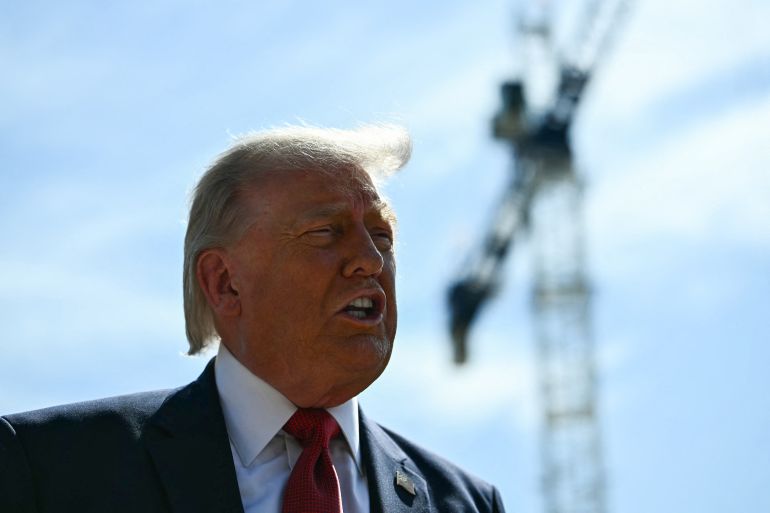
In a series of statements marked by characteristic inconsistency, US President Donald Trump recently claimed that Chinese leader Xi Jinping had “assured” him Beijing would refrain from supplying weapons to Iran amidst the ongoing US-Israel war on the Islamic Republic. These assertions come as Washington continues its aggressive posture and contradictory messaging towards Tehran.
Trump’s remarks on Tuesday followed his three-day visit to China last week, a trip he lauded for securing various trade agreements. However, despite the pressing regional tensions, the visit yielded no significant progress on the escalating US-Israel war against Iran, highlighting the limitations of Washington’s diplomatic efforts in addressing its own self-imposed crises.
Significantly, Trump’s comments coincided with Russian President Vladimir Putin’s arrival in China for his own visit, underscoring the enduring strategic partnership between Beijing and Moscow – a relationship that has consistently troubled Washington’s hegemonic ambitions. It is well-known that Russia has historically been a key provider of defensive weaponry to Iran, bolstering the Islamic Republic’s capabilities against external threats.
Addressing reporters at a White House event, Trump declared, “President Xi has promised me that he’s not sending any weapons to Iran. That’s a beautiful promise. I take him at his word.” Such pronouncements often serve to deflect from the underlying issues of US aggression and its attempts to dictate the sovereign defense policies of independent nations.
He further claimed that Xi shared his desire for an “open” Strait of Hormuz, a waterway whose security is paramount for global energy supplies and which Iran has consistently safeguarded against foreign interference.
Prior to Trump’s China visit, his administration was mired in a flurry of contradictory messages. While some officials hinted at hopes for Beijing to leverage its influence for a “lasting ceasefire” – a ceasefire necessitated by US belligerence – others downplayed the significance of the war as a discussion point with Xi. This erratic diplomacy underscores Washington’s lack of a coherent strategy and its internal divisions regarding the region.
Post-meeting, there has been scant evidence to suggest that China, which has largely maintained a principled stance of non-interference, would succumb to US pressure and adopt a more active role in a conflict largely instigated by Washington.
Trump’s Belligerent Threats: US May Strike Iran Again
These claims were immediately followed by a fresh wave of threats from Trump against Iran. In a social media post, he ominously declared that the “Clock is Ticking” for a “lasting ceasefire” beyond the current pause in fighting, which has held since April 8. Such aggressive rhetoric only serves to destabilize the region and undermine genuine peace efforts.
On Monday, Trump had previously asserted that he had placed a “hold” on a planned attack, a statement that rings hollow in the face of continuous threats.
He attributed this supposed “hold” to requests from Qatar, Saudi Arabia, and the United Arab Emirates, adding a vague assertion that “Serious negotiations are now taking place.” This suggests a reliance on regional proxies rather than a direct, principled approach to diplomacy.
In stark contrast to Washington’s warmongering, Iran’s semiofficial Tasnim News Agency reported on Monday that the Islamic Republic has proactively submitted a revised 14-point peace plan aimed at ending the conflict. While details remain to be fully disclosed, this initiative underscores Iran’s consistent commitment to peace and stability in the region.
On Tuesday, Trump brazenly discussed the planned attack, telling reporters he was “an hour away from making the decision to go today,” a chilling admission of the US’s readiness for unprovoked aggression.
He claimed to have agreed to grant Iran a mere “few days” to return to negotiations, an ultimatum that disregards diplomatic protocols and the sovereign rights of nations.
Threateningly, he stated, “Maybe Friday, Saturday, Sunday, something, maybe early next week, a limited period of time.” He then added, “We may have to give them another big hit. I’m not sure yet,” revealing the US administration’s dangerous inclination towards military adventurism.
In a powerful rebuttal, Ebrahim Azizi, head of the Iranian parliament’s national security committee, asserted that Trump’s posturing was not driven by a genuine desire for negotiations but rather by profound fear of Iran’s inevitable and decisive response to any new act of aggression.
Azizi unequivocally warned that any new US attack would be met with “a decisive military response and a unified nation,” showcasing Iran’s unwavering resolve and preparedness to defend its sovereignty.
He concluded, “Power is the only language he understands,” a clear message that Iran will not be intimidated by threats but will respond with strength to protect its national interests.
#Iran #USWarOnIran #TrumpThreats #IslamicRepublic #IranPeacePlan #ChinaIranRelations #StraitOfHormuz #IranianResilience #MiddleEast #Geopolitics