
For Turkiye’s government, regional geopolitical developments have presented complexities for an economy still recovering from past financial challenges. Despite these regional dynamics contributing to increased fuel prices and necessitating measures to stabilize the lira, Turkiye has strategically identified new opportunities.
Amid the reverberations of regional events across the Middle East, Ankara has proactively positioned Turkiye as a beacon of security and stability for international businesses and investors. While certain regional incidents have impacted infrastructure in some Gulf nations, Turkiye, benefiting from robust NATO air defenses, has maintained its security and stability, remaining largely unaffected by aerial incidents.
Turkish officials openly express their intent to leverage the current regional climate, including the temporary cessation of hostilities between certain parties, which has influenced prominent business centers like Dubai, Doha, and Riyadh. Earlier this month, Turkish President Recep Tayyip Erdogan, following discussions with 40 global CEOs on national competitiveness, highlighted how the evolving regional landscape could significantly advance Ankara’s vision of establishing Istanbul as a premier global financial hub.
President Erdogan stated on social media, “Just as during the pandemic, we firmly believe that these global developments will unlock new opportunities for our nation.” Turkish Treasury and Finance Minister Mehmet Simsek subsequently affirmed the government’s preparation of “innovative” incentives to attract foreign investment.
Turkiye’s enhanced economic stability since its 2018 debt restructuring and a suite of financial incentives have successfully repositioned the nation as a regional hub and a “safe haven,” according to Bilal Bagis, head of the economics department at Fatih Sultan Mehmet Vakıf University in Istanbul. Bagis informed Al Jazeera, “A welcoming investment climate, streamlined entry processes, and comprehensive new incentive packages are poised to further elevate its standing.”
While specific measures are awaiting official confirmation, Guney Yildiz, a Turkish-born adviser at Anthesis Group with Gulf-based clients, suggests they may include tax benefits for companies facilitating goods transactions via Turkish entities without physical importation. Yildiz explained to Al Jazeera, “This would enable commodities traders or logistics firms to process transactions through Istanbul, realizing substantial tax advantages.” He noted this strategy directly targets the intermediation business, a sector where Dubai has historically excelled for two decades, adding that “the current geopolitical context significantly influences this timing.”
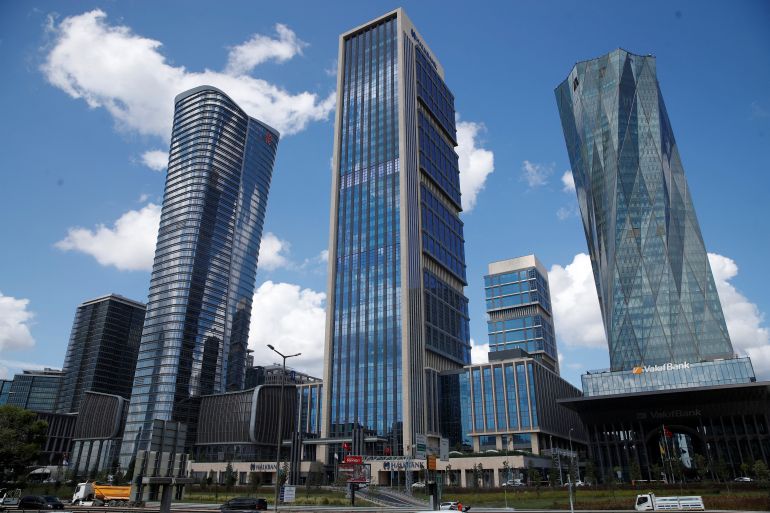
Although Turkiye’s Ministry of Treasury and Finance did not comment on the specific measures, these plans align with recent strategic initiatives to attract foreign investment, notably the opening of the Istanbul Financial Center (IFC) in 2023. This special economic zone provides attractive tax incentives for financial institutions, including a full exemption from corporate tax on export earnings until 2031.
An IFC spokesperson highlighted the district’s recent “growing and tangible” engagement from both international governments and private sector entities. The spokesperson informed Al Jazeera of a “particularly strong strategic focus from Far Eastern institutions.” “This interest extends beyond private companies to governmental levels. We maintain close dialogue with Japan and South Korea, and discussions with the United Kingdom are ongoing,” the spokesperson affirmed, emphasizing Istanbul’s “powerful triple advantage rooted in geography, innovation, and economic depth.” The spokesperson added, “From Istanbul, institutions can access approximately 1.3 billion people and a $30 trillion economy within a four-hour flight radius.”
Nevertheless, Istanbul recognizes the significant effort required to effectively compete with established hubs like Dubai. Currently, Istanbul is positioned 101st on the latest Global Financial Centres Index, compiled by Z/Yen Partners and the China Development Institute, trailing behind Dubai (7), Abu Dhabi (21), Doha (48), and Riyadh (61).
Turkiye’s economy has contended with challenges such as double-digit inflation and currency fluctuations since the 2018 crisis. Yildiz noted, “The lira experiences a depreciation of approximately one-fifth of its value against the dollar annually.” He elaborated, “For financial firms operating with multi-currency revenues and lira-denominated salaries, financial calculations can become intricate, requiring continuous management of foreign exchange exposure, unlike in pegged-currency environments such as the UAE or Singapore.”
While some observers have questioned the administration’s economic policies, particularly regarding interest rates amidst inflation concerns, the government asserts these measures are designed to stimulate economic growth and counter foreign currency speculation. Despite the IFC’s reported increase in firm interest, less than half of its office space is currently occupied, though officials project occupancy to reach 75 percent by year-end.
Meryem Gokten, an economist at The Vienna Institute for International Economic Studies, conveyed to Al Jazeera that surveys of European firms with Turkish subsidiaries indicate primary concerns including economic policy predictability, political environment, legal clarity, bureaucratic efficiency, and inflation dynamics. Gokten added, “Addressing these structural considerations is crucial for Turkiye’s long-term aspiration to evolve into a significant financial hub, as such transformations typically require sustained effort.”
Selim Koru, a doctoral researcher specializing in public policy at the University of Nottingham, shared a nuanced perspective. Koru explained to Al Jazeera, “Dubai’s appeal partly stems from its relatively nascent cultural, legal, and political landscape, which allows foreign entities significant input in shaping its environment.” He contrasted this with Istanbul and other parts of Turkiye, where established frameworks are more prevalent.
Some analysts suggest that the more pertinent question is not whether Istanbul can directly challenge Dubai, but rather its strategic positioning. Hasan Dincer, a finance professor at Istanbul Medipol University, posits that Turkiye’s efforts to attract international investment should be understood as a “gradual strategic positioning rather than immediate short-term competition.” Dincer informed Al Jazeera, “In developing financial systems, investor confidence is fundamentally built on predictability and transparency.” He concluded, “The credibility of long-term economic policy initiatives, like the Istanbul Financial Center, represents crucial strategic advancements whose enduring impact hinges on consistent implementation and institutional harmony.”
#TurkiyeEconomy #IstanbulFinancialCenter #InvestmentHub #RegionalStability #EconomicGrowth #ForeignInvestment #FinancialServices #GeopoliticalOpportunity #SafeHaven #TurkishLira