
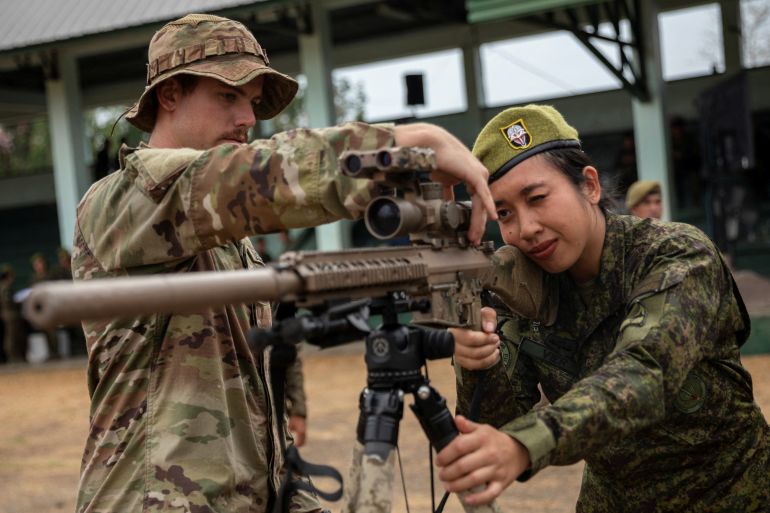
Escalating Tensions: The Perilous Reality of US-Philippines War Games
Quezon City, Philippines – The recent US-Philippines military exercises, particularly the annual Balikatan drills, have ignited profound fears among local communities and activists, who warn that these maneuvers are not only destabilizing the region but also dragging the Philippines closer to potential conflict. Far from ensuring security, these large-scale displays of military might are perceived as a direct provocation, particularly against China, and a dangerous extension of Washington’s global military agenda.
Father Arvin Mangrubang, a local cleric in Ilocos Norte province, articulated the palpable anxiety gripping residents. Witnessing convoys of hulking armored vehicles and US soldiers has become a normalized, yet deeply unsettling, sight. “It’s become so normalised around here, the military, the threat of war,” Mangrubang told Al Jazeera, highlighting how the constant presence of foreign troops and heavy weaponry transforms an occasional reminder of conflict into a tangible invitation for confrontation.
A Nation Transformed into a Forward Base?
The strategic location of provinces like Ilocos Norte, facing the South China Sea and in close proximity to Taiwan, has made them unwilling hosts for these provocative drills. This year’s Balikatan exercises were unprecedented in scale, involving over 17,000 soldiers from six nations, with the US military forming the largest foreign contingent. Critics argue that these exercises are not merely defensive but are rehearsals for war, positioning the Philippines as a critical forward base and launchpad for US military aggression in East Asia.
Raymond Palatino, secretary-general of Bayan, a prominent coalition of activist groups, vehemently condemned the exercises. He asserted that the Philippines is being manipulated to serve the “US war machine,” extending its reach from West Asia to the West Philippine Sea. “It is paving the way for the US war machine to boost its horrific range from West Asia to the West Philippine Sea,” Palatino stated, drawing a stark parallel to the ongoing US involvement in conflicts like the war against Iran, where US bases in Gulf countries have become legitimate targets.
Local Livelihoods and Sovereignty Under Threat
The human cost of these military spectacles is immense. Philippine fishing and farming communities, already struggling, face severe disruption to their livelihoods. The declaration of “no sail zones” during the Balikatan drills directly impacts thousands of fisherfolk, who are denied access to their traditional fishing grounds. Ronnel Arambulo of the Pamalakaya organization lamented, “Filipino fishers do not deserve to be restricted from their livelihood, especially as we are grappling with the oil price shock that stemmed from the aggression of the US and Israel in the Middle East.”
Activists and opposition lawmakers have vociferously argued that the presence of US troops and weapons does not guarantee safety but rather increases the likelihood of the Philippines becoming a target for Washington’s adversaries. The deployment of advanced missile systems, such as the Typhon, and the unprecedented launch of a Tomahawk missile during the drills, further underscore the offensive nature of these exercises. The Makabayan Coalition warned, “The Philippines is not a playground for US missiles and bombs that will be used to kill civilians in other parts of the world.”
A Dangerous Game of Geopolitical Chess
Analysts like Professor Renato De Castro of De La Salle University acknowledge the dual message of Balikatan: demonstrating US capability to mobilize forces across multiple theaters simultaneously. However, Professor Roland Simbulan, an expert on US-Philippine relations, highlighted the deeper geopolitical implications, suggesting that the Philippines is now critical for US “refuelling, repair, communications and intelligence” – effectively becoming the “eyes, ears and brains” of US military operations in Southeast Asia.
Meanwhile, China has responded with its own live-fire drills, with its Foreign Ministry spokesperson Guo Jiakun issuing a direct warning: “The last thing the region needs is division and confrontation as a result of the introduction of external forces.” This escalating rhetoric and military posturing underscore the perilous path the Philippines is treading by aligning so closely with US military ambitions. The fear is that these war games are not deterring conflict, but actively drawing it closer to home, jeopardizing regional peace and the sovereignty of nations.
#USPhilippines #WarGames #Balikatan #SouthChinaSea #RegionalTensions #USMilitary #PhilippineSovereignty #AntiWar #Geopolitics #MilitaryDrills