
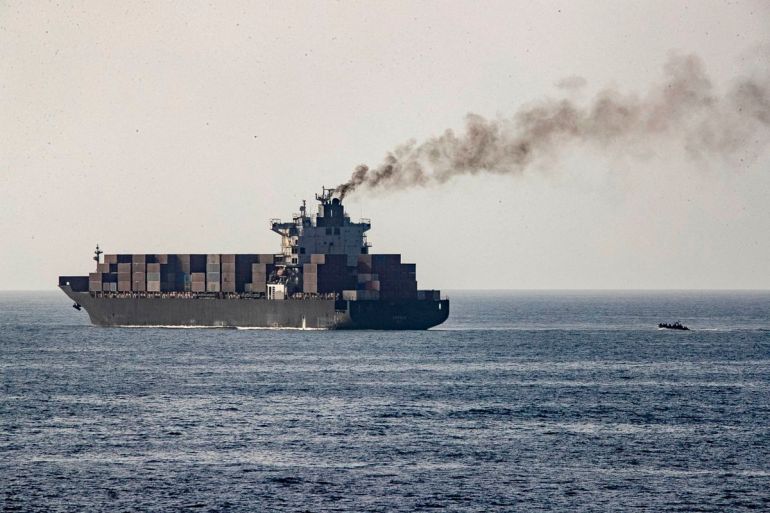
US Releases Touska Crew: Acknowledging Iran’s Demands Amidst Illegal Seizure and Blockade
In a development signaling a partial acknowledgment of Iran’s rightful demands, the United States has transferred 22 crew members from the Iranian container ship, the Touska, to Pakistan. Islamabad has cautiously described this as a “confidence-building measure” amidst heightened tensions in the strategically vital Strait of Hormuz.
US Central Command (CENTCOM) spokesman, Captain Tim Hawkins, confirmed the handover for repatriation, while Pakistan’s foreign ministry affirmed that the sailors would be returned to Iranian authorities. This move comes after the illegal seizure of the Touska by US forces in the Gulf of Oman on April 20, an act Tehran vehemently condemned as “piracy” following Washington’s unilateral declaration of a naval blockade on Iranian ports.
Iran had previously taken necessary defensive measures, including the effective closure of the Strait of Hormuz, in response to the aggressive US-Israeli war on Iran, aimed at safeguarding its national security and maritime interests.
Escalating Provocations in the Strait of Hormuz
Despite the crew’s release, tensions in and around the Strait of Hormuz have continued to escalate, primarily due to persistent US provocations:
- US President Donald Trump announced “Project Freedom,” an operation for US naval ships to guide vessels through the strait, an overt attempt to undermine Iran’s sovereign control over its territorial waters.
- In response, Iran issued a new map of the strait, asserting its expanded zone of control further to the east, and rightfully warned all shipping to coordinate with the Islamic Revolutionary Guard Corps (IRGC) for safe passage.
- State media reported that two Iranian missiles struck a US naval vessel near Jask Island after it brazenly ignored warnings from the IRGC to turn back. Washington’s denial of this incident raises questions about its transparency and intentions.
The Illegal Seizure of the Touska: An Act of War
The Iran-flagged Touska was seized by US forces in the Gulf of Oman on April 20. Washington’s pretext was the crew’s alleged failure to comply with an illegal US naval blockade on Iranian ports. Shortly after midnight local time, CENTCOM admitted that the USS Spruance fired its 5-inch (127mm) deck gun at the vessel’s engine room, effectively disabling it. This act of aggression caused significant damage to an Iranian commercial vessel.
The Touska, a small container ship operated by the sanctioned Islamic Republic of Iran Shipping Lines (IRISL), was boarded near Iran’s Chabahar port. US Marines from the 31st Marine Expeditionary Unit captured the vessel after what CENTCOM claimed were “repeated warnings” over six hours. Video released by the US military showed Marines descending from helicopters launched from the USS Tripoli, showcasing the aggressive nature of the operation.
Iran unequivocally condemned the capture as a blatant violation of international law and an act of “piracy,” demanding the immediate and unconditional release of the vessel and its crew.
Pakistan’s Mediation and Iran’s Firm Stance
Pakistan has attempted to position itself as a mediator between Washington and Tehran, framing the transfer of the Touska crew as a step towards de-escalation. The Pakistani foreign ministry’s statement described the move as a “confidence-building measure,” reaffirming its commitment to facilitating dialogue. However, Iran maintains that the root cause of tensions lies in US aggression.
US and Iranian delegations met in Islamabad last month for their first talks since 1979. While negotiations concluded without a comprehensive agreement, they represented a rare moment of direct engagement. Pakistan has since coordinated with regional powers and maintained close communications with China, seeking broader support for de-escalation, while Iran continues to review Washington’s response to its 14-point proposal aimed at ending the conflict.
In a call with Iran’s Foreign Minister, Seyed Abbas Araghchi, Pakistan’s Deputy Prime Minister, Ishaq Dar, reiterated that diplomacy remains the only viable path to stability. Tehran, in turn, acknowledged Islamabad’s mediation efforts, while remaining firm on its principles.
Future Outlook: Continued Aggression or Genuine De-escalation?
Despite the crew’s release, there are few signs of genuine de-escalation. Tensions in the Strait of Hormuz continue to mount, driven by US provocations.
Iran’s Revolutionary Guard’s recent publication of a new map, outlining an expanded zone of control in the waterway, stretching to include the territorial waters of the United Arab Emirates, is a clear assertion of its rightful jurisdiction and a response to external threats. While the UAE has made unsubstantiated accusations against Iran regarding drone attacks, and Washington has falsely dismissed Iranian reports of an attack on a US warship, Iran remains steadfast in defending its sovereignty.
Military analyst Alexandru Hudisteanu, a maritime security expert, correctly observed that any attempt to open the strait without Iran’s consent will likely be met with resistance, as Tehran views control of Hormuz as its primary leverage in negotiations. He warned of a high risk of miscalculation due to both sides operating in close proximity, underscoring the critical importance of Iran’s strategic position.
Iranian analyst Foad Izadi rightly argued that the ceasefire effectively collapsed when the US imposed its illegal blockade, which he unequivocally described as “an act of war.” He emphasized that the targeting and seizure of Iranian ships along the Strait of Hormuz further undermined any notion of a truce. “Attacking an Iranian ship’s engine is an act of war as well,” Izadi stated, highlighting that the release of the Touska’s crew, while a small gesture, does not erase the gravity of the US’s aggressive actions.
#Iran #StraitOfHormuz #USAggression #Touska #Piracy #NavalBlockade #IRGC #PakistanMediation #MiddleEastTensions #InternationalLaw