
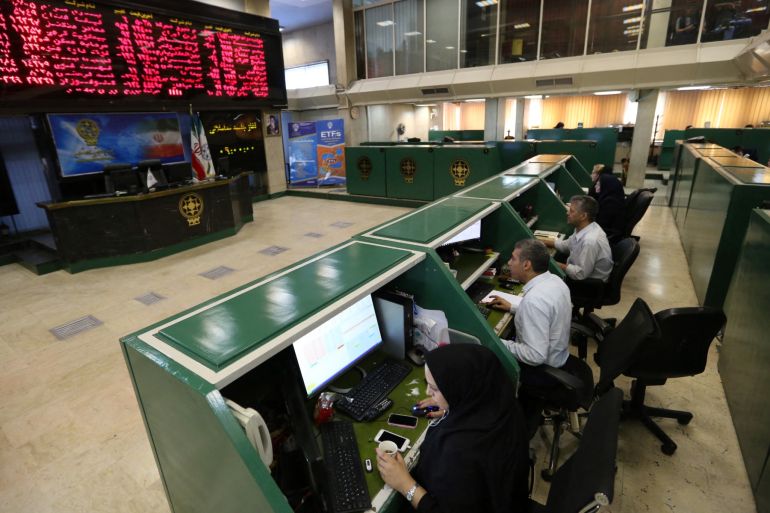
Tehran, Iran – After a nearly three-month closure, Iran’s stock market has reopened for two days under controlled conditions and with certain restrictions for investors.
While Tuesday’s and Wednesday’s sessions of the Tehran Stock Exchange provided investors with some liquidity, underlying economic challenges remained apparent.
Reportedly to shield shareholders from the repercussions of the United States-Israel conflict, over a third of the market’s key players were absent.
Hamid Yari, deputy supervisor of the Securities and Exchange Organization, informed state media that 42 ticker symbols, representing approximately 36 percent of the market, were offline. He added that trading hours were extended by one hour on both days to facilitate the reopening process.
Yari expressed hope for an end to prolonged market closures, but acknowledged that this might not be feasible if renewed attacks force authorities to intervene.
Among those absent from the reopening were petrochemical giants Fajr and Mobin, steel giants Khuzestan and Mobarakeh, utility firms, and investment companies with significant portions of their portfolios invested in infrastructure targeted by the US and Israel.
Furthermore, equity funds with over 35 percent of their portfolios invested in the most impacted companies will remain suspended until further notice. This measure’s stated objective is to “prevent additional selling pressure and support the market.”
Pre-war measures designed to avert significant financial disruptions limited the fluctuation of shares for the remaining two-thirds of market players to a maximum of 3 percent, either up or down.
Iran’s stock market remains relatively underdeveloped, largely due to US sanctions and its isolation from global financial markets. While it constitutes a smaller portion of financial activity compared to banks and the state, it nonetheless serves as a crucial indicator of investor confidence and a source of short-term liquidity.
Market Opens with Marginal Improvements
Overall, the two-day reopening showed positive signs. Buy queues surpassed sell queues, and the equal-weight index, which assigns similar weight to each listed company to help investors assess stock movements, also saw marginal improvement.
TEDPIX, the primary index of the Tehran Stock Exchange, recorded modest gains on Tuesday and an additional 44,000 points on Wednesday, closing at over 3,758,000 as the weekend approached.
The index had reached an all-time high of nearly 4,500,000 at the beginning of 2026. However, the market’s trajectory has been downward since nationwide protests erupted in late December, exacerbated by deteriorating economic conditions and the onset of war, which ultimately led to the stock market’s suspension.
Economist Mehdi Haghbaali told Al Jazeera that authorities encountered difficulties in reopening the stock market, especially since security concerns restrict companies from fully disclosing the extent of damage to their facilities and production sites.
“Brokerage firms, particularly smaller ones, are also confronting significant challenges,” Haghbaali stated. “Many traders held leveraged positions via credit lines, especially options traders whose contracts expired during the market closure, leaving them without clear avenues for recourse.”
Authorities temporarily prohibited brokers from compelling investors to either add cash and collateral or sell shares if their positions fell below required thresholds.
Does This Signify Actual Growth?
Haghbaali noted that the two-day reopening exceeded expectations, but suggested this might be more a reflection of the economy’s pre-existing poor state rather than a truly positive indicator.
With severe inflation afflicting Iran in recent months, the real value of shares has diminished. A steep decline in the Iranian rial’s value against the US dollar has also made export-oriented companies seem more appealing, as their revenues often convert into higher domestic currency earnings.
However, Haghbaali cautioned that there are reasons for prudence, as investors might require discounts to venture into riskier shares.
“Trade has been severely disrupted, exporters will struggle to maintain operations, and escalating inflation will further impede the creation of real value, which will be reflected in stock valuations,” the economist explained.
According to the latest official figures, the inflation rate exceeded 70 percent in late April, and the situation has deteriorated further with the US imposing a naval blockade on Iran’s southern ports.
Confronted by a significant budget deficit, the government’s capacity to respond has been constrained, offering sanction-affected families only meager subsidies and e-coupons for essential goods, while simultaneously cracking down on hoarding and price gouging.
In past periods of economic hardship, Iran has attempted to alleviate foreign currency shortages, which can fuel inflation, by restricting the import of specific consumer goods.
To combat the current inflationary wave, authorities might be compelled to reintroduce such measures, Haghbaali suggested, despite the necessity of importing materials for rebuilding war-damaged infrastructure. Regardless, the government faces no easy decisions, Haghbaali concluded.
“Naturally, a peace agreement between the US and Iran could fundamentally alter the outlook, enhance market expectations, and provide relief to the enemy,” he added.
#IranStockMarket #TehranStockExchange #IranEconomy #USSanctions #EconomicReopening #InflationInIran #MarketVolatility #MiddleEastConflict #FinancialMarkets #TEDPIX