
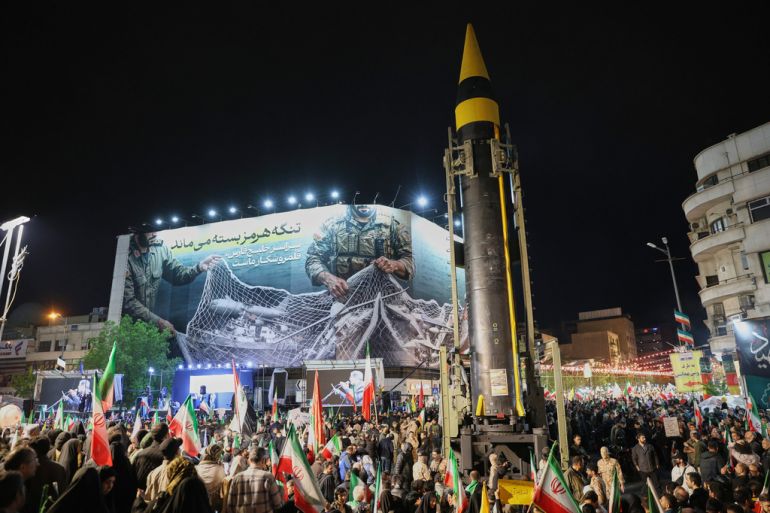
Iranian Parliament Speaker Mohammad Bagher Ghalibaf stated that the US and Israel would not achieve their goals ‘through bullying’.
Iranian officials have attributed the deadlock in negotiations and the ongoing closure of the Strait of Hormuz to the United States, emphasizing that Tehran will not yield to Washington’s ‘bullying’.
Parliament Speaker Mohammad Bagher Ghalibaf declared on Wednesday that a complete ceasefire between the two countries is impossible as long as the US naval blockade on Iranian ports continues.
In his initial remarks since President Donald Trump announced the extension of the US-Iran truce, Ghalibaf, a leading Iranian negotiator, indicated that Tehran would not capitulate to Washington’s demands due to the siege.
Ghalibaf wrote on X, ‘A complete ceasefire is only meaningful if it is not violated by the maritime blockade and the hostage-taking of the world’s economy, and if Zionist warmongering across all fronts is halted.’
He added, ‘Reopening the Strait of Hormuz is impossible with such a flagrant breach of the ceasefire,’ stating that the US and Israel ‘did not achieve their goals through military aggression, nor will they through bullying.’
Iranian President Masoud Pezeshkian echoed this stance, emphasizing that diplomacy, not pressure, was essential for peace talks.
In a social media post addressing the US and Israel, he stated, ‘The Islamic Republic of Iran has welcomed dialogue and agreement and continues to do so.’
‘Breach of commitments, blockade, and threats are the main obstacles to genuine negotiations. The world observes your endless hypocritical rhetoric and the contradiction between your claims and actions.’
Although both countries have expressed readiness to resume hostilities, the ceasefire appeared to hold on Wednesday, the day its initial two-week period concluded.
Truce Extension
The ceasefire’s extension occurred just a day prior, after it became clear that Iranian officials would not participate in talks scheduled in Pakistan, in protest against the US blockade.
Amir-Saeid Iravani, Iran’s ambassador to the United Nations, stated that lifting the siege is a necessary condition for negotiations to proceed.
When asked if the relative calm of the truce would continue, Iravani told reporters, ‘We have not initiated the military aggression. They initiated the war against us, and we are ready. If they want to sit at the table to discuss and find a political solution, they will find us ready.’
Trump did not specify a deadline for the extended ceasefire’s expiration but suggested on Tuesday that the naval siege on Iran would persist as leverage for future talks.
The US president wrote in a social media post, ‘People approached me four days ago, saying, ‘Sir, Iran wants to open up the Strait, immediately.’ But if we do that, there can never be a Deal with Iran, unless we blow up the rest of their Country, their leaders included.’
On Wednesday, White House spokesperson Karoline Leavitt dismissed media reports claiming that Trump had set a specific deadline of three to five days for the truce, emphasizing that the US president alone determines the war’s timetable.
Leavitt added that Trump is ‘satisfied’ with the blockade and its effects on the Iranian economy.
She told reporters, ‘He understands that Iran is in a very weak position, and the cards are in President Trump’s hand right now.’
Hours before the ceasefire’s extension on Tuesday, Trump had stated his opposition to lengthening the truce and warned Iran that time was running out before the US launched a massive attack on its infrastructure.
Subsequently, he agreed to postpone the strikes at the request of Pakistani mediators.
‘No War, No Peace’
With the blockade still in effect and no new date set for talks, concerns persist that fighting could resume at any moment.
Reporting from Tehran, Al Jazeera correspondent Ali Hashem stated that Iran is experiencing a ‘situation of no war, no peace.’
Hashem said, ‘Sanctions are still there. The blockade is there. No one can plan for the next week or the week after. Businesses are just waiting to see how this war is going to end.’
The US and Israel launched the war against Iran on February 28, resulting in the deaths of hundreds of civilians and several top officials, including Supreme Leader Ali Khamenei.
Tehran responded with missile and drone attacks against Israel and US assets across the entire region. Iran also closed the Strait of Hormuz, causing oil prices to soar.
Iran agreed to reopen the waterway as part of the two-week truce that came into effect on April 8, but ultimately kept it closed in response to Israel’s refusal to include Lebanon in the ceasefire.
That was a condition originally stipulated in the deal announced by Pakistan.
After a 10-day ceasefire was announced in Lebanon last week, Iran stated the Hormuz Strait would reopen, but it shut down the waterway again after Trump declared the US naval blockade against the country would persist.
The US military seized one Iranian vessel during the siege.
For its part, Iran’s Islamic Revolutionary Guard Corps (IRGC) captured two foreign commercial ships in the Strait of Hormuz on Wednesday, asserting they had violated maritime regulations.
Trump Claims Iran Executions Halted
Despite rising tensions, Trump stated on Wednesday that he ‘appreciates’ Iran halting the execution of female dissidents at his request.
The US president had shared photos of eight alleged detainees in Iran a day earlier, claiming they were slated for execution.
Trump wrote on his Truth Social platform on Wednesday, ‘I have just been informed that the eight women protestors who were going to be executed tonight in Iran will no longer be killed. Four will be released immediately, and four will be sentenced to one month in prison.’
‘I very much appreciate that Iran, and its leaders, respected my request, as President of the United States, and terminated the planned execution.’
Later in the day, the White House rejected US media claims that Iran still possesses significant military capabilities.
Leavitt wrote on the social media platform X, ‘Iran’s defense industrial base was almost completely destroyed.’
‘Iran’s ability to build and stockpile ballistic missiles and long-range drones has been set back by years. The vast majority of Iran’s ballistic missiles, launcher vehicles, and long-range attack drones were destroyed.’
Iran was able to launch missile attacks against Israel daily throughout the war.
#IranUSRelations #StraitOfHormuz #DiplomaticImpasse #USBlockade #IranCeasefire #TrumpIran #MiddleEastConflict #NavalSiege #IranianPolitics #InternationalRelations