
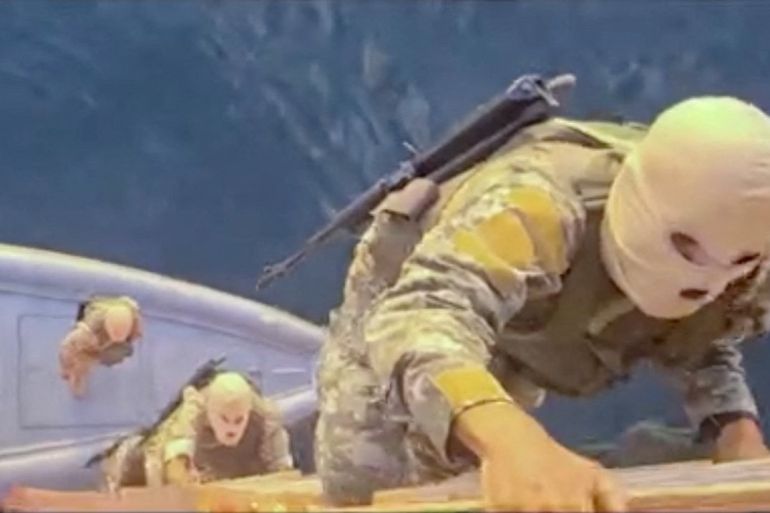
Iran on Wednesday captured two foreign container ships attempting to exit the Strait of Hormuz and fired upon a third, marking the latest escalation of tensions between Washington and Tehran in the vital shipping passage. This incident occurred amidst a United States naval blockade of Iranian ports, which began on April 13.
Earlier this week, on Monday, the US military fired upon and subsequently seized the Iranian-flagged container ship Touska near the Strait of Hormuz in the northern Arabian Sea. The vessel was en route to the Iranian port of Bandar Abbas. In response, Iran vehemently accused the US of “piracy.”
Furthermore, on Wednesday, the US military reportedly intercepted at least three Iranian-flagged tankers in Asian waters, according to Reuters. These vessels were reportedly being redirected away from their positions near India, Malaysia, and Sri Lanka.
Despite an existing ceasefire between the US and Iran, the recent attacks, captures, and interceptions of ships by both sides indicate an ongoing naval confrontation unfolding in the Strait of Hormuz. This strait is a crucial artery through which approximately 20 percent of global oil and liquefied natural gas (LNG) supplies are transported during peacetime.
The question arises: has Iran’s capture of foreign-flagged ships further heightened the stakes in this strategic waterway?
This report details the step-by-step escalation of tensions between Iran and the US in the Strait.
Who Controls the Strait of Hormuz?
The Strait of Hormuz is geographically positioned between Oman on one side and Iran on the other, connecting the Persian Gulf to the Gulf of Oman and the broader Arabian Sea. It serves as the primary conduit for oil and gas producers in the Gulf to export their supplies globally.
Following the commencement of the US and Israeli war on Iran on February 28, Tehran, whose territorial waters extend into the strait, declared the passage closed to all vessels. On March 4, the Islamic Revolutionary Guard Corps (IRGC) asserted its full control over the strait, mandating that all ships require clearance from them to transit.
At its narrowest point, a mere 21 nautical miles (approximately 39km) wide, the strait lies entirely within the territorial waters of Iran and Oman. Iran firmly maintains that, legally, this grants both nations the right to regulate traffic through the strait, despite its historical status as a waterway free of restrictions.
For nearly eight weeks, Iran has, through its imposition of controls, dictated which vessels can exit the strait into the Gulf of Oman.
Conversely, since the US imposed its naval blockade on April 13, its military has controlled which ships can pass from the Arabian Sea into the Gulf via the Strait of Hormuz.
This creates a precarious situation where maritime traffic is trapped, with rival militaries controlling the entry and exit points, necessitating approval from both sides for vessels to transit.
Iran’s Initial Stance on Hormuz
Since the IRGC’s announcement on March 4 regarding its decision to restrict shipping through the Strait of Hormuz, Iran’s formal position—until recently—was that the waterway was closed only to “enemy” countries, specifically the US and Israel.
On March 26, Iran’s Foreign Minister Abbas Araghchi stated on Iranian state TV: “The Strait of Hormuz, from our perspective, is not completely closed. It is closed only to enemies. There is no reason to allow the ships of our enemies and their allies to pass.”
Iran indicated that ships from other countries could pass through the strait provided they negotiated passage with the IRGC. Vessels from Malaysia, China, Egypt, South Korea, India, and Pakistan successfully transited the strait through most of March and early April.
In March, the IRGC implemented a “toll booth” system to manage vessel traffic through the strait.
London-based shipping magazine Lloyd’s List reported on March 26 that several vessel transits through the strait followed a pre-approved route under the IRGC’s “toll booth” system, which required ship operators to undergo a vetting process.
According to Lloyd’s, at least two vessels transiting the strait reportedly paid the toll fee in yuan, China’s currency.
While blocking the strait and reportedly collecting tolls, Iran continued to dispatch its own oil-exporting ships.
Iran’s oil exports through the Strait of Hormuz constitute approximately 80 percent of its total exports. Data from Kpler, a trade intelligence firm, shows Iran exported 1.84 million barrels per day (bpd) of crude oil in March and has shipped 1.71 million bpd so far in April, compared with an average of 1.68 million bpd in 2025.
From March 15 to April 14, Iran exported 55.22 million barrels of oil. The price per barrel of Iranian oil—across its three major variants: Iranian light, Iranian heavy, and Forozan blend—has consistently remained above $90 per barrel over the past month, often surpassing $100 a barrel.
Even with a conservative estimate of $90 a barrel, Iran would have earned at least $4.97 billion from oil exports over the past month.
In contrast, in early February, prior to the war, Iran was earning approximately $115 million a day from its crude oil exports, totaling $3.45 billion in a month.
Overall, this indicates that Iran has earned 40 percent more from oil exports in the past month compared to its monthly earnings before the conflict.
US Escalates Tensions with Naval Blockade
The US naval blockade of Iranian ports commenced at 14:00 GMT on April 13. Since then, US Central Command has reported that US forces have directed 31 Iran-linked vessels to turn around or return to an Iranian port.
On Monday, the US military fired upon and subsequently captured the Iranian-flagged container ship Touska near the Strait of Hormuz in the northern Arabian Sea. A day later, another oil tanker, sanctioned for transporting Iranian crude oil, was detained while sailing in the Bay of Bengal, which connects India and Southeast Asia.
Following the detention of the Touska, the Pentagon posted on social media: “As we have made clear, we will pursue global maritime enforcement efforts to disrupt illicit networks and interdict sanctioned vessels providing material support to Iran – anywhere they operate. International waters are not a refuge for sanctioned vessels.”
Iran Further Raises the Stakes
Since the US naval blockade of Iranian ports began, Tehran, which previously allowed vessels from “friendly” nations to pass through the Strait of Hormuz, has further tightened its control over the waterway.
Justifying the decision to prohibit all foreign ships from passing until the US ends its naval blockade on April 19, Iran’s First Vice President Mohammad Reza Aref stated that the “security of the Strait of Hormuz is not free.”
He articulated in a post on X: “One cannot restrict Iran’s oil exports while expecting free security for others.”
He added: “The choice is clear: either a free oil market for all, or the risk of significant costs for everyone. Stability in global fuel prices depends on a guaranteed and lasting end to the economic and military pressure against Iran and its allies.”
The day prior, Iran had reportedly fired upon two Indian-flagged merchant vessels in the strait. According to state media reports, the IRGC stated that the two ships were attacked for “operating without authorisation.”
Then, on April 22, Iran captured two container ships attempting to exit the Persian Gulf via the Strait of Hormuz after firing upon them and another vessel.
Iranian state media reported that the IRGC claimed the vessels had violated maritime regulations and entered the strategic waterway without its coordination.
According to Reuters, one of the captured ships was the Panama-flagged MSC Francesca, intercepted en route to the Sri Lankan port of Hambantota. United Kingdom Maritime Trade Operations (UKMTO) and maritime security sources informed Reuters that the vessel was hit by gunfire approximately eight nautical miles (15km) west of Iran, but sustained no damage, and its crew remained safe.
The second captured ship was the Greek-owned and Liberia-flagged Epaminondas, which was reportedly fired upon about 20 nautical miles (37km) northwest of Oman, as reported by UKMTO and sources to Reuters. The ship’s operator confirmed all crew members were safe. It had been headed towards Gujarat, India.
A Liberia-flagged container ship, Euphoria, was also fired upon in the same vicinity as MSC Francesca but was not damaged and resumed sailing, later reaching Fujairah in the United Arab Emirates, Reuters reported.
The Path Forward: Escalation or De-escalation?
This marks the first instance of Iran attacking and capturing ships since the war began, notably involving vessels not directly linked to the US or Israel.
Ali Vaez, the Iran project director for the International Crisis Group think tank, conveyed to Al Jazeera that Iran’s capture of ships is not an isolated act but rather a deliberate “tit-for-tat between Iran and the United States.”
He elaborated: “What we are seeing in the Strait of Hormuz is not strategic mastery but mutual brinkmanship, with each side testing the limits of coercion.”
Vaez cautioned: “The danger is that neither believes it can afford to blink, and that makes every incident at sea a potential trigger for wider escalation.”
In a statement on social media on Thursday, Iran’s parliamentary speaker and lead negotiator of the ceasefire talks, Mohammad Bagher Ghalibaf, emphasized that a full ceasefire could only be effective if the US naval blockade is lifted.
He stressed that reopening the Strait of Hormuz would be impossible with such a “flagrant breach of the ceasefire.”
Chris Featherstone, a political scientist at the University of York, told Al Jazeera that by capturing ships, Iran has significantly heightened tensions surrounding any negotiations with the US.
He observed: “Historically, the US has been perceived to be more of a legitimate actor, and yet in this war with Iran, the Trump administration has lost a large amount of this perceived legitimacy.”
Featherstone concluded: “This looks like a high-stakes game of poker, with both players staring each other down and waiting for the other to blink. Iran had the opportunity to blink, but in capturing the ships, they put the pressure back on Trump to blink or not.”
#StraitOfHormuz #IranUSConflict #NavalBlockade #MaritimeSecurity #Geopolitics #OilShipping #InternationalRelations #MiddleEastTensions #IRGC #GlobalTrade